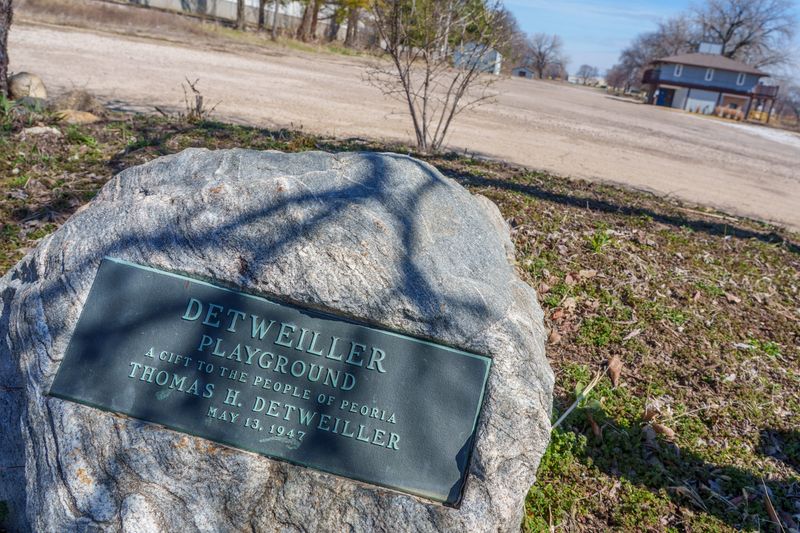
On May 16, 1947, Thomas Detweiller, son of Civil War veteran and boat captain Henry Detweiller, wrote his last will and testament.
After he asked for his his debts and funeral expenses to be paid off, he bequeathed all of his personal belongings and effects to his sister Amelia before taking up another cause. He asked that a piece of real estate he owned along the Illinois River be “made available for playground and recreation purposes for the Peoria community,” with a trust founded to facilitate keeping the land open for public use. Detweiller died in 1947 and is buried at Springdale Cemetery.

Over the next 70-plus years, the Detweiller Playground Trust kept true to the promise made by Thomas Detweiller to have that little parcel of land remain open, even as industrial development swirled around it.
The Detweiller trust operated a marina on the property for many years, but with fewer and fewer people operating boats out of that launch, it said it felt hard-pressed to continue.
On Sept. 10, 2025, the trust filed a petition to modify a use restriction on the property, as it had negotiated a sale for a part of the property to O’Brien Steel, whose headquarters was directly across from it. The trust said that compliance with the restriction had become “impracticable,” “wasteful” or “impaired” the charitable use of the property, as it had become unsustainable to maintain the land for future use.
This set off a two-month legal proceeding in late 2025 that ultimately led to the Illinois Attorney General’s Office approving the plan and a Peoria County judge signing off on the removal of the restrictions. It proved to be the beginning of a burgeoning battle between the Detweiller trust, O’Brien, the city and local advocates who want to preserve the land in accordance with Thomas Detweiller’s wishes.
Documents obtained by the Journal Star via a Freedom of Information Act request show what the Detweiller trust argued when it asked for the removal of the use restriction and what led to the plan’s approval by the state and courts.
The petition to allow Detweiller land sale
According to Detweiller’s president, Andy Schneider, a sale was needed because the property no longer was profitable. In 2018 alone, it lost $86,000.
Talks between Detweiller and O’Brien began in 2023 and by April 2025, the two sides had reached a deal that would allow O’Brien to expand onto a 10-acre piece of the property.
However, approval was still needed from the attorney general’s office and Peoria County Circuit Court. Detweiller had to prove that circumstances had changed to a point where compliance with the use restrictions would prevent “sound charitable use” of the property.
In the September 2025 petition, the trust says that it was using up its income and assets to maintain the park, which had become unsustainable. In addition, it said that the marina had become unsustainable due to a loss of revenue stemming from higher fuel costs and changes in the Illinois River that were turning away customers.
Because of those changes, the trust said that it had become difficult to carry out the charitable intent of the trust. Changes needed to be made in order to ensure that the trust and the property had a future, which meant pursuing a sale with O’Brien and getting approval to change the terms of the trust.
The trust said that it wanted to retain a portion of the property to allow it to continue pursuing Thomas Detweiller’s wishes while eliminating the expenses that came with having to maintain the entire portion of the property. Thus, it asked that the attorney general’s office and the court approve the removal of the use restriction, providing the authority to sell a portion of the property to O’Brien and use the income from the sale to maintain the remaining land.
The attorney general’s office gets involved
On Oct. 15, 2025, the Illinois Attorney General’s Office, represented by its Charitable Trust Bureau, filed an appearance in the case, which led to discussions between the two sides about how best to proceed. Frank Ierulli, an attorney with Heyl Royster who was representing the Detweiller trust, asked Assistant Attorneys General Nicholas Appleby and Pat Esposito if they wanted to speak with him on the matter.
A short conversation took place that day, according to emails obtained by the Journal Star, with Ierulli saying that he would discuss the proposed sale with their “transactional folks.” Ierulli said there was been a purchasing agreement with O’Brien that needed the approval of the court, with a price tag of $740,000.
The next day, Ierulli clarified some answers with Schneider, saying that the trust’s purpose would remain unchanged despite the sale. In addition, the trust said it was also pursuing the purchase of other riverfront property to continue pursuing Thomas Detweiller’s wishes.
Ierulli also said that the purchasing agreement with O’Brien required that they protect access to the remaining property still owned by Detweiller, with an easement above the north property line included. The trust said it aimed to keep the property accessible to vehicles with convenient parking near what was remaining.
Esposito responded the next day, saying that another meeting with Schneider might be helpful to provide a better understanding of the deal with O’Brien. He noted that his office wasn’t familiar with the property and the plans could be going against Thomas Detweiller’s wishes.
The attorney general’s office wanted to hear more from the trust regarding why the property was unsustainable, what kinds of restrictions the land that was sold would have and about the plans to acquire more riverfront property.
Detweiller provides more details into land sale plan
Ierulli sent back a three-page letter on Oct. 29, explaining the situation. In the letter, the trust said that the sale honors Detweiller’s original vision, saying that the property had evolved numerous times since it was originally given to the people of Peoria in 1947. For instance, the property had, at one point, three separate parcels, which were then combined to create one large tract of parkland.
In addition, fill had been placed along the shoreline of the marina to create protective breakwaters, which added a new feature to the property that wasn’t there originally.
The surrounding conditions had also continued to change, with continued industrial development, such as O’Brien Steel and the Army Corps of Engineers. As a result, the trust believed that the property was “isolated, poorly suited for family recreation and seldom used by the public.”
The trust said that had Thomas Detweiller viewed the aerial imagery of the property and surrounding area, he would believe that he would rather have his name attached to recreational areas that were “visible, welcoming and beneficial” to Peoria, like Detweiller Park just up the road on Illinois Route 29 that is currently operated by the Peoria Park District.
In addition, the trust argued the property was not sustainable for it, as the public had lost interest in the marina and stripped the trust of the “modest” income made from boaters in the past. Only twelve rentals remained as of the publication of the letter and more and more money was being used on maintenance costs.
The trust noted that a recent repair of an underground fuel tank had cost it $25,000. Even though the assets were still well-managed, they wouldn’t be enough to manage the property as it currently stands, according to the trust.
It also noted that the city no longer worked with the Peoria Park District to maintain the land, which led to citations for code violations and charging the trust for repairs to the property, which on the low end cost around $1,000.
If the sale was denied, the trust said it believed it could go bankrupt within 10 to 12 years, particularly if it only made bare minimum expenditures for maintenance.
The trust further detailed the sale to O’Brien, reiterating that access would continue to be made available for the remaining property. It also noted that O’Brien would have to work with the city on ensuring that people who use the Rock Island Greenway Trail that runs through the property could still access it, either through or around it.
The trust said that it would use the proceeds from the sale on furthering Detweiller’s original goal to preserve the property for future generations. Initially, it said it would do its best to improve the remaining property while exploring other sites to further the Detweiller mission. The trust noted that it was in discussions with two other riverfront properties that would provide better access and visibility than the original site, but those discussions were deemed “confidential.”
Ultimately, the trust argued that the sale was consistent with Detweiller’s aims and would ensure its long-term sustainability.
Esposito responded to the letter on Nov. 4, 2025, saying that the bureau would discuss the findings internally before the another court date on Nov. 19. Ierulli inquired on Nov. 12 about the status of the petition, with Esposito asking him to file an amended petition in order to further clarify their position.
State and courts sign off on Detweiller plan
On Nov. 14, 2025, Ierulli sent Esposito a copy of an draft affidavit, along with a proposed order for Peoria County Circuit Court. In the affidavit, Schneider reiterated the issues with the use restriction, from the un-sustainability of the property, the continued industrialization of the riverfront, and the increased cost of maintenance, in order to ask the attorney general’s office and the court to remove the use restrictions and go forward with the sale.
On Nov. 17, Esposito responded by officially saying that their office had no objection to the proposed order. Two days later, Peoria County Circuit Judge Sean Donohue officially approved the order, authorizing the Detweiller-O’Brien sale and removing the use restriction.
In a statement to the Journal Star, the attorney general’s office said that “in accordance with Illinois law, the Attorney General’s Charitable Trust Bureau was named as a necessary party to a petition filed by the trustees of The Detweiller Playground. It is important to note that our review and authority in these matters is limited to principles of charitable trust law.”
O’Brien and Detweiller then began negotiations with the Peoria Park District on trying to move the location of the Rock Island Greenway Trail to one that looped the property in order to ensure that people could continue to use it. On March 11, 2026, those plans were revealed to many in the public for the very first time at a committee meeting prior to a park district board meeting.
Citizens in the North Valley became upset with Detweiller, O’Brien and the city of Peoria, saying that the sale had betrayed Thomas Detweiller’s wish stated in his will to keep the property for public use. A group quickly organized, saying that the court and the attorney general’s office had received inaccurate information to make their decisions.
In a statement made on April 8 to the park district, the opposition group said that legal notice requirements for the hearings had been met by publishing it in the Peoria Chronicle, a small weekly newspaper of 8,000 readers rather than the Journal Star. They also claimed that trustees hadn’t attempted to engage any of them to find a solution that would better preserve the property.
In an 990 filing made to the Internal Revenue Service for 2024, the trust had assets of over $380,000 in cash, with expenses of nearly $27,000. About $15,500 was used for legal and accounting purposes. However, the opposition group said that the Peoria Boat Club and the Tree Surgeon had occupied several acres of the property for their own uses.
Indeed, the group said that in 2016, the Charitable Trust Division ruled that the Peoria Boat Club couldn’t use the property, as it was inconsistent with Detweiller’s wishes. All of this came about as the city was considering buying a portion of the land for other public uses. The deal did not go through, even though the attorney general’s office ruled they could do so as long as the boat club didn’t renew their lease.
However, the Peoria Boat Club continued operating out of their part of the property, and the group noted that as part of the deal with O’Brien, seven acres of the property would be gifted to the boat club rather than providing it to the park district or other groups to retain public access.
The group also said that the trust was not in financial peril as it claimed in their correspondence with the attorney general’s office. Rather, it was in negotiations with O’Brien for several years to sell the land for industrial expansion by the company. J.R. O’Brien, an executive vice president for the company, does serve as a trustee, according to the group, who provided the forms showing O’Brien’s involvement with the trust.
Emails were also provided showing company CEO J.P. O’Brien’s communications with Peoria City Manager Patrick Urich on a meeting discussing the plans, held prior to the March 11 park district board meeting where the details were first revealed.
The group called on the park district to negotiate with Detweiller and O’Brien beyond just the right-of-way for the trail, advocating for a revision of the sale plans to protect as much land as possible at the riverfront, in addition to the trustees gifting the remaining property to the park district.
Advocates also called for more discussions with the city regarding Caroline Street, which would be closed as part of the deal. This would require Peoria City Council approval.
During the park district’s April 8 meeting, the board of trustees approved a measure to further engage Detweiller and O’Brien on discussions beyond the trail, while also exploring how to best protect public access to the land. Karrie Alms, one of the group’s leaders, said that they were happy with the park district’s move, while also promising they would keep in touch throughout the process.
“It would be nice if the Detweiller Playground (Trust) would reach out and meet with us as groups, too,” Alms said. “Since the park district acted as an intermediary and they declined to meet, that would be good if they would be willing to meet with us. You can see that we’re not screaming, yelling people. We’re very calm and rational and we would just like a seat at the table.”
This article originally appeared on Journal Star: Documents show how Detweiller trust got state approval for land sale
Reporting by Zach Roth, Peoria Journal Star / Journal Star
USA TODAY Network via Reuters Connect