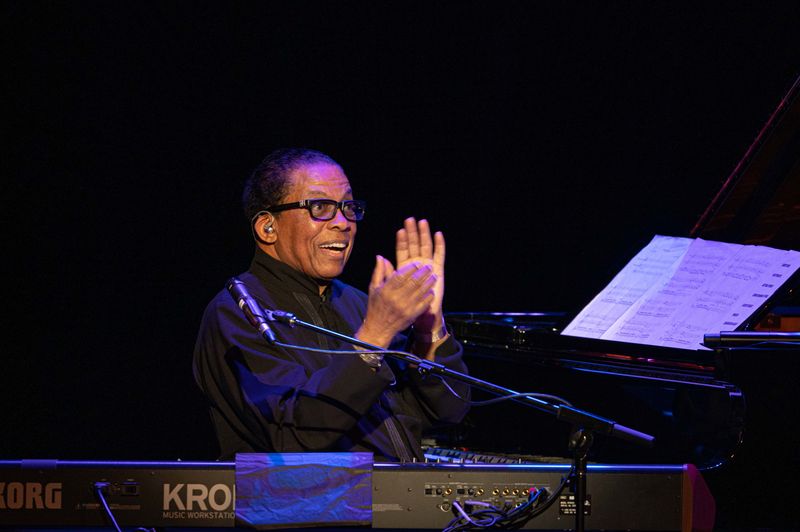
From his 1962 solo debut album, aptly titled “Takin’ Off,” to six decades later, jazz keyboardist Herbie Hancock’s career has been defined by looking and moving forward.
After playing in trumpeter Donald Byrd’s group and then releasing “Takin’ Off” — featuring his breakout hit and enduring jazz standard, the irresistibly funky instrumental “Watermelon Man” — Herbie Hancock joined jazz visionary Miles Davis’ band in 1963. Both during his time with Davis and after, Hancock embraced electronic instruments, becoming an early adopter of the synthesizer and vocoder.

His 1983 single “Rockit,” which incorporated DJ turntable scratching in an early blend of jazz and hip-hop, was a No. 1 dance club hit and won Hancock his first Grammy for Best R&B Instrumental Performance. Hancock has since earned 14 competitive Grammys and a Grammy Lifetime Achievement Award, an Oscar for his score to the 1986 film “Round Midnight” (starring fellow jazz musician and “Takin’ Off” bandmate Dexter Gordon) and NEA Jazz Masters, the self-proclaimed highest honors the U.S. bestows upon jazz artists.
In more recent years, Hancock helped establish International Jazz Day — which is on April 30 and celebrates its 15th anniversary in 2026 — and has collaborated with contemporary musicians such as Thundercat and Flying Lotus. He continues to tour as well, including a May 9 concert at Sarasota’s Van Wezel Performing Arts Hall and a headlining spot at this year’s Newport Jazz Festival.
In a phone interview with the Herald-Tribune on April 20, about a week after his 86th birthday, Hancock discussed being an early adopter of electronic musical instruments and hip-hop, what he learned from Donald Byrd and Miles Davis, and more. Here are excerpts, edited for brevity and clarity.
You’ve mentioned working on a new album produced by Terrace Martin with musicians like Thundercat, Flying Lotus, Kamasi Washington and Kendrick Lamar. I was just curious if you had an update on that.
It’s something that we started, but I had to put it by the side — there were too many other things that came up, touring and other projects, that I had to do. So I haven’t been able to return to that yet, and I have to wait until a lot of things are out of the way this year like International Jazz Day, that’s coming up. Then later on, I’m going to South Korea and doing some touring there, and other things on my schedule. So there’s nothing new that I can report to you about that project.
A lot of those musicians I just mentioned are somewhere at the intersection of jazz and hip-hop, and you were somewhere near the beginning of that intersection with “Rockit.”
I just felt like I was lucky to be at the right place at the right time, and have the right people that I was working with, and everything came together. Like, you know when you put a key into a lock? If you’ve got the right key, the lock opens. And that’s happened a lot of times to me, just happened to be at the right place at the right time with the right people that pointed me in a direction that would move me forward, move my career forward. I’ve been really fortunate that that’s happened throughout my life. A lot of times, I was the last person to realize what the heck’s going on, why is this happening? (Laughs) Especially with “Rockit,” when I did that, I had no idea that it was going to take off like a rocket and open doorways for hip-hop, for example, which was more underground before that. Then all that changed.
You were also an early adopter of electronic musical instruments, including synthesizers. Was being an electrical engineering major part of your interest in those?
Well, I’ve been a nerd since I was about three years old. (Laughs) I was always wondering how things worked when I was a kid, and I remember when I was maybe three or four years old, picking up a screwdriver and trying to dismantle a clock because I was wondering how does the second hand work. But I’ve always been curious and a nerd, that’s always been a part of me, and that’s led to me being one of the early adopters of synthesizers and technologies from that time. That’s how I am. Curiosity’s my basic makeup.
The vocoder was one thing I picked up back in the ’70s. Later on, that led to a lot of that type of technology that singers use today for various reasons. The first instrument that I used as a solo keyboard that I could carry around on stage and use with a vocoder was something that I didn’t develop, but I had some friends that were tech nerds and they put this keyboard together. It was really heavy, too. It was either a Minimoog or one of the early keyboards, maybe it was an ARP keyboard, but I was able to play it and be able to sing. A long time ago.
A even longer time ago, your debut album “Takin’ Off” came out in 1962 when you were just 22 years old and a few years out of college. Do you remember how that time felt? Daunting? Exciting? A combination?
Well, I felt really fortunate that it was Donald Byrd that hired me to play in his band. I moved from Chicago to New York, and I remember Donald really helping me to get my own publishing company and telling me don’t give my tunes to the record label and let them be the publisher of the music. He said, “I’ll help you to put together your own official publishing credentials” and I followed his advice. So I was able to keep the publishing of “Watermelon Man” when I did that for Blue Note, because they were going to insist that I put in on their label or else they weren’t going to be able to record me. But I stuck to my guns, and they changed their mind. I think they heard something when I played the song “Watermelon Man” for them, I think they thought, “I think we might have something here.” Anyway, the record did very well, and soon after that, Mongo Santamaria recorded it and that became a big hit. Because I was the publisher, I got paid. (Laughs)
Then a year later, you joined Miles Davis’ band. As someone who’s now a teacher and been an inspiration to younger artists yourself, what would you say was the most valuable lesson you learned from your time with Davis?
To be yourself, and don’t try to look forward to fame and money. The whole thing is about expressing yourself and developing yourself and your own creativity. That’s what’s most important because otherwise, it can lead you down the wrong path that will be in the long run less satisfying and not a happy outcome. It’s important to unlock yourself and to really trust the best part of who you are in leading yourself forward.
A few years later, you did the score for “Blow-Up,” and then several film scores after that — “The Spook Who Sat by the Door,” “Round Midnight.” Do you have a favorite experience of those?
I enjoyed all of it. Doing “Round Midnight,” that film was a big highlight in my life, and I got a chance to do a little acting. And then I got an Oscar for it, which that was a huge thing, as it would be for anybody. I couldn’t believe that I actually got selected for that. Because it was barely enough music that was original music that I had written for that, it just barely got under the wire.
Is there anything else you have coming up?
Right now, I’m working mostly on doing the live performances, but I’m looking forward to getting back in the studio and doing another record. But that may not happen until next year, because I got a lot on my plate this year. It’ll come out when it comes out. But in the meantime, I’m doing these live performances. And I’m not getting any younger, might as well do what I can while I can.
If you go
Herbie Hancock: 7 p.m. May 9; Van Wezel Performing Arts Hall, 777 N. Tamiami Trail, Sarasota; $81-$126; 941-263-6799; vanwezel.org
Email entertainment reporter Jimmy Geurts at jimmy.geurts@heraldtribune.com. Support local journalism by subscribing.
This article originally appeared on Sarasota Herald-Tribune: Herbie Hancock interview: ‘Curiosity’s my basic makeup’
Reporting by Jimmy Geurts, Sarasota Herald-Tribune / Sarasota Herald-Tribune
USA TODAY Network via Reuters Connect