Iowa’s aging population and young people’s exodus from rural towns to larger cities are well documented, and state and federal agencies have spent millions trying to revitalize those communities.
But another problem gets in the way of rural renewal: vacant buildings that once housed businesses selling clothes, serving food and providing hardware and other necessities to the townspeople and surrounding farmers.

Also left empty are been hundreds of once-proud school buildings, discarded as shrinking school districts consolidated.
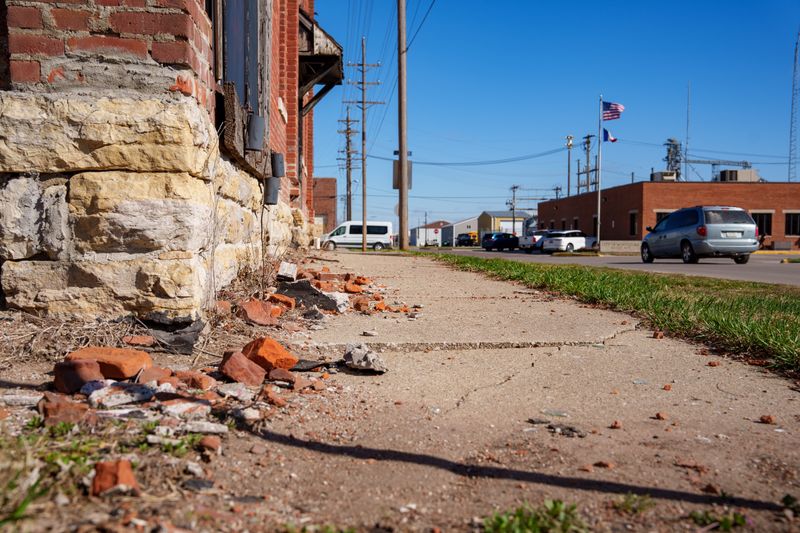
Some of the buildings have been neglected since the 1980s Farm Crisis, which accelerated the depopulation of rural Iowa, and have deteriorated to the point of being dangerous.
Faced with tax bases that have shrunk in step with their populations, small towns already struggling to keep water flowing, sewage treated, parks mowed and streets paved lack the resources to deal with the derelict structures. Forcing owners to cover the cost of the buildings’ repair or demolition often isn’t possible because taxes haven’t been paid on the properties in years and ownership has fallen on the cities.
Mickey Shields, deputy director of the Iowa League of Cities, said the flow of new entrepreneurs purchasing buildings in small towns to replace those leaving has been interrupted by out migration.
“The city would love to see that, of course, just naturally, organically turn over like you’d hope it would, like it normally would, but again, the prospects of that happening in some of our towns are just probably pretty small. So it just becomes more of a city issue eventually,” Shields said.
Nobody has conducted a comprehensive count of empty commercial, school and other buildings in rural Iowa communities, but “there’s not a small town that doesn’t have some rickety abandoned buildings that need to be taken down…for health and safety purposes,” said Abigail Gaffey, a community development specialist with the Iowa State University Extension Service.
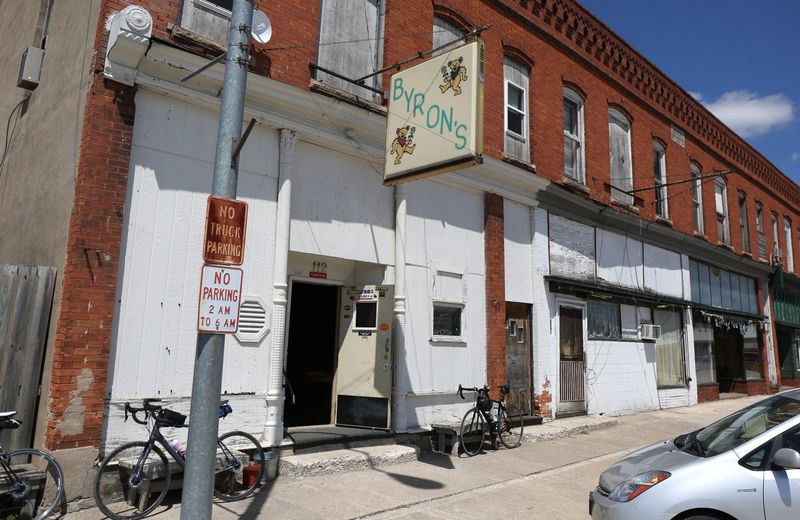
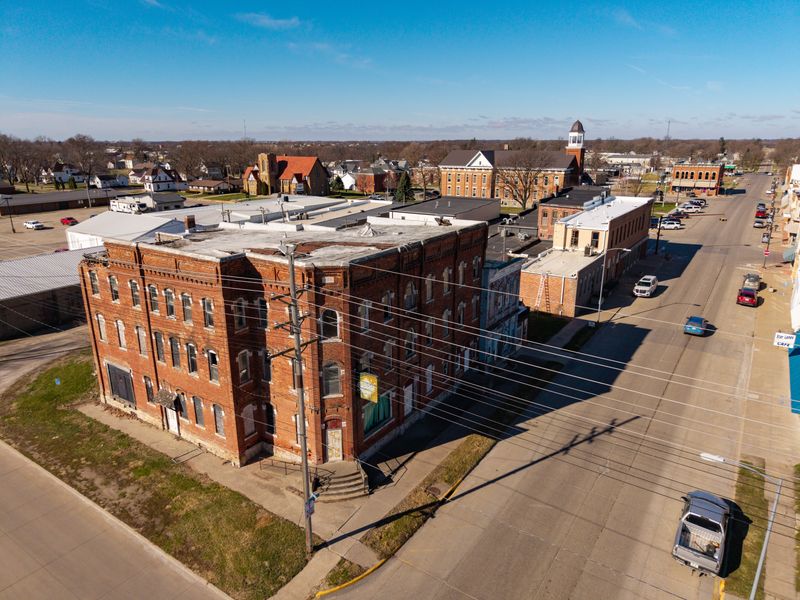
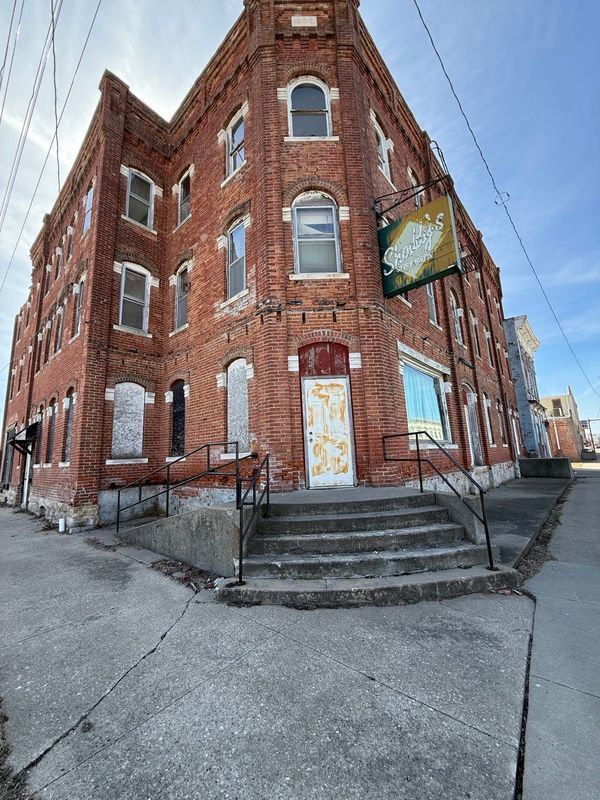
Gaffey, who travels to small towns throughout the state, said a lot of derelict buildings on Main Streets share walls with buildings housing businesses and services that continue to operate, making demolition problematic. She pointed to bar and music venue Byron’s in the northwest Iowa town of Pomeroy as a prime example.
Over the three decades it has operated, Byron’s has become a destination for musicians and music lovers, who travel from across the state for performances there, helping keep Pomeroy on the map.
“We’re booked every Sunday through the rest of the year,” the bar’s owner, Byron Stuart, told the Des Moines Register.
A native of Pomeroy, Stuart purchased the building where the bar was located in 1995. It had been quickly built in 1893 amid recovery from a tornado that leveled most of the town.
By the time Stuart acquired it, a different kind of hazard was taking a toll: neglect, which had left the building and others around it empty. But Stuart said that despite problems like the bar’s leaky roof, “everything was going good” until 2024. That’s when Byron’s nearly went out of business, its building condemned because it shared a wall with an adjoining structure that no longer was stable.
The faithful followers of Byron’s rallied on Stuart’s behalf, holding fundraisers that collected $120,000 and allowed him to strike a deal with the city of Pomeroy, buying the community center for $100,000 and relocating Byron’s there in summer 2024.
That has kept the venue a cultural touchstone and visitors’ dollars flowing into the local economy. But such rescues are a matter of luck and opportunity ― commodities in short supply in communities just trying to remain viable.
Will dead diner doom Derby’s post office?
No second chance appears likely for the once-famous Derby Restaurant in the Lucas County town from which it took its name. The population there, which peaked at 324 a century ago, was already shrinking when it began a more precipitous decline as farm bankruptcies ballooned in the 1980s. It now has just 90 people.
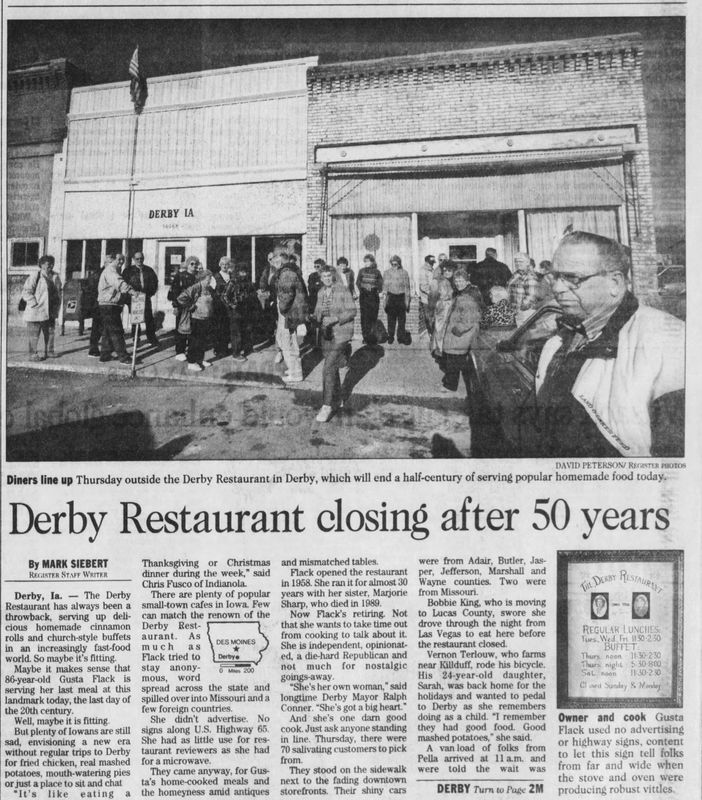
Gusta Flack opened the diner in 1958 and ran it until the final day of 1999, when she retired at age 86. She lived to be 100, dying in 2014. But nobody stepped in to revive the homestyle cooking that won her restaurant such fame that even Florida’s Orlando Sentinel praised its “ultimate ambience.”
“I have pictures of people lined up down the road, yep, all the way down the sidewalk, waiting to get in,” said Melissa Bundy, a Derby City Council member and former mayor.
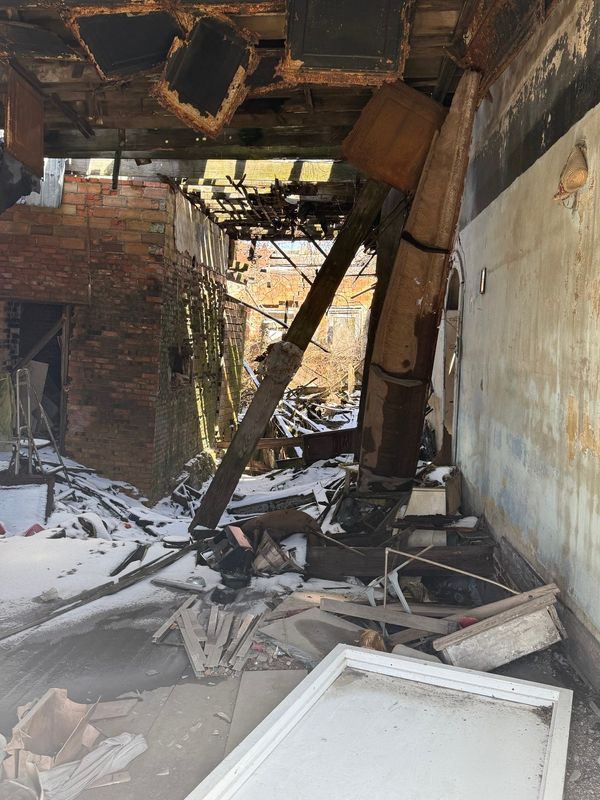
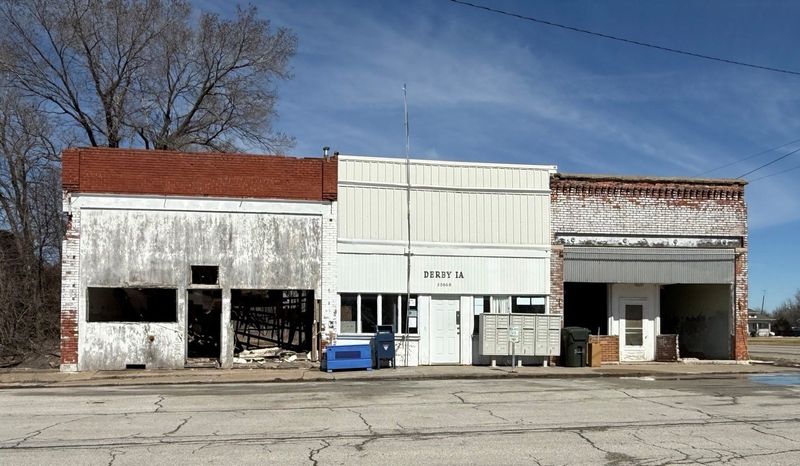
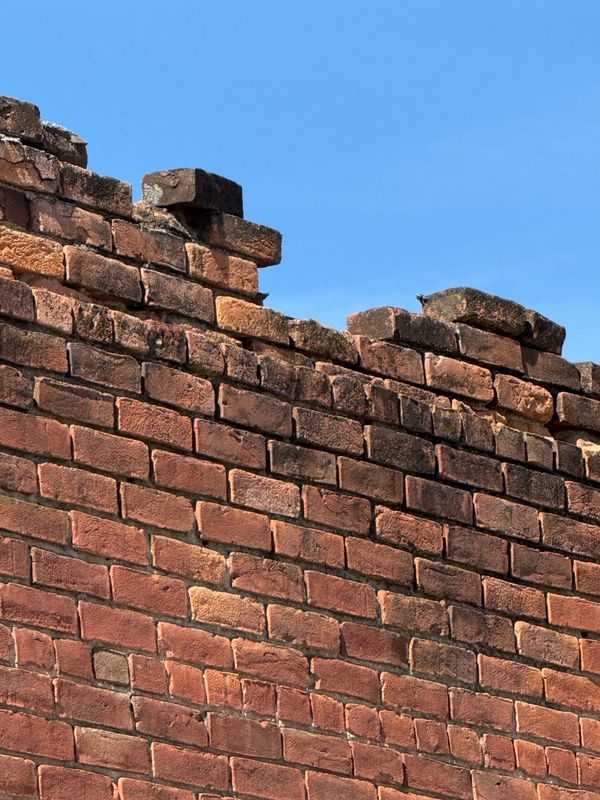
Today, the 2,800-square-foot building on the corner of Front and Broad streets is a shambles. Windows are gone from the front façade, leaving the interior open to anyone and everything. A peek inside reveals that the roof has caved in and the rear wall is largely missing. Bricks have fallen from the parapet on the east side of the building.
An old table and chairs and an inoperative freezer are the only signs left of the building’s heyday.
It’s is now threatening a more durable institution: the town’s post office, with which it shares its west wall. The post office also shares its east wall with another dilapidated building.
At one point, Bundy and her husband held some of the deeds along with hopes of bringing the buildings back to life.
“The money and the time is like, dang, it’s gonna take a special person to save those buildings, you know what I mean?” she said.
Joe Swinson hopes to be that special person. Swinson currently owns the old diner and the building west of the post office. He said he wants to “deconstruct” the buildings and eventually redevelop the lots.
But it’s a project with serious challenges. Because the buildings are still in private ownership, Bundy said, the city is ineligible to participate in state programs to have them removed. And the shared walls raise what Bundy said is the problem of carrying out demolition without jeopardizing the post office.
“I mean, Derby definitely wouldn’t want to lose the post office. No, that would be the end of Derby,” she said.
Governor adds $1 million to Derelict Building Programs. Is it enough?
The plight of small communities dealing with abandoned and run-down buildings has not escaped Iowa leaders’ attention.
Gov. Kim Reynolds proposed adding $1 million a year to the $400,000 Derelict Buildings Program administered through the Iowa Department of Natural Resources. The program works with rural communities of less than 5,000 people.
Since 2011, the DNR has reimbursed 173 communities $3.4 million to cover expenses for 187 projects.
“Governor Reynolds is proposing $1 million for the derelict buildings program as part of her Fiscal Year 2027 budget proposal, acknowledging the health and safety risk outdated infrastructure poses to Iowans, and identifying the need to beautify buildings in order to sustain and attract economic growth,” Reynolds spokesperson Mason Mauro said. “Additional funding for the program is supported by cities and local municipalities throughout the state and remains a priority for the Iowa League of Cities.”
In addition, Rep. Matthew Rinker, R-Burlington, introduced House File 2569, a bill aimed at making it easier for cities to hold former owners responsible for the costs of demolishing abandoned buildings.
Rinker said that in some cases, those owners treated the buildings in a predatory way, stripping them of valuable components such as copper wire and piping, then leaving the remainder to rot.
“The bill that I have filed is to get the conversation started on what tools can we provide cities to have an opportunity to go back either after the person who’s stripped it of its value and walked away, or perhaps of the person who didn’t do proper due diligence in selling that building, or sold it in poor faith, that it wasn’t going to become a burden for the property taxpayer,” he said.
Rep. Dean Fisher, R-Montour, introduced another bill ― House File 133 ― to establish a grant fund for demolition of vacant school buildings.
“It could be a city, county, school district, township, any local government entity could take it on,” said Fisher.
Based just on the number of abandoned schools in his area and extrapolating across the state, Fisher estimates there could be 200 vacant school buildings in Iowa.
Christina Eichen, president of the Iowa League of Cities board, said the town of Bennett, where she serves on the City Council, currently is in the process of removing a derelict building that is collapsing. The cost will be about $30,000 for a town of only about 400 residents.
She praised Reynolds’ proposal to add $1 million to the fund for dealing with such structures, calling it “a great start.” But she noted that Bennet’s problem is “just one building in one town and you start adding that up.”
In many older buildings, there are also high costs associated with asbestos abatement.
Even once a troublesome building is down, Eichen said, small towns with limited tax bases “don’t really have the funds, either, to make it into something else.” Converting the empty lot into “a beautiful green space” will be a project “we’ll allocate funds to… each year,” she said.
“But it’s going to take time for smaller communities because funds are tight and making things better, bigger and beautiful isn’t always our first concern when our roads and other infrastructure is more concerning,” she said.
Old school buildings linger long after students are grown
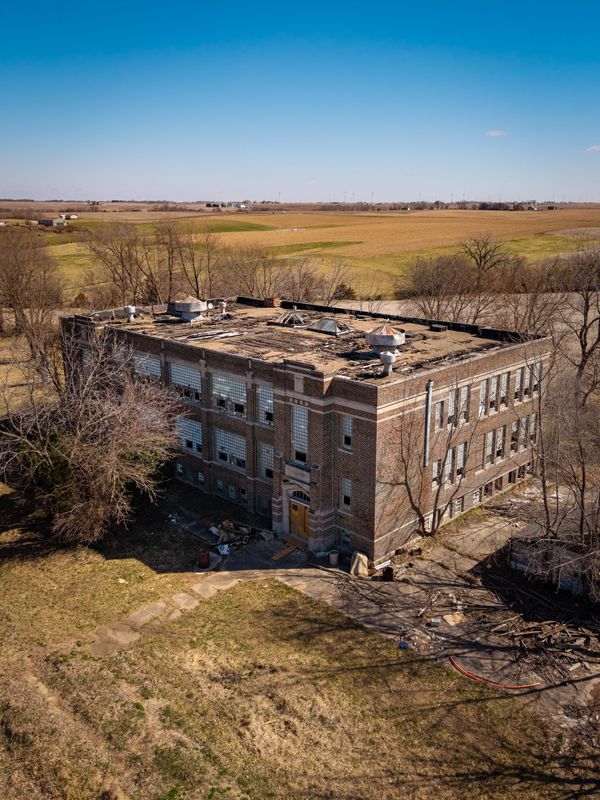
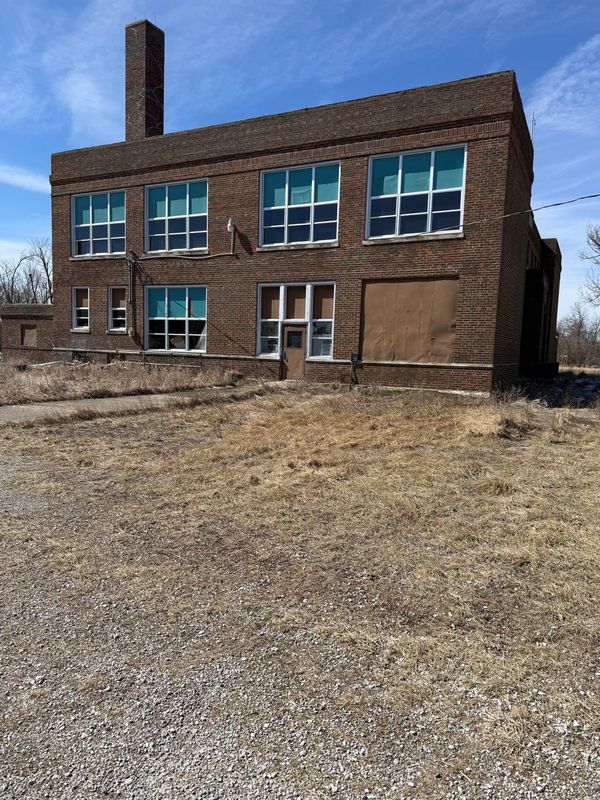
Empty school buildings bring their own challenges. David Daughton, a lobbyist for a number of educational organizations, including Rural Schools of Iowa, said often districts try to sell or give away old school buildings, which can create issues.
“Sometimes you just try to give it to the community, but they don’t have the resources to be able to do anything with it, so they don’t want it. At other times, you can sell them to communities, organizations or to businesses who want to convert it into a warehouse or something like that, so it’s just a mixed bag,” Daughton said.
“But in the end… when you drive around smaller communities, especially in Iowa, what you see are abandoned school buildings that are just decaying because there’s really no use or any way to do anything with them,” he said.
Draped in nostalgia, the buildings are prone to linger until they are beyond usefulness.
“People want to see something happen with them, but then nothing happens, and that’s where you end up with the decay and the building literally falling in on itself in a lot of cases,” Daughton said.
The former superintendent of the Wayne Community School District in southern Iowa, he recalled two school buildings that became vacant in Lineville, which straddles the Missouri border.
An older building was sold locally to a buyer wanting to salvage material from it. That building is currently “falling in itself,” Daughton said.
An area business purchased a newer building to use in its production process, Daughton said.
Another old school building, in Cambria, an unincorporated community in Wayne County, last hosted elementary students in 1995. But don’t call it abandoned.
“We don’t consider it abandoned, but temporarily in limbo,” said Sharon Perkins, a member of the Cambria Area Betterment Association that provides upkeep for the building.
It once housed a high school, and Perkins, who was in the last graduating class in 1959, said the building is still structurally sound even though the group has had to deal with vandalism over the years.
For a time it provided a place for 4-H groups, home schooling and photo and dance studios, but has been vacant for the past several years.
“There are a lot of good memories there,” Perkins said, adding that that group is hoping some other reuse emerges.
Monetzuma landmark on its last legs
Montezuma’s problem is on a larger scale: A three-story, 30-room hotel, once a centerpiece of the city, is in an advanced stage of deterioration. Along the east wall of the building, constructed in 1892, bricks have fallen on a sidewalk below.
At a meeting in January, the City Council voted to publish a public notice that the building is in a state of disrepair and is dangerous.
As with the old schools, the building is deeply engrained in the town’s identity. Most recently the Carter Hotel, it previously was the New Carroll House Hotel, and replaced another hotel ― lost to a fire ― that was built on the site in 1852. It’s on the National Register of Historic Places, and its lobby and restaurants over the years were the scene of many events.
A 10-minute drive from Interstate 80, Montezuma, the county seat of in Poweshiek County, shows signs of life. Its town square, dominated by a tall-steepled courthouse, has local businesses occupying historic structures. Adjacent Ponderosa Lake has its share of million-dollar homes. And Montezuma’s population of 1,442 in 2020 was down only fractionally from a decade earlier.
Once a symbol of Monetezuma’s prosperity, the hotel brought commerce to the downtown district in a day when people arrived and departed by train. It was the automobile era that marked the end of the hotel’s days of splendor, as travelers no longer needed an overnight stay to conduct business in the city.
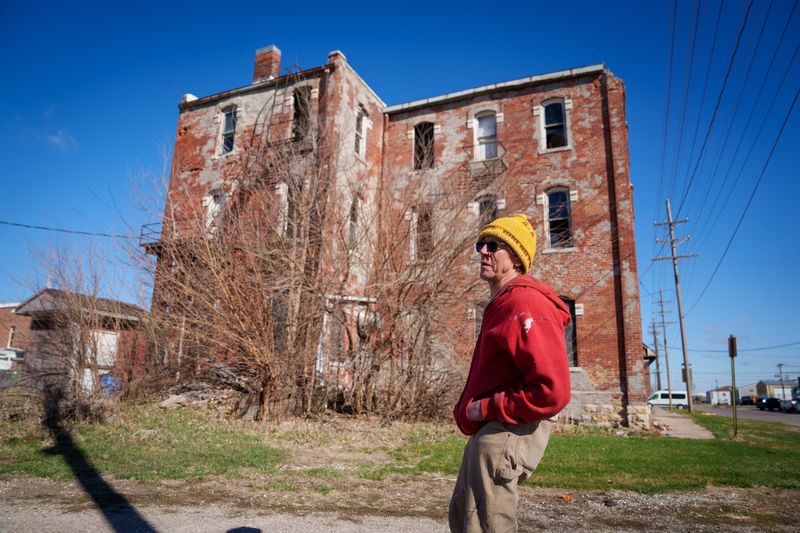
Pat Cashman, who recently moved to the town after retiring from farming, is a believer in Montezuma’s potential. But he sees the old hotel as a barrier to it, and has been a constant voice at City Council meetings wanting something done about the building. He’s even pledged not to cut his hair until it’s torn down.
He said he’s motivated by “the safety and the fact that Montezuma can let something like that just deteriorate on our Main Street, a block from our beautiful courthouse.”
Cashman is also a big fan of the Montezuma Library just across the street to the east.
“You know, if you were a young family, moved to Montezuma and had kids going to school and then maybe want to check out the local library, so you go do that and then you come out and it’s like, well, are we in the ghetto?” Cashman said of the looming, dilapidated hotel.
Will Cashman achieve his goal? Figuring out who even owns the building requires research. The last owner on tax records was Ernie Wilcox, who died in May 2015. A Register examination of probate records for his estate turned up no mention of the hotel property.
“The man who owned it has been dead over 10 years, and they’re saying that his estate is not settled so that hotel is owned by a ghost,” Cashman said.
But the Montezuma State Bank has paid the property taxes on the hotel, and when asked, President Kyle Cook acknowledged the bank holds title, acquiring it in settlement of outstanding debts Wilcox owed.
Cook conceded that the costly demolition of the building needs to occur.
“I would love to preserve it, but some buildings are just beyond that point,” he said.
As so often is the case with old, deteriorating buildings, there is a complicating factor. The hotel shares a wall with a small building housing A Cut Above the Rest Barbershop and Salon. That building’s owner, Liz Stoker, could not be reached for comment, but Cook said any demolition of the hotel will need to take into consideration how Stoker’s building could be affected.
The bank’s owernship of the hotel also complicates the pathway to grant sources like the Derelict Building Program which requires public ownership for eligibility, another concern for people like Cashman.
“I’m afraid they are just going to continue to kick the can down the road until the city finally has to step in and take care of it and then it’s the city’s expense. I don’t think that the citizens of Montezuma should have to ante up to pay for the total demolition costs. Maybe some of it,” he said.
But pragmatic viewpoints like that of Cashman, a relative newcomer to the community, can be at odds with those of people whose families have been in a town for generations. Balancing the sentimental value residents may attach to the old buildings that once constituted the core of their town ― like the hotel in Montezuma ― can be a challenge when it comes to dealing with abandoned buildings, said Reid Bermel who administers the Derelict Buildings Program for the DNR.
“I mean, it’s definitely a concern to a certain extent, but there again, it gets back to how much sentimental value is worth, right? Where do you draw that line?” Bermel asked.
He said communities often struggle between trying to preserve the historic presence of old buildings and the necessity of dealing with structures that have become a nuisance or dangerous.
“That’s where it gets tough, because how much tax base do you have and are you able to fund those projects? You can ask three different people in a community what they think and you’ll get four opinions because you will always get the one person that’s indecisive,” Bermel said.
Cashman said he understands that demolishing the hotel would leave a hole in the heart of Montezuma.
“I don’t like to take stuff down,” he said. “It could have been a grand building, but it’s too late. It’s just too damn late.”
Kevin Baskins covers jobs and the economy for the Des Moines Register. Reach him at kbaskins@registermedia.com.
This article originally appeared on Des Moines Register: Derelict buildings may imperil rural Iowa’s finances ― and future
Reporting by Kevin Baskins, Des Moines Register / Des Moines Register
USA TODAY Network via Reuters Connect