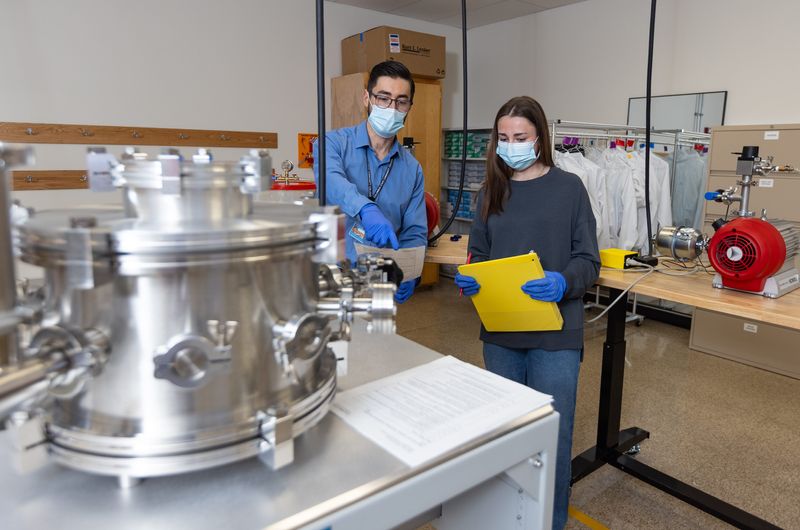
When semiconductor manufacturer Intel announced plans in 2022 to build a massive plant in the Columbus region, local college and university officials began imagining how they could train the company’s future employees.

Though Intel’s development has faced significant delays, the plans to retrofit higher education classes and degrees to match a growing need for modern biotech and manufacturing skills are still going strong.
“Everyone started to scramble with Intel, and that’s stopping, but now we’re looking beyond that to what we need to do to ramp up to make sure our curriculum is matching what industry needs are,” says Mark Mahoney, dean of business, engineering and technology at Columbus State Community College.
Although Columbus State officials have always consulted with business and industry leaders like Honda and Amgen Inc. to make sure its curriculum meets workforce needs, the process has accelerated as changes in manufacturing and technology have accelerated and, in the case of the biotech industry, growth has skyrocketed.
Mahoney says in the past year college leaders have talked with officials from 60 different industries of various sizes through CSCC’s Business and Industry Leadership Team effort, funded with a National Science Foundation grant, and soon will be working with faculty to modify curriculum based on those discussions.
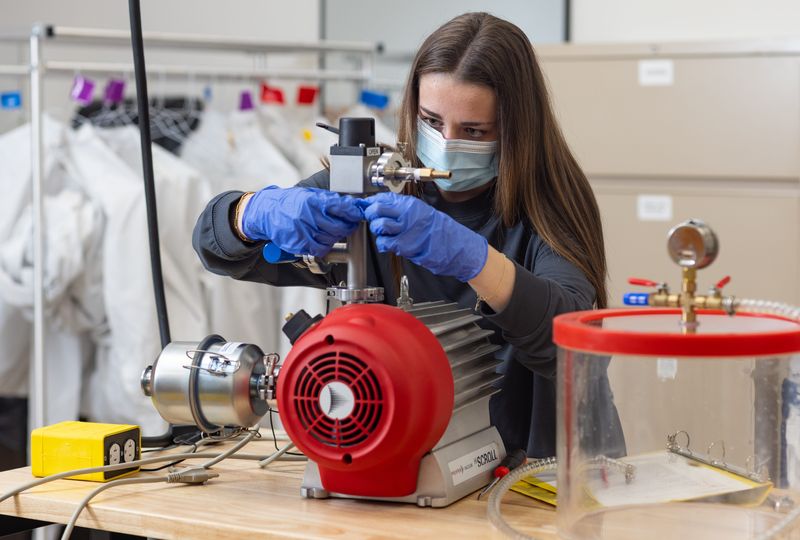
One change in the works is the addition of a semester-long capstone course to the college’s two-year Electro-Mechanical Technology degree. The planned class will help graduates troubleshoot and improve multifaceted manufacturing systems, Mahoney says. “This is something our faculty realized was missing and industry confirmed it,” he says. “It’s very valuable for someone going into modern manufacturing.”
Student Ava Zellers, who will graduate from Columbus State in May with an Electro-Mechanical Technology degree, says the value of the classes became evident through her part-time job at biotechnology company Amgen.
“I’ve realized how important it is to have both electro and mechanical technology skills,” she says. “You’re ahead of the competition if you know and understand both of them. Most colleges don’t offer this degree.”
Stay connected to the region’s business community. Subscribe to Insider, Columbus CEO’s newsletter.
To accommodate growing demand for manufacturing classes, Columbus State plans to build the Ohio Center for Advanced Technologies, a new campus structure funded by federal, state and local sources. Preliminary designs call for a $60 million building of up to 100,000 square feet.
Although two-year degrees or certifications are adequate for many industrial jobs, others require four-year degrees, and Ohio State University is working to expand those offerings.
“We’re looking out to the horizon to see, ‘What role does a four-year institution play in workforce development?’ ” says Randy Smith, vice provost for academic programs at OSU. “We need to define our role.”
Smith heads a task force identifying additional programs Ohio State could offer, how students would funnel into those programs and which outside organizations could help define and facilitate them. Those may include new degree offerings, as well as stackable certificates, particularly for those who already have degrees, Smith says. OSU works closely with Columbus State so students can attend there and then complete degrees at Ohio State. That also is part of the task force considerations, Smith says.
One new major planned at OSU is cybersecurity, which Smith says may start in late 2027. He says a degree or certificate offerings in advanced manufacturing also may find a future niche.
The university already has capitalized on another high-demand field with a Master of Supply Chain Management degree, which it began offering in 2023. “Supply chain management touches just about every industry, and the pandemic made it clear how critical strong supply chains and strong leaders really are,” says Aravind Chandrasekaran, interim dean and John W. Berry Sr. chair in business at the Fisher College of Business. Offering the master’s degree was a natural step for the college, which Chandrasekaran says is recognized for its expertise in logistics and operations. He says it has attracted students working for companies including DHL Supply Chain, Procter & Gamble, Owens Corning and Honda.
At Central Ohio Technical College in Newark, a two-year program in respiratory therapy was introduced in response to demand. “That was based on the needs of local hospitals,” says Provost Greg Ferenchak. “We rely on the local workforce to determine which programs we start. We don’t want to offer something and just hope students come.”
In 2023, the college added a semiconductor associate degree, based on Intel’s future needs. With the company’s future in Central Ohio unclear, the college is reworking the degree and working with other companies to see which ones can use graduates from that program, Ferenchak says.
COTC also is incorporating artificial intelligence education into many classes and degrees. “It’s just exploded as far as the need for students to know it, and we’re teaching them how to use it, especially in IT classes,” Ferenchak says.
Kathy Lynn Gray is a freelance writer.
This story appears in the Spring 2026 issue of Columbus CEO. Subscribe now.
This article originally appeared on Columbus CEO: Local Colleges and Universities Respond to Changing Workforce Demands
Reporting by Kathy Lynn Gray, Columbus CEO / Columbus CEO
USA TODAY Network via Reuters Connect