Ford Motor Co. is days from reporting its first-quarter results during what is a challenging year for the Dearborn-based automaker as it navigates: ongoing tariffs on imported autos, auto parts, steel and aluminum; supply chain disruptions and its pivot from electric vehicles to a more balanced powertrain lineup.
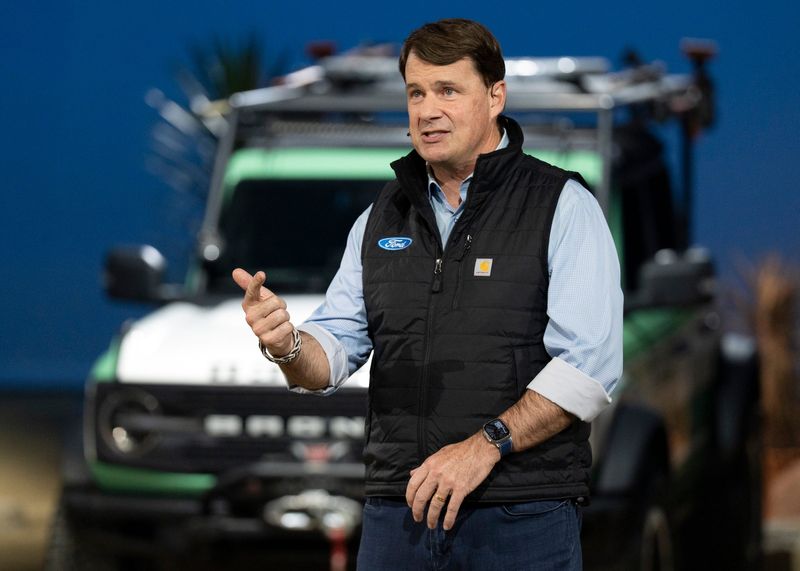
Yet CEO Jim Farley said all the global volatility right now just reconfirms that Ford is on the right path.

“Everything we’ve seen with escalating fuel prices in the U.S. is reinforcing our choices, not because I’m the CEO of Ford and we’re always right, but because we move first among all the competitors,” Farley said during a recent podcast.
“We got out of high-end electric vehicles. But what we decided to do is double down on our affordable, and that’s what is selling today around the world, not just in the U.S. The commuter-type low-cost vehicle is where the market has gone.”
It is where Ford intends to go with its future lineup. In fact, Farley even hinted that, as the automaker plans to roll out several new “affordable” vehicles across different powertrains by 2030, there might even be a sedan in that mix. That would be a startling development if it happens given Ford stopped production of sedans in 2020 as customer tastes shifted to SUVs and pickups.
The comments came during Farley’s appearance on the “Rapid Response” podcast that aired April 17.
In a far-reaching interview, Farley talked about how the war in Iran is forcing Ford to realign costs, how Ford cannot make “boring cars” anymore and how Chinese automakers, through their innovation and speed at bringing new technology to market, will push United States’ car companies to be better.
“That is the gift that China gave us: to be fearful and respectful enough of their progress that we could not organically just phone it in,” Farley said. “We need to use innovation to compete against the best in the world.”
Ford must adjust to higher costs
Ford is expected to release its first-quarter earnings on April 29 after the market closes. Therefore, Ford’s leaders have to be careful about stating any forward-looking comments that could violate the Securities and Exchange Commission’s rules until earnings are out.
But when asked how the war in Iran was impacting the auto industry and Ford, Farley was candid, saying it is hitting world markets and forcing Ford to watch costs.
“In the first quarter, the Chinese market, which is a third of all new vehicles sold on the planet, was down almost 30%,” Farley said.
He said in Australia, where the Ford Ranger pickup has been the best-selling vehicle for three years in a row, the price for gasoline is sky-high because the nation gets its oil through the Strait of Hormuz, which Iran closed. The Strait has remained closed for nearly eight weeks now due to the U.S. and Israeli attacks on Iran.
“They’re out of fuel,” Farley said of Australia. “Most companies are asking people to stay at home, many providences are giving away free transportation because you just can’t get fuel. The Middle East … business is completely stopped. That’s very important for logistics. Commodity costs have gone up, not just oil, but all commodity costs have gone up. So, we have to adjust to the higher costs level.”
Expensive cars can’t go any higher
Tony Flanagan, managing director at AlixPartners, told the Detroit Free Press on April 24 that roughly 20% of the world’s daily oil supply travels through the Strait of Hormuz. He said if that oil can’t get to the auto industry and suppliers, it will drive up prices for the oil that is available.
“It impacts energy costs and that represents a significant part of production costs,” Flanagan said “So think of your steel mills and your aluminum smelters, and any producer or suppliers like that. They’re the ones that are essential to every stamping line that’s out there. These are some of the most energy-intensive facilities in the sector.”
Flanagan added that vehicles contain well over 100 pounds of plastic components: dashboards, bumpers, wiring systems, door panels and so on.
“Those are obviously all petrochemical-based, so the price of those is going up, as well,” Flanagan said. “Then the synthetic rubber — where there’s tires, hoses, seals — those were all oil-based, too. So all of these are having an impact on the supplier, which will then be knocking on the (automaker’s) door and having an impact on the (automakers).”
But given that new cars are already expensive, this will mean carmakers have to absorb these costs somehow because there is not room to push the prices of new cars any higher, Flanagan said.
What Ford got wrong on EVs
Farley agreed, stating that the industry has learned that even though the average EV has seen a $10,000 boost in transaction prices in the United States and the fact that electric cars are now up to 7% of the U.S. auto industry sales, the EVs that are selling in volume are the affordable EVs and used EVs priced at $30,000 or less.
He admits that Ford was early out with EVs that were “kind of designed the wrong way, let’s put it, and so they lost a lot of money. But we got to see how customers choose.”
Ford has been losing about $5 billion a year on the sale of EVs. But recently Ford leaders said the company expects to break even on EVs by 2029.
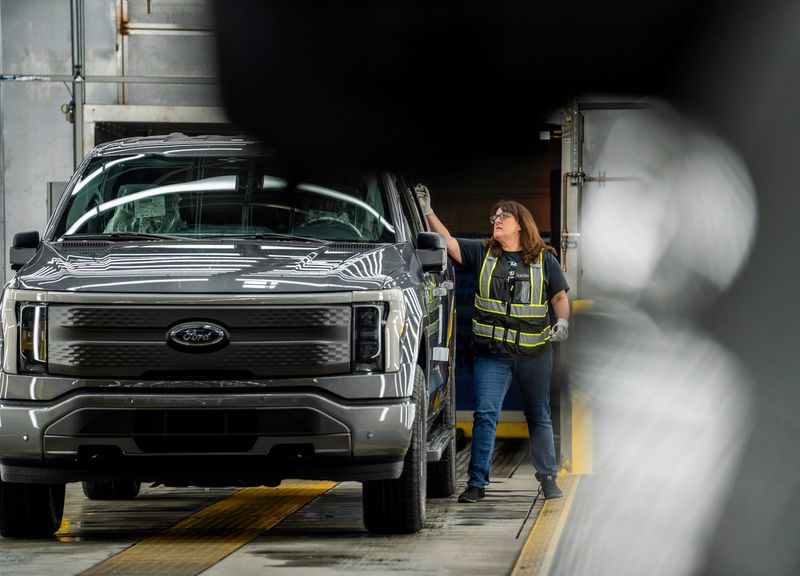
Farley said Ford is getting out of high-end EVs. Last year, the company said it would no longer make the F-150 Lightning as an all-electric vehicle. Instead, the Lightning will be relaunched as an extended range EV and have a small gasoline engine that allows it to get 700 miles of range.
To compete in the future, Farley said, Ford and other automakers must match the costs of Chinese automaker giant BYD and then focus on the part of the market they know well.
In Ford’s case, that will be pickups and SUVs — Ford will launch a midsize all-electric pickup in 2027 off its new Universal Electric Vehicle platform to be priced at about $30,000. Ford is expected to reveal that new pickup later this year, he said.
Ford is about to launch a number of other affordable vehicles, not just off the new UEV platform “but a number of them,” Farley said. “You’ll see that come out in the next couple of years.”
Farley’s big wish
Farley said one thing he can promise is that Ford will not offer any more “boring products.”
“I believe that Ford is best at naturally working on vehicles I would call vehicles with deep passion: work, off-road, on-road passion vehicles. Mustang is a passion vehicle,” Farley said. “That’s what I mean by no boring products. We don’t want to phone it in. We want vehicles that are truly differentiating for our customers like pro-power on board, or a Bronco or a Raptor … or a Mustang or a Mach-E Mustang.”
But he said a two-row crossover such as the Escape did not meet the idea of a passion vehicle that differentiated Ford. As a result, Ford ended production of the Escape and its luxury-brand Lincoln counterpart, the Corsair. Farley said it also did not make sense to continue in that vehicle segment.
“Especially when you compete in the middle of the market and you don’t have a cost advantage,” Farley said. “I wish we could have done affordable vehicles, or sedans, a long time ago. We decided not to come out with sedans in the U.S. because we didn’t have a competitive cost base. Until our company got serious about cost and quality, we didn’t really have the rights to compete.”
Farley said he could not allocate capital to a Ford Fusion sedan or a Focus compact car if they we’re going to lose $4,000 a vehicle compared to Toyota Corolla or a Honda Civic sedans.
“I need to transform my costs,” Farley said. “Go back to the mountain and figure out how we radically get costs out of our platforms and then we can compete. If we do compete in those — I would say ubiquitous segments, we better bring something new to the table.”
Might that be a new sedan? Only time will tell.
Jamie L. LaReau is the senior autos writer for USA TODAY Co. who covers Ford Motor Co. for the Detroit Free Press. Contact Jamie at jlareau@freepress.com. Follow her on Twitter @jlareauan. To sign up for our autos newsletter. Become a subscriber.
This article originally appeared on Detroit Free Press: Jim Farley on how the war in Iran affects Ford and its future lineup
Reporting by Jamie L. LaReau, Detroit Free Press / Detroit Free Press
USA TODAY Network via Reuters Connect