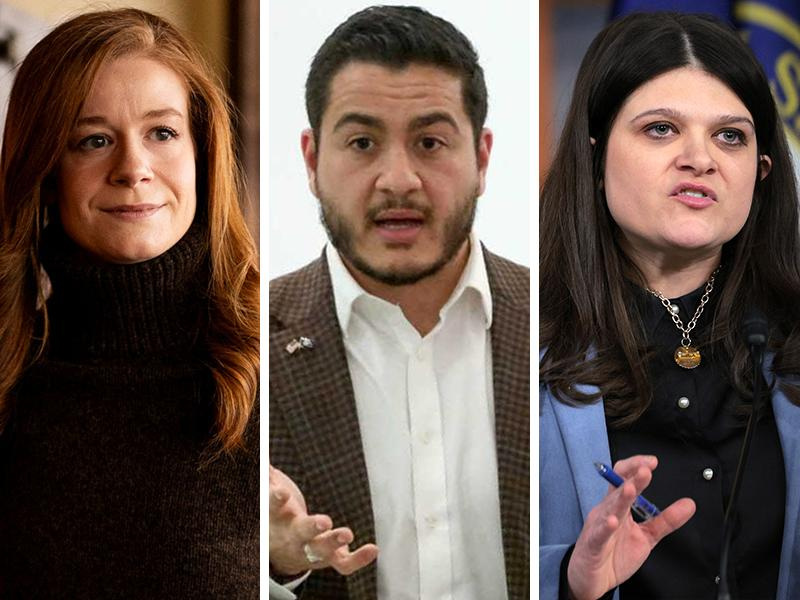
Three Democrats vying for a closely fought nomination to Michigan’s soon-to-be-open U.S. Senate seat debated Friday, April 24, on foreign policy, health care, economics and more, with few fireworks and even fewer instances of clear differences on the issues, but that doesn’t mean no verbal punches were thrown.
The debate, held before an invitation-only audience by the Council of Baptist Pastors of Detroit and Vicinity at Messiah Baptist Church on 7 Mile and broadcast to a couple of hundred watchers on Facebook live, saw state Sen. Mallory McMorrow, U.S. Rep. Haley Stevens and former Wayne County and Detroit health director Abdul El-Sayed burnish their records while honing their campaign messages with a little more than three months before the Aug. 4 primary.

Here’s a rundown of some of the high points:
Stevens refused to discuss AIPAC support…
Perhaps the most spirited moment of the debate came late when El-Sayed, of Ann Arbor, who is widely considered the most progressive of the three and the most openly critical of Israel in its counteroffensive against Hamas in Gaza and treatment of Palestinians in the occupied territories, noted he was the only one of the three who hadn’t taken funding from “the Israel lobby.” McMorrow, of Royal Oak, noted she hasn’t received any support from AIPAC, the American-Israel Public Affairs Committee (AIPAC), which has supported Israeli Prime Minister Benjamin Netanyahu, but Stevens, of Birmingham, who has received that support in the past, sidestepped any chance to address the funding, twice, declining any mention of it (though she did note her vote to restrain the U.S. military involvement in the war alongside Israel in Iran).
“We fundraise in a way that all elected officials do,” she said, adding her campaign does so “fairly and transparently.” (McMorrow, by the way, has been endorsed by J Street, a more moderate group that has been critical of Netanyahu; she said AIPAC, where her husband once interned, is now a “far-right, pro-Netanyahu organization.”)
…But presses her case that she’s best positioned to win
Stevens, though, leaned heavily into her legislative record, her support of Michigan manufacturing, her knowledge of Detroit (name-checking Mumford and Cass Tech high schools; mentioning at least twice her dad taught in the city) and, significantly, her time as the de facto chief of staff for former President Barack Obama’s auto task force that helped rescue General Motors and what was then Chrysler in 2009-10. More importantly, she made repeated mention of “the other guy not here,” meaning former U.S. Rep. Mike Rogers of White Lake, who is widely predicted to win the Republican nomination (there was no indication he was invited). The Real Clear Politics average of polls suggests that while McMorrow and El-Sayed may be leading the nomination race (and McMorrow has erased Stevens’ financial edge), Stevens − who is seen as more of a mainstream Democrat − may fare better against Rogers in a race Democrats probably have to win if they are to have any chance of retaking the majority in the chamber.
“I am the best, if not only, Democrat who can beat Mike Rogers,” she said. “I win tough races.” McMorrow, too, made several mentions of Rogers and the funding national Republican groups are sending in to help him, clearly also beginning to pivot toward an electability argument as she gains momentum in the race.
McMorrow hits her marks before a Detroit audience
McMorrow has already called for a series of debates she hopes will let her build a lead on the other two, but this probably wasn’t what she had in mind: A non-televised debate on Facebook Live on a Friday evening in April. But she still hit her marks, noting that the church where the debate was held is in her state Senate district, name-checking a small business owner on the nearby Livernois commercial corridor (and efforts in Lansing she’s been part of to get capital and coaching to small businesses) and talking up the need to help provide caregivers, mental health resources and more where necessary.
She also made sure to underscore, several times, her role as a mom, mentioning her own battle with postpartum depression (and the need for others to have access to the health care resources she had) and the fact that her 5-year-old heads off to kindergarten next fall.
El-Sayed pushes the need for change
Of all the candidates, El-Sayed probably spent the least time talking about his record − he’s never been a legislator after all − though he did rattle off a list of accomplishments as a health director, working on programs to provide eye screenings and glasses to kids and make overdose treatments more accessible. His larger message, however, was what he sees as a fundamental need to purge elections of corporate money, provide a government health plan for all Americans, abolish Immigration and Customs Enforcement (ICE) and bring an end to governments providing corporate breaks to land jobs. And while many of his positions − the need to increase taxes on rich corporations and individuals, provide mental health intervention in crisis situations and improve access to health care − were echoed by the others, he took a more strident tone.
And although El-Sayed has been criticized by some for campaigning with at least one divisive figure, Internet streamer Hasan Piker, who some critics have called antisemitic, El-Sayed, the son of Egyptian immigrants, spoke about the need for understanding across faiths. “I’m Muslim,” he said. “I hold my face to the ground 34 times a day… What I’ve learned is that what faith means to others and what faith means to me is it’s not about what you pray, it’s what you pray for. I think we pray for the same things.”
Contact Todd Spangler: tspangler@freepress.com. Follow him on X @tsspangler.
This article originally appeared on Detroit Free Press: Democrats talk AIPAC, faith, electability in first U.S. Senate debate
Reporting by Todd Spangler, Detroit Free Press / Detroit Free Press
USA TODAY Network via Reuters Connect