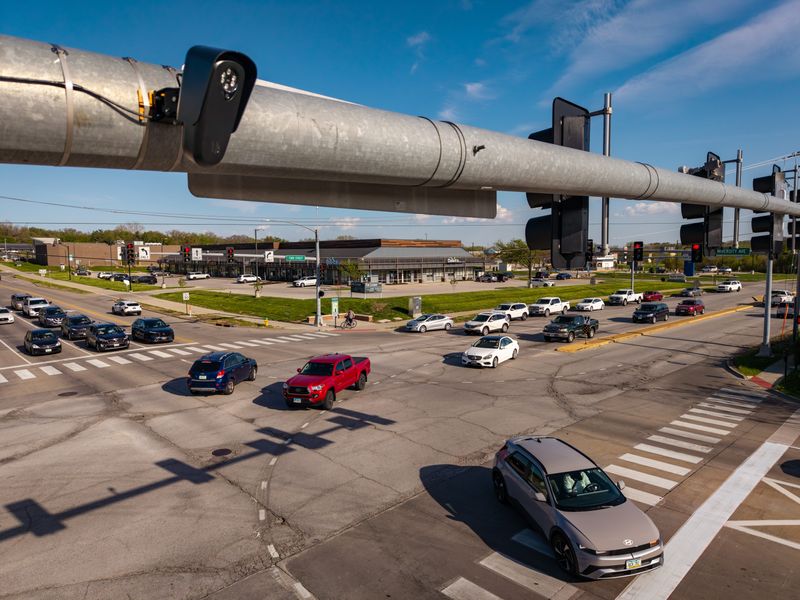
At busy intersections, entrances to cities and high traffic roads in the Des Moines metro, cameras are watching cars drive by, taking photos and collecting information.
All that data aids police investigations on the local, state and national levels by connecting to a national crime database.

There are more than 300 license plate reader cameras around the metro, most of which are operated by Flock Safety, a company under scrutiny for privacy concerns.
The city of Coralville nixed its contract with Flock Safety after public outcry over possible privacy violations. The Iowa Attorney General’s Office also admonished the city for its policy against using the camera for immigration purposes.
Nationally, residents in cities with license plate readers have expressed concern that they’re being used to aid in President Donald Trump’s mass deportation efforts. Some cities have deactivated their cameras in response.
Central Iowa police leaders, including those in Altoona, Ankeny, Clive, Des Moines, Johnston, Urbandale, Waukee and West Des Moines, say their departments have no plans to follow Coralville’s lead.
Waukee Police Chief Chad McCluskey said in a statement the cameras are “a critical resource for law enforcement and have contributed to numerous positive outcomes in serious investigations that may not have been solved as quickly — or at all — without this technology.”
Wade said the cameras are “second-to-none” because law enforcement can use the data to check if vehicles are stolen, connected to any missing-person alerts or tied to someone who has a warrant for their arrest.
A Flock camera in West Des Moines led to the arrest in a case of road rage in 2025 that resulted in an attempted murder charge, Wade said. A camera in Des Moines recently helped aid in the arrest of a man in a fatal hit-and-run.
“We’re not going to get rid of the cameras in West Des Moines because anybody else got rid of theirs,” Wade said. “We see a value in these cameras.”
What are license plate readers?
License plate readers are cameras that can automatically recognize and register license plate characters and numbers and store images of the plates. The cameras can be stationary, in vehicles, or portable with solar panels.
The cameras take still photos of the back of vehicles when motion is detected, also store location, time, and date, as well as car make, model, and color.
The data cameras capture is stored in a national database and can be shared with approved law enforcement and government agencies.
Flock Safety is among the most frequently used manufacturers, starting private operations in 2017 and transitioning to law enforcement around 2019. It’s the company most Iowa cities use, though Des Moines uses Motorola license plate readers, according to police spokesperson Sgt. Paul Parizek.
License plate readers are not the same as automated traffic enforcement cameras triggered by a violation, such as speeding. License plate readers take images of all vehicles that pass by, regardless of whether a motorist has done anything wrong.
Where are license plate readers in the Des Moines metro area?
There are nearly 320 license plate readers in Altoona, Ankeny, Clive, Des Moines, Johnston, Urbandale, Waukee and West Des Moines:
All cameras in the metro are operated by local police departments and are located along high-traffic intersections and roadways, as well at city borders.
What can and can’t a license plate reader do?
Flock cameras are not able to detect speed. The cameras’ motion detection works up to 75 feet, with a field of view of about 20 feet wide, according to the company’s website. The cameras use infrared technology at night.
The Flock Transparency Portal for each agency that uses the cameras outlines what is and isn’t recorded. Cameras record license plates and vehicles, but not drivers or passengers, race or gender, and do not use facial recognition technology.
Law enforcement agencies that use Flock cameras can decide what the data collected by the cameras is and isn’t used for.
Holly Beilin, a spokesperson for Flock Safety, said Flock cameras have “accountability and transparency mechanisms built into the product,” such as an indefinite log of who accesses the information, and data deletion after 30 days.
Despite national conversations around immigration safety, according to a blog post from Flock, the company “does not have a contract with ICE or any sub-agency of the Department of Homeland Security.”
In the metro, all but one city prohibits the use of data for immigration enforcement: Altoona does not include immigration enforcement as a prohibited use, according to its transparency portal.
Altoona police spokesperson Lt. Alyssa Wilson said officers “partner with federal agencies as requested.”
“These technologies serve as another essential resource to safeguard our community, allowing residents, visitors, and families to live, work, play, and grow without fear of victimization,” Wilson said in a statement.
The Des Moines Police Department’s cameras are used only for “the purpose of furthering legitimate law enforcement investigations and enhancing public safety,” according to the department’s general orders.
Data from Des Moines’ license plate readers, which are mostly in police vehicles, can be used for investigations with arrest warrants; to find missing and endangered persons, stolen vehicles and license plates, persons of interest in an investigation and sex offender registry violators; collect overdue fines from habitual parking violators; and enforce some parking regulations.
All police departments in central Iowa prohibit the use of data for traffic enforcement, harassment/intimidation, to target anyone based on race, sex or religion, and personal use.
Agencies also choose the organizations that can access the data captured by their cameras.
“The city or the agency, they don’t have to share data with any other city or agency if they don’t want to, or they can only share data with cities and agencies that they know are also not doing immigration enforcement,” Beilin said. “That’s entirely within their hands.”
The Urbandale City Council amended its contract with Flock Safety on April 7, requiring the company to give the city at least a 10-day notice before disclosing data collected by its cameras to any law enforcement authority, government official or third party. The change would give the city time to challenge or limit the information requested.
According to Iowa Code Chapter 321P.4, photos of vehicles and other data captured must be deleted no later than 30 days after the image was taken. A violation is a simple misdemeanor.
The data can be copied and stored longer if it’s is relevant to an ongoing investigation.
Senate File 2284, introduced in the 2026 legislative session by the Committee on Transportation, would prohibit data collected by license plate readers from being shared with a third party except for law enforcement, certain law enforcement contractors, or an insurance organization for official, investigative purposes. It also would prohibit facial recognition.
Amendments made by the Iowa House would require a local ordinance authorizing the use of license plate readers, restrict data access to authorized personnel, and require a log of data searches. The Iowa Department of Public Safety also would be required to maintain a list of approved license plate readers.
The bill passed through the Iowa House on a vote of 76-11 on Thursday, April 16, and will be sent back to the Senate to vote on amendments.
ACLU of Iowa says LPRs invade your privacy
The ACLU of Iowa says license plate reader cameras — specifically those from Flock — are “Big Brother-style government surveillance” that are spreading across the nation and across Iowa, according to the organization’s website.
In conjunction with the University of Iowa College of Law’s Technology Law Clinic, the ACLU released a report in December that sounded the alarm on law enforcement agencies’ growing use of ALPRs.
The report highlighted inconsistencies in the use and regulation of license plate camera data in Iowa, including how the data is kept and deleted, what information is publicly available and who can access the data and run searches.
“Because of the policy differences, the policy shifts and change(s) as Iowans drive from place to place around the state,” said UI associate clinical professor Megan Graham, director of the Technology Law Clinic.
There have been reports of license plate readers being used to aid in immigration enforcement efforts as Trump administration’s illegal immigration crackdown intensified. The study did not find similar incidents in Iowa.
The report found some Iowa communities’ contracts contained broad language that allows Flock to share the data “worldwide” and have a loosely defined “purpose.”
The report also found that 22 states have laws that include data retention limits, data usage and who data can be shared with, including Illinois, Minnesota and Nebraska — but not Iowa.
Kyle Werner is the breaking news and public safety reporter for the Register. Reach him at kwerner@registermedia.com.
This article originally appeared on Des Moines Register: Police in Des Moines metro defend Flock cameras as privacy fears grow
Reporting by Kyle Werner, Des Moines Register / Des Moines Register
USA TODAY Network via Reuters Connect