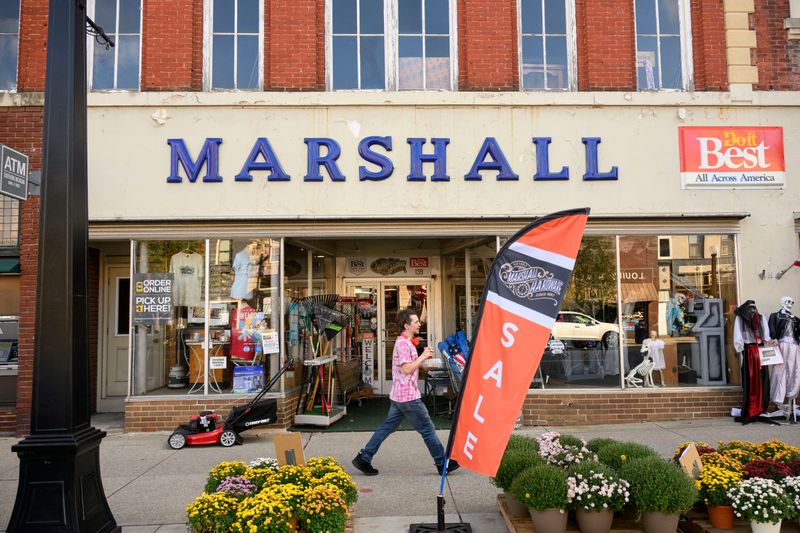
MARSHALL — Downtown Marshall is the kind of place you drive to on a Saturday morning, grab coffee or brunch, and linger in one of the eclectic shops lining West Michigan Avenue.
But if you follow West Michigan Avenue out of town, cross Interstate 69 and drive a couple of miles farther, you are still in Marshall — technically. Here, the road splits at a place called Opportunity Drive — a vanity plate of a name that feels less like a direction and more like a declaration.

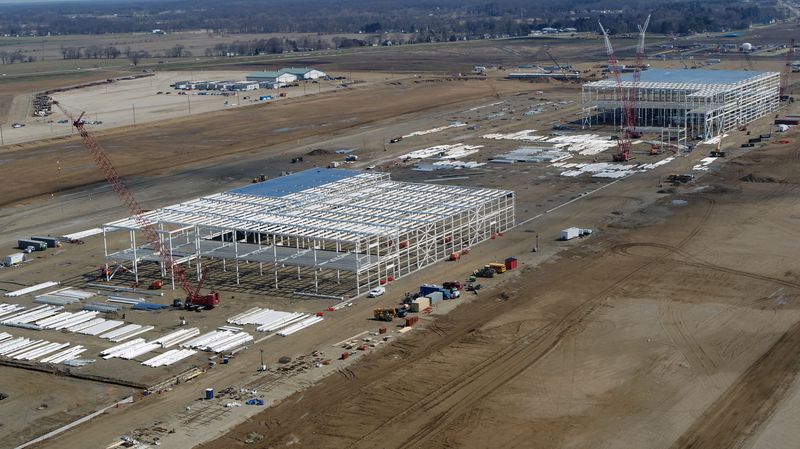
Opportunity Drive leads to a new $3.5 billion EV-battery manufacturing plant the size of 30 football fields, representing the future of Ford Motor Co.
Yet, while the plant promises to bring jobs, vitality and tax revenue to Marshall, residents felt they were not heard during the negotiating process. They sued the city, alleging the improper zoning of agricultural farmland.
The fight has unfolded in courtrooms as much as in the community.
Residents filed suit in 2023 to stop the project, arguing the rezoning of agricultural land was improper. They lost again at trial court, then again at the Michigan Court of Appeals in 2024.
The Michigan Supreme Court briefly revived the case in 2025, sending it back for further review — but as of late March, the appellate court has again sided with the city.
‘Some of the best farmland in town’
The site, described by Marshall resident and opposition leader Regis Klingler as once “some of the best farmland in town” is now home to Ford Motor Co.’s massive new Blue Oval Battery Park Michigan, a $3.5 billion lithium iron phosphate plant. It sits on 500 acres of a total of 2,000 acres primarily owned by Ford in partnership with the Marshall Area Economic Development Alliance.
Still, opposition continues. Appeals persist. And through it all, construction has moved forward with battery production expected to begin this year.
This is no longer just a legal fight. It feels more like a philosophical one.
Old versus new.
History versus momentum.
And a citizenry wrestling with whether it was heard — or simply disregarded.
The opposition group Committee for Marshall – Not the Megasite has become the public face of that resistance. Its members are not anti-growth, they insist. They are pro-process.
They wanted a vote.
They wanted a say.
They wanted time.
In an astonishing display of grit, committee members have staged protests just about every Saturday and Wednesday near the site since January 2023. They carry homemade signs in neon pink and green with slogans like: “United We Stand” “It’s Not Over,” “Save Historic Marshall” and “Never Give Up.”
Regular citizens practicing their First Amendment right to hold their government accountable.
Conversely, Michiganders are making their voices heard against the growth of AI data centers citing negative environmental impacts and secretive deals. Michigan currently is home to more than 70 data centers with more to come, according to the website Data Center Map . This includes centers operating in Battle Creek, Mount Pleasant, Grand Rapids, Kalamazoo and Flint.
A grandmother remembers
On a recent sunny late-winter afternoon, I joined 75-year-old retiree Brenda Brockmeyer, who was born in Marshall, at a sidewalk table. Sipping a smoothie in the very same block where she ate ice cream as a child, Brockmeyer reflected on a town she left and then came back to.
“I just don’t think there was a lot of consideration in how they went in and tore things down,” she said. “No one likes change, and for the community it was too much too soon.”
Then she paused — and, like many here, held both truths at once.
“I think it will help our community grow, which is fine. Things have to change. They can’t stay stagnant.”
That tension is evident throughout Marshall, where nearly a quarter of its residents are over 65.
For Lynn Sleight, a member of the committee, the issue is not the plant itself but how it came to be.
“For me, this is about citizens’ rights,” she said. “The township has no real say in industrial zoning decisions.”
Klingler, a retired engineer who has lived in Marshall for a decade, sees something deeper — uncertainty.
“People say it’s a done deal,” he told me. “What’s next for the remaining land, and why can’t people have a say in what will be there on the other 1,500 acres?” he asked. What they would prefer not to see is another industrial site there.
And that may be the real story here.
Because even as the plant rises — steel, scale and inevitability — the argument is shifting.
It is no longer just about what was built.
It is about what was lost: trees, farmland, houses and perhaps trust.
And what comes next. Ford reduced the footprint of its plant by almost a third, leaving about 1,000 for what comes next.
The opposition can’t stop the factory from rising, but they do want a say in further development.
Marshall is, after all, a place rooted in history.
More than 850 buildings sit within its National Historic Landmark District. It is a town where horsedrawn carriages were once the primary mode of transportation. Preservationists laud Marshall’s 19th- and 20th-century architecture. The Hemmingsen Rexall Drug Store on West Michigan dates to 1847 and this year celebrates its 90th year under the Rexall brand. The old-timey navy and orange neon Rexall sign is a town cornerstone and somewhat of a signifier.
While I was there, a fuel truck drove right through the middle of town, where the speed limit is 25 miles per hour. Clearly, some drivers chose to ignore Michigan speeding laws. Brockmeyer notes how much louder the traffic noise has become.
And now in this slice of Americana with 6,500 residents, a Gulliverian presence looms in a former soybean and corn field, where cutting edge-manufacturing technology will carve a new path for America’s oldest automotive brand.
Brockmeyer knows both versions of Marshall.
She left at 16. She raised children. And now, as a grandmother this is home again. And today, she watches.
Change is coming. It always does, or towns die.
Marshall is no longer just a refreshing stop off the main road.
It is a crossroads, not just of roads but of trust.
Because what’s rising beyond Interstate 94 is more than just a manufacturing plant. It is a test of whether progress can come and bring people along, too.
As Henry Kissinger, one of America’s greatest negotiators, once said, if both sides are not somewhat dissatisfied, the negotiation is not complete.
It seems to me that Marshall has an imbalance, a quiet tension that could have been avoided. One side got a plant. The other is still asking to feel like they had a legitimate say in the matter.
Byron McCauley is a regional columnist for USA Today Co. Email him at bmccauley@usatodayco.com. Call him at 513-504-8915. This column was originally published in the Holland Sentinel.
This column has been updated to correct an error.
This article originally appeared on The Detroit News: In Marshall, Ford EV battery plant brings progress, but also pain points | McCauley
Reporting by Byron McCauley, The Detroit News / The Detroit News
USA TODAY Network via Reuters Connect