Six Wisconsin sheriffs’ departments have been using an outdated immigration policy that authorizes deputies to detain people based on suspected immigration status – a practice that already cost a city in Washington state $49,000 in a lawsuit over racial profiling.
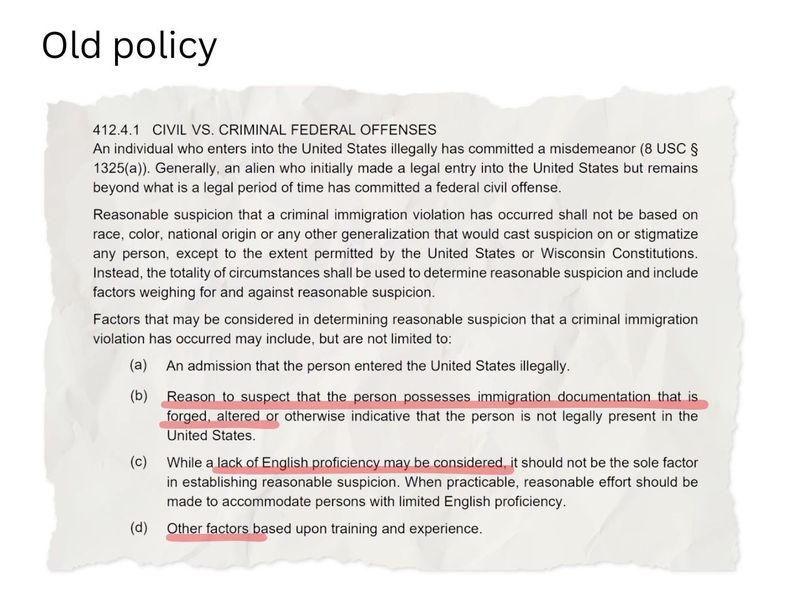
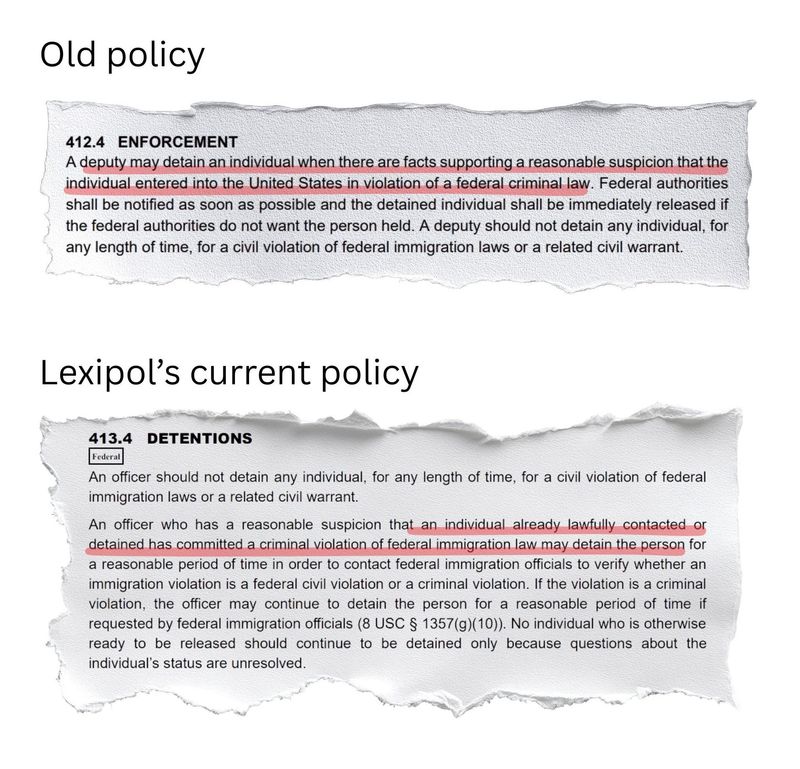
The policies used by Door, Forest, Green, Juneau, Langlade and Marinette counties allow deputies to detain people they have “reasonable suspicion” entered the country illegally, including those who aren’t in custody or part of a criminal investigation.

The policies come from an old template created by Lexipol, a private company based in Texas that provides law enforcement policies nationally to around 4,800 agencies.
However, Lexipol scrapped that template in 2020 after a lawsuit in Spokane, Washington.
The 2018 lawsuit alleged that Gabriel Gomez Maciel, a Latino resident who was the victim of a car crash, was held at the scene of the crash while a responding police officer asked U.S. Border Patrol if the agency had “any interest” in him.
When agents arrived, Gomez was handcuffed, denied medical attention and ultimately detained for nearly a month, according to the lawsuit. He had no criminal record.
The ACLU of Washington, which represented Gomez in the lawsuit, argued the Spokane Police Department’s immigration policy allowed the police officer to hold Gomez solely because he is Latino.
The city settled in court, agreeing to pay Gomez $49,000 and to prohibit officers from stopping, detaining or arresting individuals based on suspected criminal immigration violations.
Even though Lexipol wrote the policy in question, the company is shielded from liability, said Joanna Schwartz, a professor at the UCLA School of Law and an expert on police misconduct litigation.
“When there is any pushback about the content of those policies, the response is that local governments can, of course, make their own decisions,” Schwartz said.
That means Wisconsin taxpayers could be on the hook for any similar lawsuits here.
Mark Thomsen, a Milwaukee civil rights attorney, said the policy could lead to unlawful detentions in violation of the Fourth Amendment, which prohibits unreasonable searches and seizures. He said the policy’s interpretation of “reasonable suspicion” is too broad.
“They have to change it,” Thomsen said, of the sheriffs’ departments with the outdated policies. “You can’t have a policy that’s inconsistent with the law.”
Outdated policy includes ‘lack of English proficiency’ as possible factor for detention
All the sheriffs’ departments – except for Forest County – provide the same list of factors that could determine “reasonable suspicion” that someone broke federal criminal immigration law.
Among them: if the person’s immigration documents seem forged or “indicative” of unlawful presence, if the person is not proficient in English, and “other factors based upon training and experience.”
The policy clarifies that lack of English proficiency cannot be the “sole factor” in detaining someone.
Tim Muth, senior staff attorney for ACLU of Wisconsin, said the outdated policies used by the six Wisconsin sheriffs invite racial profiling.
The policies only allow deputies to detain individuals they suspect of a criminal immigration offense, not a civil violation. Most immigration issues are considered civil violations.
However, Muth said it is highly unlikely that deputies are trained to distinguish between civil and criminal immigration violations, let alone identify evidence that would justify detention.
As a result, deputies could end up detaining people based on stereotypes – such as speaking Spanish or working on a dairy farm – rather than any actual criminal conduct, he said.
Mike Ranalli, a Lexipol program manager, said Lexipol substantially changed its recommended immigration policy in 2020. The new policy – which has been adopted by a majority of Wisconsin sheriffs – no longer allows deputies to detain individuals based on reasonable suspicion of illegal entry.
Instead, it limits immigration-related holds to individuals who are already lawfully stopped or detained. Under those circumstances, deputies can detain the person while they contact federal immigration officials to verify whether a criminal violation occurred.
Lexipol’s legal team analyzes thousands of pieces of legislation a year, only updating its policies when it’s “glaringly obvious” that a court case mandates they do so, Ranalli said.
However, he said it’s common for law enforcement agencies to use outdated Lexipol policies. According to Ranalli, some agencies save money by downloading policies as they find them online, leaving them with outdated versions that are no longer legally sound.
“They are opening up a vulnerability because they’re not privy to the changes that we’re delivering,” Ranalli said.
Muth said Lexipol’s current immigration policy still leaves sheriffs’ departments vulnerable to lawsuits because it does not require ICE to produce a warrant signed by a judge to hold someone for immigration reasons.
“Just because Lexipol writes it doesn’t make it true,” Muth said.
Three sheriffs update immigration policies
Shortly after reporters contacted the sheriffs’ departments, three of them updated their immigration policies.
Langlade County Sheriff’s Office has had its policy for the past six years. But deputies haven’t taken action with it, said Robin Stowe, corporation counsel for the county.
“It is my understanding that the Langlade County Sheriff’s Office is/was not performing any immigration enforcement services ‘out in the field’ so to speak,” Stowe said in an email.
According to Stowe, the sheriff’s office discovered that its immigration policy included a mixture of older and newer versions of Lexipol’s policy and contacted Lexipol to reset their system.
“Or policy now reflects the most current version available through Lexipol,” he said in a March 26 email.
The Juneau County Sheriff’s Office initially sent the Journal Sentinel a policy that included the outdated passages. After reporters reached out, deputy sheriff Gary Pedersen sent reporters a new version without those sections.
Pedersen said he did not know how the change occurred. He suggested the update may have taken place when he took the policy out of “draft” status on March 25.
“That is the only thing we can think of,” he said.
Marinette County Sheriff Randy Miller said his office implemented the outdated policy last year, unaware that there was a newer version.
“Apparently the previous update, for some reason, did not go through when it was put into the manual,” Miller said in an email. “[I] am working with Lexipol today to rectify that and get it updated and sent to all deputies to become familiar with it.”
Miller said he scheduled a training to familiarize deputies with the new policy.
The sheriff’s offices of Forest and Green counties did not respond to requests for comment.
The Door County Sheriff’s Office was unaware its immigration policy was outdated, said Sean Donohue, corporation counsel for the county.
“We wouldn’t intentionally put something in there that was not legal,” Donohue said. “I appreciate you bringing this to my attention.”
Donohue said he would investigate the policy and follow up with reporters. He didn’t respond to further requests for comment.
Symone Sandoval, an immigration advocate in Door County, said she was shocked to see Door County deputies can detain people for suspected immigration violations.
Sandoval said she has helped friends and coworkers navigate interactions with law enforcement during traffic stops. She wants the department to update the policy to ensure that immigrants feel safe asking law enforcement for help.
“If they keep this, it suggests that’s what they want to do,” Sandoval said. “There’s no other reason to keep it.”
Zara Norman and Ben Lauren are graduate students at Northwestern University’s Medill School of Journalism. Gina Castro and Bridget Fogarty are reporters for the Milwaukee Journal Sentinel. Vivian Barrett is a reporter for the Green Bay Press-Gazette.
Are you navigating the immigration system? Do you have questions about immigration enforcement in Wisconsin? Contact us at wisconsininvestigates@gannett.com.
This article originally appeared on Milwaukee Journal Sentinel: Outdated ICE policies expose 6 Wisconsin sheriffs to legal risk
Reporting by Zara Norman, Gina Castro, Ben Lauren, Bridget Fogarty, Vivian Barrett, Milwaukee Journal Sentinel / Milwaukee Journal Sentinel
USA TODAY Network via Reuters Connect