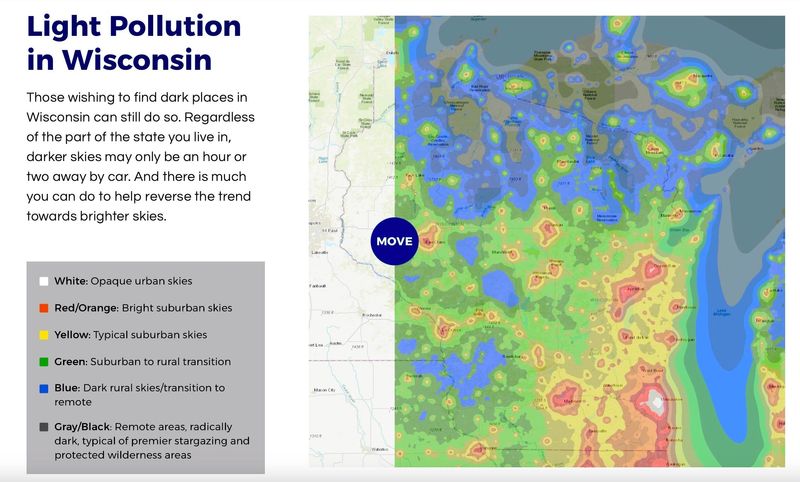
As development marches on, the world is experiencing an increase in light pollution, or excessive artificial light after dark.
Its effect can be seen from satellites in orbit and humans on the ground.

Viewed from overhead after dark, large cities and other highly affected areas are an opaque blob of white.
From below, light pollution is a haze that obscures the stars, even on a clear night.
It’s not just a visible nuisance, either. Studies have shown light pollution can disrupt circadian rhythms in humans and is linked to sleep disorders, stress, anxiety and potentially higher risks of cancer (breast, prostate), diabetes and obesity.
It also has negative impacts on wildlife, especially migrating birds, and in many areas prevents stargazing and hinders astronomical research, according to the National Geographic Society.
In an effort to address the problems associated with light pollution in Wisconsin, in September 2025 a coalition of individuals and organizations with diverse interests united behind a common goal and formed Lights Out Wisconsin.
Their objective: Reduce light pollution.
Their motto: “Saving birds, fireflies and night skies in Wisconsin.”
Their mission: Increase awareness of light pollution and provide education on ways people can reduce it.
The coalition includes bird, energy efficiency, astronomy and dark sky advocates.
“We’ve come together for a common goal and are working to reach the broadest possible audience,” said Lisa Gaumnitz, a co-founder of SOS Save Our Songbirds. “It’s an issue that affects everybody and also one that everybody can make an immediate difference.”
Although the mechanism has yet to be fully understood, it’s well known that birds can be confused by artificial lights at night, at times disrupting their migrations and causing collisions with buildings. Since 80% of migratory birds in North America migrate after dark, light pollution is an important ecological issue, said Kyle Horton, leader of the AeroEco Lab at Purdue University.
That includes invertebrates such as fireflies, which rely on dark conditions to use their bioluminescent flashes to find mates and reproduce. Excessive light can interfere with fireflies’ courtship rituals.
And efforts to make the night sky darker is helpful to amateur star gazers and professional astronomers alike.
Lights Out Wisconsin promotes low-impact lighting including downward facing lights, timers, dimmers, 2200 Kelvin or lower color temperature lighting, and turning off non-essential lights when not in use.
And it recommends people subscribe to free BirdCast Migration Alerts from the Cornell Lab of Ornithology. Alert emails are sent on days when the migration forecast is high; Lights Out Wisconsin recommends people turn off all lights on nights of peak bird migration.
Four Wisconsin cities – Milwaukee, Madison, Appleton and La Crosse – have been added to the BirdCast alerts this year; other sites close to the Wisconsin border such as Duluth and Minneapolis, Minnesota, are also included.
BirdCast organizers recommend subscribing to the city nearest to your residence or place of interest.
Lights Out Wisconsin received its initial funding support from the National Audubon Society.
Its partners include Bird City Wisconsin, Dane County Humane Society’s Wildlife Center, Dark Sky Wisconsin, Driftless Birds, Focus on Energy, Homegrown National Park, Kickapoo Valley Dark Sky Initiative, Lake Michigan Bird Observatory, SOS Save Our Songbirds, Southern Wisconsin Bird Alliance, Wisconsin Bird Conservation Partnership, Wisconsin Society for Ornithology and Xerces Society for Invertebrate Conservation.
Formed just last year, the coalition is hopeful its goal of assisting birds, improving nighttime viewing of stars and reducing energy usage will resonate with a majority of the public.
To receive BirdCast migration alerts, visit birdcast.org. To learn more about Lights Out Wisconsin and recommendations to reduce light pollution, visit lightsoutwi.org.
This article originally appeared on Milwaukee Journal Sentinel: Lights Out program promotes reducing light pollution to help migrating birds
Reporting by Paul A. Smith, Milwaukee Journal Sentinel / Milwaukee Journal Sentinel
USA TODAY Network via Reuters Connect