With their gravity-defying ability of flight, birds likely have been a source of fascination for humans as long as they have coexisted on Earth.
But the feathered animals gave up their secrets slowly over the millennia.

Until the early 1800s, hypotheses abounded for the disappearance of birds from the Northern Hemisphere in fall and winter. Some thought they hibernated in mud or underwater, others believed they turned into other life forms.
But in 1822, a white stork was found in Germany with a 30-inch-long spear in its neck. After the spear was traced to Central Africa, the “Pfeilstorch,” or “arrow stork,” provided the first tangible proof European birds migrated south for the winter.
Other important clues about bird migration came later in the 19th century courtesy of lighthouse keepers and mariners.
In “Destruction of Birds by Light-houses,” published in the July 1880 Bulletin of the Nuttall Ornithological Club in Cambridge, Massachusetts, author J.A. Allen estimated birds killed by flying at night into the lighted towers of lighthouses on the East Coast “must amount to the many thousands annually.”
Allen also detailed bird deaths on a May 17, 1877, voyage of the steamer “Glaucus” from New York to Boston. The ship arrived in Boston after a night at sea in which “feathered songsters were attracted by the steamer lights, and the birds came crashing against the masts, the shock killing large numbers, and causing them to fall to the deck in showers.”
One hundred sixty-eight dead birds of 13 species, including brown thrush, bobolink and catbird, were collected from the ship. “How many fell into the Sound, nobody can tell,” Allen wrote.
Such incidents, though tragic, provided key information on bird behavior.
But why were the birds moving at night? And why were they attracted to light?
The coming decades helped fill in more blanks as improvements in optics allowed scientists and others to observe birds flying at night against the moon. And advances in sound recordings also documented nocturnal movements of birds.
By the mid-1900s, there no longer was any doubt: many birds migrate at night.
“It’s one of the most remarkable things,” said Benjamin Van Doren, an assistant professor at the University of Illinois Urbana-Champaign and leading bird researcher. “There is a veritable river of birds passing overhead while we’re sleeping that most people, including me until I learned about it, are oblivious to.”
BirdCast takes mystery out of when birds migrate
Though mysteries remain, the modern status of knowledge about bird migration is the envy of previous generations of scientists and birders.
There is no longer any reason for anyone to be in the dark about when most birds migrate. Or even how many are in flight.
Thanks to an ambitious project called BirdCast, the public has unprecedented, free access to all manner of details on bird migration.
It’s now established, for example, that 80% of migratory birds in North American migrate after dark.
BirdCast uses data from NEXRAD (or next-generation radar), a weather surveillance network of 143 high-resolution Doppler radars operated by the National Weather Service, Federal Aviation Administration and U.S. Air Force.
The radar detects moisture, yes, as shown on TV weather reports and apps on your phone.
But it’s so powerful, it also picks up biological targets such as insects, bats and birds.
“It’s been a game changer,” said Kyle Horton, associate professor in the Department of Forestry and Natural Resources at Purdue University and leader of the Purdue AeroEco Lab. “We’re able to not only observe what’s in the air but make predictions about what’s coming.”
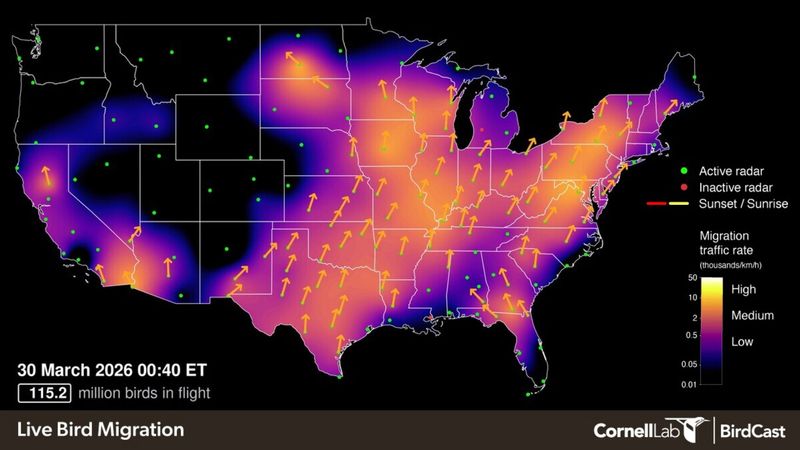
The sophisticated technology has been utilized by BirdCast scientists to allow measurements and estimates of bird movements, including intensity, altitude, direction and speed. The data is combined with historical migration patterns, weather forecasts and machine learning to predict bird movements.
On the night of March 29, for example, BirdCast picked up a peak of 4,698,400 birds in flight over Wisconsin. Their general heading was north at a speed of 33 miles per hour and an altitude of 700 feet. The peak occurred at 11:50 p.m., according to BirdCast.
All of the information is at the public’s fingertips on the BirdCast website. The migration tools include live maps, forecast maps and migration alerts.
Creation, development of BirdCast has been large collaboration
The chief scientific partners of BirdCast are Cornell University, the University of Illinois Urbana-Champaign, University of Massachusetts Amherst and Purdue University.
The core scientific team is led by Adriaan Dokter at the Cornell Lab of Ornithology and includes Horton at Purdue, Van Doren at Illinois and Daniel Sheldon, professor of computer science at UMass Amherst.
The project has received support from the National Science Foundation, Leon Levy Foundation, Lyda Hill Philanthropies, NASA, Edward W. Rose Postdoctoral Fellowship, the Marshall Aid Commemoration Commission and Amazon Web Services.
BirdCast got its start in 1999 as a collaboration of the Environmental Protection Agency, National Audubon Society, Cornell Lab of Ornithology, Clemson University Radar Ornithology Laboratory, the Academy of Natural Sciences in Philadelphia and GeoMarine Inc.
Its goals included maintaining a website to post educational information about bird migration and steps property managers could take to mitigate the danger and stress migrating birds face when passing through an area; predicting and monitoring bird migrations on a daily basis using weather radar; collecting and disseminating volunteers’ reports of bird sightings to “ground truth” the radar data; and raising public awareness about the sensitivity of migratory bird populations.
Fortified by a decade of operational experience and additional research, in 2010 ornithologists and computer scientists from Cornell University and Oregon State University obtained a National Science Foundation award and worked to refine BirdCast.
Their efforts received a boost from advancement in radar technologies.
Until about 2013, WSR-88Ds collected three primary radar moments: reflectivity, radial velocity and spectrum width, Horton said. In 2013, the U.S. upgraded the NEXRAD network to dual-polarization, an update that resulted in the collection of three additional data products: differential reflectivity, correlation coefficient and differential phase.
The incorporation of this second plane of polarization added another “dimension” for describing precipitation, atmospheric debris and biological scatterers, Horton said.
When folded into the BirdCast project, the radar upgrade has provided researchers increased confidence in describing migratory behaviors as well as characterizing biological scatters and measuring migrant orientation.
The researchers have refined BirdCast to be able to tell the difference between bats, birds and insects.
Van Doren, who has been working with BirdCast since 2012 when he was an undergraduate at Cornell, said a key is that insects typically can’t fly faster than the wind.
He said in recent years he’s seen how BirdCast resonates with the public and has brought bird migration “into the light.”
“BirdCast brings bird migration to the masses with visuals to help capture this humongous phenomenon that moves across the continent mostly under the cover of darkness,” Van Doren said. “[BirdCast] has been able to leverage technology in a new way and people have locked onto it.”
More updates, improvements coming for BirdCast
The BirdCast team continues to make updates to the product. This year, the website had a complete refresh, Van Doren said, and introduced the email alert feature for 200 U.S. cities, including four in Wisconsin.
Over time, BirdCast researchers also integrated information from another Cornell project called eBird, an online tool for the public to report bird sightings, to help provide species-specific data.
All of these advancements are occurring while bird populations are declining. A paper published in 2019 in “Science” showed bird populations in North America dropped by nearly 3 billion, or 29%, since 1970.
The concerns cover all bird groups but are especially high for grassland and boreal forest species.
They also are taking place as bird watching is increasing in popularity in the U.S. In 2022, 148 million U.S. residents watched wildlife, principally birds, according to the U.S. Fish and Wildlife Service. The number equaled 57% of Americans 16 years of age or older, according to the service.
The maps and digital tools of BirdCast appeal to many in the birding community, Horton said.
“In my mind, there’s no replacing seeing a grosbeak or tanager in the field, but if BirdCast is making bird watching a little easier and more accessible, that’s a win,” Horton said.
Despite all the advances, science has yet to unlock all the secrets of bird migration. Like the mariners and lighthouse keepers, modern researchers have hypotheses but no definitive conclusion about why most birds migrate at night or fly into lights or lighted buildings.
Work continues on those questions, Horton said.
In the meantime, BirdCast provides alerts to the public by email during periods of peak bird migration. The goal is to have people turn out lights and reduce the risk of confusing or drawing birds to lights.
What does the future of BirdCast hold? Horton said the project is working at making better forecasts, just like meteorologists.
BirdCast also is working on providing species information that isn’t available via radar. One strategy: to identify birds in flight at night by their vocalizations. Van Doren and other researchers have microphones set up at sites and are working on incorporating the audio data in BirdCast.
Since BirdCast has been heavily focused on nocturnal migration, Horton said, the team might also expand into daytime observations. Most raptors, for example, migrate between sunrise and sunset. A HawkCast could be in the future, Horton said.
Based on historical BirdCast data, bird migration peaks in mid-May in Wisconsin. In spring 2025, for example, peak migration traffic across the Badger State included 31,509,600 birds at 3:20 a.m. May 15 and 28,825,900 at midnight May 24.
A main takeaway: The birds were flying at night.
Horton said one of the keys to BirdCast is making people more aware of when birds are migrating, both daily and seasonally. He is part of the team that initiated the “lights out” alerts.
“Birds are susceptible to lights at night,” Horton said. “[Lights] might cause a bird to collide with a structure, might slow down their migration, make them less successful in their migration.”
Turning out lights at night is a relatively simple fix, but not an easy one because it takes wide participation.
“It’s one of our key points, because if you change this one action today, the fix will be in action tonight,” Horton said. “That’s not true with many things affecting birds. So we hope BirdCast can help people be more aware and take action to help birds.”
Sign up for migration alerts
To receive free BirdCast Migration Alerts by email from the Cornell Lab of Ornithology on days when the migration forecast is high, plus updates about birds, birding and opportunities to help conservation, visit birdcast.org.
Four Wisconsin cities − Milwaukee, Madison, Appleton and La Crosse − are included in the options, as well as cities close to the state border such as Duluth and Minneapolis, Minnesota. BirdCast organizers recommend people subscribe to an alert from a city closest to their place of interest.
This article originally appeared on Milwaukee Journal Sentinel: Nighttime navigators | How radar tracking, alerts help protect migrating birds
Reporting by Paul A. Smith, Milwaukee Journal Sentinel / Milwaukee Journal Sentinel
USA TODAY Network via Reuters Connect