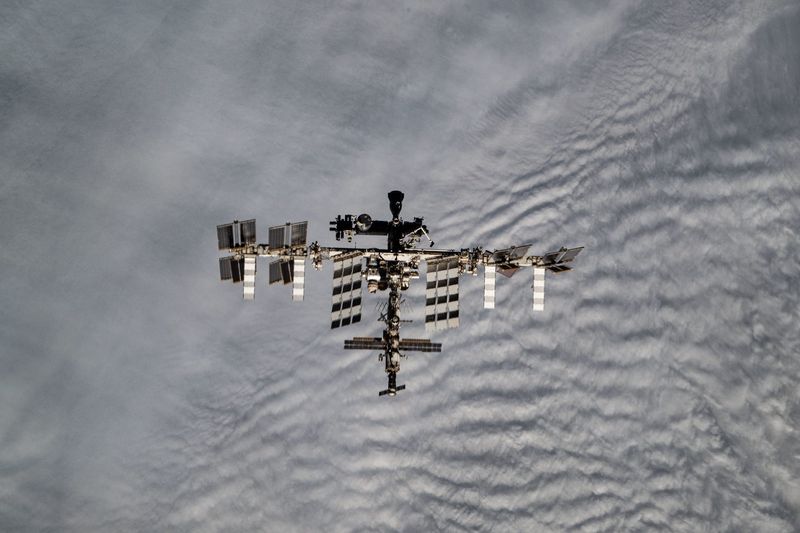
The International Space Station is increasingly becoming a place where not only government astronauts affiliated with space agencies like NASA are welcome.
Private astronauts selected by commercial spaceflight companies are due to begin venturing to the orbital laboratory more and more often in the years ahead. Such ventures aren’t exactly new territory for NASA, which has already partnered with Texas-based Axiom Space on four previous private astronaut missions.

But the U.S. space agency continues to prioritize missions with non-government spacefarers as it looks to expand commercial partnerships under the leadership of NASA Administrator Jared Isaacman.
And recently, NASA reached an agreement with a third space technology company, Voyager Technologies, to send a crew of commercial astronauts to the ISS. The focus on these types of partnerships comes as NASA prepares to retire the iconic – albeit aging – 25-year-old space station to make way for commercially-built orbital outposts.
“Private astronaut missions are accelerating the growth of new ideas, industries, and technologies that strengthen America’s presence in low-Earth orbit and pave the way for what comes next,” Isaacman said in an April 15 statement. “With three providers now selected for private missions, NASA is doing everything we can to send more astronauts to space and ignite the orbital economy.”
Here’s everything to know about the upcoming private astronaut missions to the International Space Station.
What is the International Space Station?
The International Space Station has been stationed in low-Earth orbit for more than 25 years, typically about 260 miles high, where it has been home to astronauts from all over the world. Throughout its lifespan, the station has served as a test bed for scientific research in microgravity and has in years past opened itself up to private commercial missions.
The orbital laboratory is operated through a global partnership of space agencies, including NASA, Roscosmos, the European Space Agency, the Japan Aerospace Exploration Agency and the Canadian Space Agency.
More than 290 spacefarers from 26 countries have visited the International Space Station, including 170 from the United States alone, according to NASA.
NASA partners with 3rd aerospace company on private astronaut mission
Under Voyager Technologies’ agreement with NASA, four private astronauts are due to fly as early as 2028 to the International Space Station for up to two weeks.
The April announcement comes about two months after NASA revealed that it has also partnered with California-based aerospace company Vast on a similar mission planned for summer 2027. Those two upcoming missions would resemble the ventures that Axiom Space has already conducted four times between 2022 and 2025.
Voyager and the other companies NASA selects for the missions are able to nominate four astronauts to form a crew, who NASA and its international partners must approve for the spaceflight. The private astronauts then train with NASA ahead of the launch.
But lest you think private astronauts are unqualified for such missions, retired NASA astronaut Peggy Whitson has been back to the space station twice with Axiom.
SpaceX Falcon 9 rocket, Dragon capsule to transport private astronauts to ISS
Unlike NASA’s commercial crew program that contracts SpaceX as a launch service provider, private astronauts heading to the space station on the missions will not be government astronauts. Billionaire Elon Musk’s SpaceX will still provide launch services for the private missions, which will get off the ground from Florida.
Why? Because SpaceX’s Falcon 9 rocket and Dragon crew capsule combo is the only U.S. spacecraft capable of launching and transporting astronauts to and from the ISS following liftoff at the Kennedy Space Center in Cape Canaveral.
What is Voyager? What to know about space technology company
Voyager Technologies is a defense and space technology company based in Denver, Colorado.
Along with Vast and Axiom Space, it’s also among the aerospace companies working to develop and launch commercial space stations that would one day replace the International Space Station in low-Earth orbit. Voyager’s Starlab space station, awarded $217.5 million by NASA, is central to its ambition to see low-Earth orbit operations to transition to the private sector.
Voyager is also invested in developing lunar habitat technology that could be used in concert with NASA’s Artemis moon program.
In a statement, Voyager CEO Dyland Taylor said the NASA partnership “validates our belief that the infrastructure being built in low-Earth orbit today is the launchpad for humanity’s future in deep space.”
“Voyager is committed to making American human spaceflight stronger, more capable, and more sustainable at every step of the journey,” Taylor continued.
Voyager mission would follow Axiom 5, Vast ventures to ISS
Voyager’s mission will ultimately be the seventh private astronaut spaceflight to the ISS.
Axiom Space, which has so far conducted the first four ventures, is next due to launch its fifth private astronaut mission in January 2027 after signing another agreement with NASA. Vast would then launch the sixth private astronaut mission in 2027, according to NASA.
What astronauts are on the International Space Station?
Seven astronauts who are part of Expedition 74 are now living and working about the International Space Station, including three Americans.
The most recent arrivals were spacefarers who are part of a mission known as Crew-12. A joint venture between NASA and SpaceX, Crew-12 – including NASA astronauts Jessica Meir and Jack Hathaway, the European Space Agency’s Sophie Adenot and Russian cosmonaut Andrey Fedyaev – arrived Feb. 14 at the ISS for a nine-month stay.
NASA astronaut Chris Williams and Russians Sergey Mikaev and Sergey Kud-Sverchkov, who arrived at the end of November on a Soyuz MS-28 spacecraft, are also at the orbital laboratory.
Eric Lagatta is the Space Connect reporter for the USA TODAY Network. Reach him at elagatta@usatodayco.com. Subscribe to the free Florida TODAY newsletter.
This article originally appeared on Florida Today: NASA expands private astronaut missions to space station. Here’s why
Reporting by Eric Lagatta, USA TODAY NETWORK – Florida / Florida Today
USA TODAY Network via Reuters Connect