From now until May 5, Indianapolis voters will choose the Democratic nominee for the 7th Congressional District, the state’s deep blue district that’s been represented by Congressman André Carson for 18 years.
But some voters in the district now appear to be itching for change. Carson faces what’s likely to be his toughest challenge yet as candidates George Hornedo, Destiny Wells and Denise Hatch try to convince voters that they’re the new leadership Indianapolis is craving.

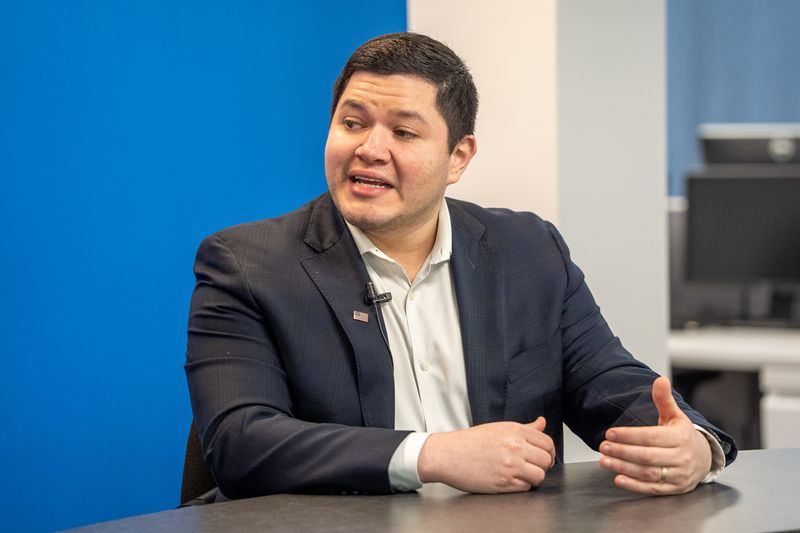
Hornedo, a Democratic political strategist who previously worked for President Barack Obama, has built his campaign on the assertion that Carson has failed to deliver real change to Indianapolis, and that a newcomer is needed to maximize the city’s potential. In an interview with IndyStar during our “Meet the Candidates” series, he promises to be a “workhorse” for the district, energizing Indianapolis to help it boost Democratic politics across the state and eliminating silos between local, state and federal government.
Hornedo’s responses to IndyStar questions have been edited for clarity, brevity and style. Watch Hornedo’s full interview here.
Q: Why are you running for Congress?
A: I am running because I am part of the exhausted majority of people that hate our politics right now and just can’t stand it. We’ve got the mad king as president. We’ve got a governor and a clown car of statewide officials that, tout a billion-plus-dollar budget surplus that is built on the backs of seniors, on working families, on children. We’ve got a scandal-plagued mayor that lacks any sort of vision for the city. And, unfortunately, we have a member of Congress that’s just not very present.
And Indianapolis deserves better. Indianapolis deserves a leader that reimagines fundamentally what this role can be. Anybody can be an up or down vote on any given issue in Washington, D.C. It is about how you use the platform. We need whoever sits in this seat to not just be our representative in D.C., but be the baseline of a representative for the community.
So how are you here at home breaking down silos between federal, state and local government? How are you building the Democratic Party from the bottom up, because we desperately need it. How are you using that platform and influence to force the conversation on all sorts of issues?
I think we need somebody that is ready to build what comes next, because the other reality is, once we are on the other side of Trump, this country’s going to need a whole new reconstruction. And I just don’t think that the leaders that got us into this mess are the ones to get us out of it.
Q: You’re challenging someone who’s been in office for 18 years. Are you worried about party infighting at a time when the party isn’t holding a lot of elected positions in Indiana.
A: Absolutely not. I think iron sharpens iron. I’ve been hearing constantly from folks all over the district that they’ve never seen André Carson in the past few months (be) as visible as he is now, and that’s because he has a primary challenge. Regardless of what happens with this race, if I’m able to make him a stronger representative for people, that’s important.
But it also shouldn’t take a competitive primary challenge to get him to show up. It shouldn’t take interviews. It shouldn’t take the cameras to be able to show up.
…The other thing I think about is this is a safe Democratic seat. By and large, you’re going to have a safe Democratic vote. So my qualms with Congressman Carson are less around his voting record … It’s about how you use the role. I think a lot about the fact that we have had 21 years of one-party Republican rule in the state. Back when Julia Carson was in office and Andy Jacobs before her, we had more balanced government.
Democrats were, at the very least, competing, often even winning statewide. And that’s when this congressional district was the best in the state in voter turnout. Under Congressman Carson, we are now the worst in a state that already ranks dead last in voter turnout. That’s embarrassing. And it doesn’t have to be that way.
…He is carrying the legacy of his grandmother. He has never had a competitive primary challenge. The general election in November is a foregone conclusion, and so he got comfortable. And when one gets comfortable, that can often lead to complacency. When somebody’s complacent, residents feel that. They then feel disconnected from their government. That disconnection can lead to disillusionment. That disillusionment can lead to disengagement. And that’s how we find ourselves in the position that we’re in now.
We need somebody that’s going to look at themselves as more than just a vote in DC. We need a party builder. We need a party leader.
Q: Have you run for elected office before? And if not, what makes you feel like you can do the job?
A: I’ve not run for elected office before. My whole career has been in Democratic politics, both at the national level as well as here in the state. But the way I think about it is campaigns are a window into how one might govern, and it’s also a window into how one has lived their lives prior. And so coming from a background working in state and national democratic politics, I know the traditional model is top-down. You spend all your time talking to donors, most of whom aren’t even from the community.
You raise as many resources as you can, and you hold on to those resources, don’t invest in the community, and then try and do TV ads in the final six to eight weeks. I don’t think that model works. And I think the biggest issue in our politics before you even get to policy or message or messenger is an erosion of trust in our leaders, in our parties, in the system at large. And you don’t solve that top down.
When I came into this race, I asked myself, if I didn’t know that those were the ‘rules’ of the game, how would I want to run? I see this campaign as more than a campaign. It is, yes, a vehicle to hopefully elect me, but it’s a vehicle to rebuild the party from the ground up.
… I guess the way I like to put it is, Congressman Carson has a lot of power and influence and juice that he doesn’t use. And Mayor Hogsett has a lot of power, influence, and juice that he uses only for himself. Nobody’s really using it for the people. I want to use it for people.
Q: You have three very ambitious priorities for Indianapolis on your website: fixing roads, ending homelessness, and making housing affordable. How would you use your position to address these issues outside of Congress, especially in the shadow of a conservative statehouse?
A: I’ve got the Fair Shot agenda, which is kind of my national piece. And there are five buckets within it, each with a slew of policy positions. But like I said, this is a field first campaign.
..We’ve had direct conversations with over 18,000 voters. It is kind of giving me a bit of a heat map on the issues that keep coming up the most. And those are three of the issues that I’ve most consistently heard. I decided to develop much more detailed plans, 50-plus page white papers, not just looking at the federal side, but federal, state, and local.
…I can’t make the mayor look at using city-owned land for affordable housing. I can’t make the governor look at, and the state legislature look at, tenant relief because we’re ranked so high in the country in eviction. I can’t make them establish a state housing trust fund, but I can force the conversation. I can be a housing advocate-in-chief. On the federal side, there’s an oversight role…a legislative and a policy role that, of course, I can play. But again, that’s what I’m talking about when I’m talking about breaking down silos. Because in the absence of a governor and a mayor with any sort of vision, somebody has to step in and fill the void.
I’m not naive to the fact that vision-building is difficult. Rallying people around a vision is even harder. Executing upon a vision is the hardest. But if you don’t have a vision, you’re walking aimlessly. And we have been walking aimlessly for far too long as a state, as a city, as a party here locally in the state, nationally as well. And so somebody needs to step up, and that’s why I’m running.
Q: A lot of your campaign centers on bringing change to a stagnant system, which another challenger, Destiny Wells, has also echoed. What differentiates your vision for change from hers?
A: I’ve appreciated watching Destiny run for the past five years, and I look forward to seeing what she runs for next.
Q: Indiana has strengthened its partnership with Immigration and Customs Enforcement recently, which has concerned a lot of residents of the 7th District. What are your views on ICE, and how would you use your position to address some of those concerns?
A: Abolish ICE, prosecute the people involved, defund DHS, is the top line of it. And quite frankly, I’m a little bit surprised that this has been a point of differentiation between myself and the congressman in this race.
It started a bit over a month ago. There was a national article by Axios talking about 100-plus Democratic co-sponsors in the House for impeachment articles for now former (Department of Homeland Security) Secretary Kristi Noem. And I fully expected to see his name on there, but it wasn’t. And so I put out a statement, called him out on it the next day, and only after that did he then sign on, which I can appreciate.
Initially, (U.S. House Minority Leader) Hakeem Jeffries was undecided on whether the Democratic caucus should vote in support of defunding DHS. Once he gave the green light to the caucus, then the congressman came out in support. Again, I appreciate it. In the weeks following the execution in cold blood of Alex Pretti in Minneapolis, I’d been pushing the congressman on abolish ICE, and he wouldn’t really get there.
Eventually he tiptoed his way into the idea of, “We’ve got to reform it and if we can’t reform it, then we’ve got to eliminate it as we know it” is the language that he’s using. For me, I don’t see any substance there. There’s no meat, there’s no governing framework. What does that mean? What does reform mean? And I don’t think that you can reform a criminal organization that has inherently lost the trust of the American people.
That’s not to say when I talk about abolish ICE, let’s not have border enforcement. That would be irresponsible, too. But it means that why is this militarized police force handling everything from immigration, asylum — and treating it as criminal by default, — to also handling civil rights violations, workplace exploitation. So I think we need to take the very necessary functions of the agency and decentralize it and have it narrowly scoped amongst departments and agencies better equipped to handle.
…This race got pretty ugly during that period of time. It was a Fox 59 CBS4 interview where the congressman was asked to respond to me pushing him on this. And he used that as an opportunity to say I was styling myself as a modern-day slave master because I expect him as a Black man and member of Congress, in his opinion, to report directly to me, which of course is unserious and a deflection from his record.
And putting aside the idea that he dialed it up to level 11 unnecessarily, I found that comment interesting because, well, yes, he doesn’t report directly to me. He reports to constituents just like myself. And I think he forgot that. And that’s also why I’m running, because this seat doesn’t belong to any one person. It doesn’t belong to any one family.
It belongs to the people at the end of the day, and you have to make an affirmative case each and every cycle to earn trust, earn people’s vote and not assume it. We talk a lot about “no kings,” but what about “no princes,” right? The era of inherited power is over. We deserve better.
Q: Any thoughts on military action in Iran, particularly now that a fellow Hoosier has died in the conflict?
A: It’s a tragedy that that’s the case, and this is an illegal war. This is a dumb war. I think, sure, we can all agree that the Ayatollah (Ali Hosseini Khamenei) was a brutal, authoritarian leader and it’s great that he’s off the map, but at the same time, Americans deserve clarity on what are our objectives. What is the off-ramp? Why are we there?
…Why is it that we have all this money to bomb nations all over the world, but we don’t have money to take care of people here at home. It’s not right. A budget is a moral document. It shows a city’s priorities, a state’s priorities, a nation’s priorities, whatever it may be. Our priorities are clearly off.
Q: Another concern for Indianapolis residents has been the acquisition of AES amid high utility costs. What would you do to keep costs low?
A: Already costs are high. Everybody’s feeling it. is. It was an issue I was hearing earlier on in the campaign, and it’s only increased. It is something that the potential BlackRock acquisition, unless the state treasurer does look to block it, would only make things worse. The forcing of data centers down the throats of communities that are repeatedly clearly and loudly saying, no, we don’t want this, and they’re being ignored, that’s going to make it even worse. I’m against bad deals. I’m against bad policy. I’m against bad process. And this is all three of those.
As a member of Congress on this specific issue, there may not be that actual purview, but it goes back to what I’m saying on being loud, organizing community.
…I haven’t seen any comment around data centers from the congressman. And then I was surprised to learn that he takes money from both AES and BlackRock. So who are we to trust? Who is he accountable to, people or Wall Street?
Q: On the topic of corporate money, are there any personal restrictions you have on what type of money you will or won’t accept?
A: I’m extremely proud to be 100% grassroots funded by individuals, 80% of which are small-dollar donors. Compare that to Congressman Carson, in which 73% of his funds come from PACs, much of that corporate PACs, and only 7% of his donations are small dollar. (Editor’s note: Open Secrets says 4% of Carson’s funds came from small donors and 57% came from PACs during the 2024 cycle). I am also proud to have four times as many in-district donors as an 18-year incumbent. In one of the first few weeks that I jumped into the campaign, I took the no corporate PAC money pledge because I think that’s important. I’ve also been vocal and have called for my opponents, the congressman included, to proactively reject any potential outside money, dark money, super PACs, anything like that, that may seek to lift up candidates or put down candidates that are from divisive national groups that aren’t invested in Indianapolis and in the community here.
…I know you had mentioned Destiny Wells earlier. Destiny Wells has been talking a lot about no corporate PAC money, which I can appreciate. And I think she serves as a good example to the congressman that you can change your mind. Destiny took corporate PAC money in her first two statewide races. So I appreciate that she’s now following my lead on this issue. And the congressman can do the same.
Q: Violent crime in Indianapolis continues to attract national headlines. Is there anything you think should be done to address the situation or even the perception of crime?
A: It’s one of those things where perception is reality, right? So when we talk to people and say, well, actually, the stats are down…that doesn’t cut it, right? That’s not enough, even if there is levels of truth to it. We are very reactive as it comes to public safety.
…I keep coming back and thinking to, if you remember the July 4th shootings here downtown and seven teenagers involved, two or three that were killed, and that’s a tragedy.
The city’s response to it afterwards was, one, a curfew, which conceptually I can understand and agree with, but there wasn’t even the capacity to enforce it.
Two, more cops, which again, I can understand, but that’s also less of the issue right now because (Indianapolis Metropolitan Police Department) has budget for that. It’s recruitment that is difficult. So that’s a pipeline issue. Then number three was parental responsibility, which absolutely is important.
What that looked like from the city is, I believe, $500 fines, which also for a lot of these families, probably puts them out in different ways. If you’re struggling to make it as it is, what does that compete with? So it’s not to say that those aren’t things that are real, but they’re band-aids on the back end. What are we doing proactively to kind of prevent this?
I look at the fact that Birmingham and Baltimore, two cities that got a lot of positive press in this past year for significant reductions in youth violence, and what are they doing? They’ve got paid summer jobs for every teen who wants one. They’ve got community, city-organized block parties in the summer. They’ve got access to mental health resources. They’ve got mentorship programs. They have, they’re keeping rec centers open later, right? I think we need to do more.
…I’ve always said that I think poverty is the single biggest and most shameful policy failure in our country. And it is less of a specific issue so much as it is a lens and a framework by which to look at everything else, public safety included. So if you’re concerned about crime and public safety, then what are we doing on the front end to help enable people to live lives of dignity and success, whatever that may look like?
…How do we make kids growing up here in Indy feel like there’s a future for them? How do we address an issue that’s much bigger than politics and its culture, and it’s that lack of belonging?
Q: You’ve talked about Indianapolis’s low turnout in the past. What would you do differently to boost it?
A: Organize year-round.
…I am both proud of the fact that we are the largest Democratic field operation in the state to combat it, but also deeply frustrated because why is it my, as a first-time candidate, my scrappy, under-resourced, grassroots campaign that’s filling that role as opposed to the state party or the congressman or the mayor or a lot of these other leaders here in the community. It’s not enough to show up at the rally and give the rah-rah speech and take the glory. We have enough show horses. We need workhorses.
…We have to start thinking of ourselves as part of a larger ecosystem. For me to be successful is not enough. How do I build the infrastructure for others to succeed as well? I keep coming back and thinking to the fact that we are just four seats short of breaking the Republican supermajority in the Statehouse, and (Carson) came into this election cycle with $450,000 cash on hand. (Mayor) Joe Hogsett raised $750,000 last year, $1,000,000 cash on hand, without a race to run, unless rumors are true that he is looking at a fourth term. Evan Bayh’s been sitting on, what, $2 million or so for almost a decade since he lost his Senate race.
To be clear, this is money that these folks raise from their donors, absolutely. But imagine if a fraction of those funds went to supporting statehouse candidates in competitive seats across the state. Where would we be?
Q: Some Democrats have been increasingly interested in candidates they view as political outsiders. Do you consider yourself an outsider?
A: I’ll put it this way. I have been fortunate enough in my career to be inside systems of power. I think traditionally when folks are inside systems of power, the incentive is to just play nice, right? But being within it has also showed me the deficiencies. It has showed me just how much systems are failing us. Knocking doors every single day, making calls, being direct to voters shows the disconnect between the party and the people that it claims to serve. I believe that political parties, through their differing perspectives, are supposed to be vehicles that serve people.
The reality is what they’ve become are vehicles to preserve the influence and power of those already in leadership. For me to have had the professional career that I’ve had, for me to have been on the board of the state Democratic Party for five years leading up to this, and to be forced off the board of the state party after getting into this race, to be denied without cause access to the voter file, which helps me reach people and meet people and hear about the challenges that they’re facing and what they expect out of the representation.
For this to be one of two primary challenges in the country that Jeffries has donated to the incumbent, for this to be the only primary challenge in the country that a member of House Democratic leadership, via the number two, (Minority Whip) Katherine Clark coming to the district to defend the incumbent, for me to win is not just to win without institutional support, it is to win with all of that institutional support lined up against me, which certainly in a race that already is going against 50 years of political legacy with the Carson name, that makes it harder. But it also makes me feel more free, because when I win, I know who put me there: it’s the people.
…So, yeah, I guess I am running as an outsider.
Contact breaking politics reporter Marissa Meador at mmeador@indystar.com or find her on X at @marissa_meador.
This article originally appeared on Indianapolis Star: 7th Congressional district candidate Q&A: George Hornedo shares his vision
Reporting by Marissa Meador, Indianapolis Star / Indianapolis Star
USA TODAY Network via Reuters Connect