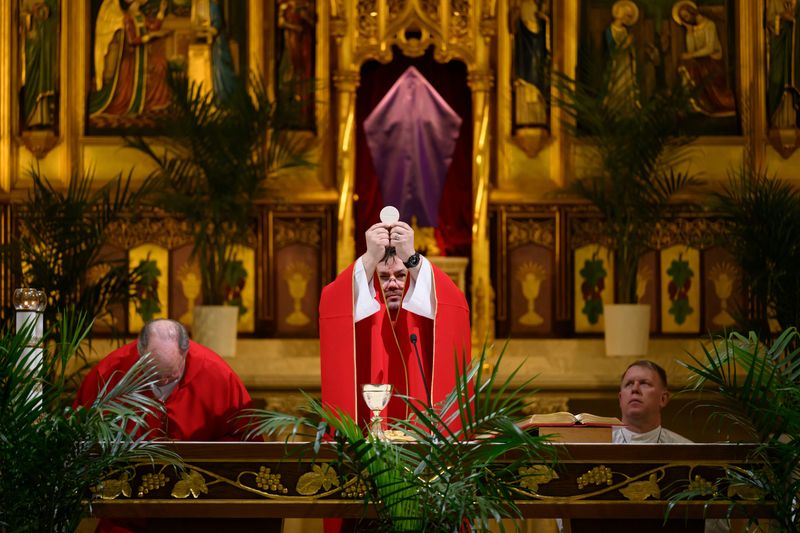
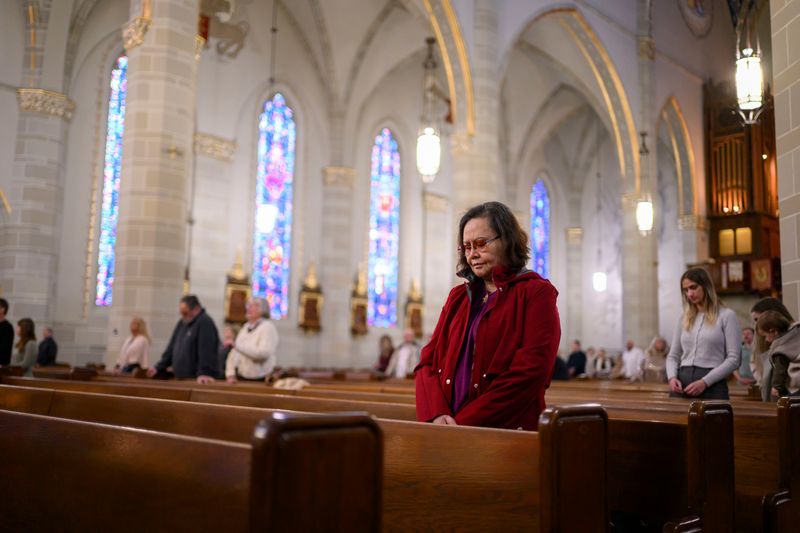
Hamtramck — St. Florian Catholic Church rises above Poland Street in Hamtramck, its stained-glass rose window sparkling, a monument of the two-square-mile city’s past as an enclave of mostly Polish immigrants.
The modified English Gothic church that stretches 190 feet in height to the top of its steeple can seat about 1,800 people, built during a period when Hamtramck was the fastest-growing city in the U.S.

But Hamtramck’s demographics have shifted to make it a Muslim-majority community, and the Polish population has shrunk. Along with it, St. Florian’s weekend mass attendance has dwindled to 150 people coming for the English masses and 200 attending the Polish masses, according to the parish priest.
St. Florian parishioners are hoping this Easter season, when Christians celebrate the resurrection of Jesus Christ from the dead, that more people will start attending mass at the church as they worry about its future. Some travel from the suburbs to attend the church, while others live in Hamtramck, including Evelyn Kasperek.
“It’s tough to see such a beautiful place pretty empty,” said Kasperek, 25. “I don’t know what to expect. … It is hard to see the community shrink a little bit, at least for people who are still coming. I know not a lot of people my age do.”
The parishioners’ reflections come as the Archdiocese of Detroit pursues a restructuring. Archbishop Edward Weisenburger announced last November that the archdiocese cannot maintain its around 200 parish buildings and is working to “right-size and reallocate personal and financial resources.”
The Rev. Mario Amore, the executive director of the archdiocese’s Department of Parish Renewal, said every parish in the archdiocese will host two listening sessions as part of this process. The sessions are scheduled to begin this month and will continue through June.
Amore said no decisions have been made about St. Florian or any parish or church in the archdiocese.
“A central principle of this restructuring process is that there are no predetermined outcomes and no list of closures,” he said. “Decisions will emerge locally, shaped by the input gathered during the listening sessions and subsequent discernment within each parish community.”
The Rev. Ryszard Czerniak, a priest in solidum at St. Florian, said he is waiting for the archdiocese’s decision.
“I just can guess that this church still will be open,” Czerniak said.
This Saturday, which is Holy Saturday, priests at St. Florian will bless parishioners’ Easter baskets, which is a Polish tradition. The baskets hold a sampling of Easter foods, such as meat, eggs and bread, according to the Irish Catholic Bishops’ Conference. St. Florian parishioners will also attend Easter Mass over the weekend.
St. Florian’s attendance shifts with changes in demographics
Hamtramck’s Polish population accounted for about 8% of the city’s about 27,000 residents in 2022, according to the Motor Cities Heritage Area.
The Archdiocese of Detroit established Hamtramck’s parish in 1907, recognizing a trend of Detroit’s Polish population moving north, said Cindy Cervanek, a lifelong parishioner of St. Florian who serves on the board of the Hamtramck Historical Museum. The population of Hamtramck — then still a village — exploded a few years later, after the Dodge Main factory opened in 1910. The city had about 3,500 people just before the factory came to town, and the population climbed to 56,000 at its peak.
Cervanek said the community of factory workers saved money, mortgaged their homes, held penny drives and did manual labor on the construction when they could to have enough money to hire one of the most distinguished architects in the U.S. at the time. Known for his Gothic Revival designs, Ralph Adams Cram was hired to design the church. St. Florian was built for $500,000, Cervanek said.
“They just sacrificed. The church was important to them,” Cervanek said. “It’s sort of reminiscent of churches in Poland, and it was not just a church to them. It became the social center of their lives.”
The slow exodus of population from Hamtramck to the suburbs started around the 1950s, she said, when growing families could afford to buy cars and bigger homes.
But the Polish presence was still significant enough that Pope John Paul II, who was Polish, visited Hamtramck and gave a speech there in September 1987 as part of a two-day swing through the Detroit area, the last leg on a nine-city U.S. tour.
Historic church draws parishioners from ‘miles’ away, priest says
Czerniak, the priest, said he was transferred to the parish last August. He is a member of the Society of Christ, a religious order that provides pastoral care to Polish people around the world, according to the St. Florian’s website. Czerniak’s last post was in Baltimore.
He said his parishioners live in Hamtramck or they travel “miles” to come to the church for Mass on Saturday or Sunday. Some drive around 30 minutes to reach the church.
Czerniak said some parishioners remember when Hamtramck had a much larger Polish population.
“Father, in 1960s, you know, it was a Polish city here in Hamtramck,” he said, recalling what people have told him.
He said that in the 20th century, Polish people came to the U.S. to “find new life.” He noted that Europe and Poland have changed, and young people prefer to stay in Poland or find work in Germany or France. All three countries are in the European Union.
Czerniak said if people are traveling miles to come to St. Florian instead of going to a church in their own town, it means “something brings them” there.
“It means the St. Florian is in some way very important for them,” he said. “I don’t know why ― because the church is beautiful, because they connect this church with their time when they were, for example, youth or young people.”
Parishioners reflect on St. Florian’s future amid restructuring talks
Kasperek, who lives within walking and biking distance from St. Florian, grew up performing Polish folk dance for the Catholic community in southeast Michigan. She said her faith is something she has always “found peace in.”
“It’s kind of difficult seeing that different places are struggling to keep it afloat,” Kasperek said of the churches.
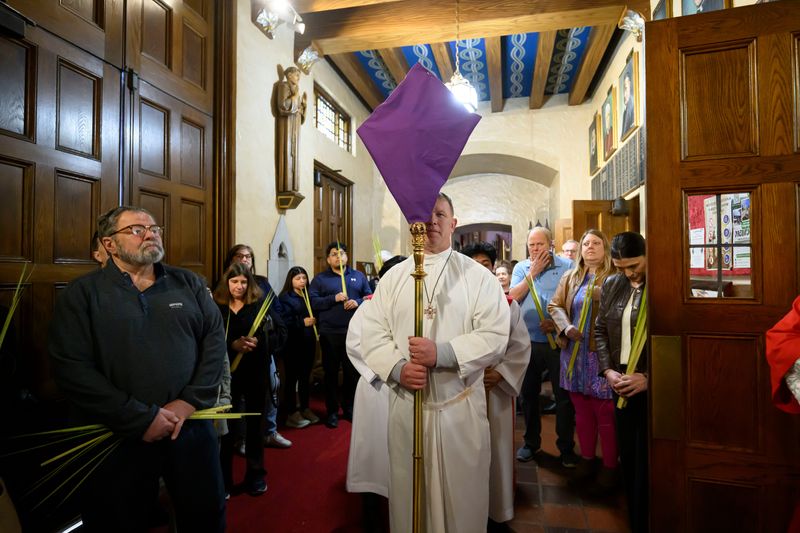
Beverley and Craig Stankiewicz were married at the Hamtramck church in 2011, and both of their daughters ― Natalia, 12, and Nadia, 7 ― have been baptized at the church. The girls served at the altar on Palm Sunday.
“My second daughter is getting her first communion in the middle of May,” said Beverely Stankiewicz, 47. “Because of my husband’s Polish heritage, he used to come here with his grandparents and his parents growing up. It’s important to him and the Polish heritage to come here, so that’s why we drive here every Sunday.”
“We hope that our children have the opportunity to get married here as a possibility when they’re older. … We’re just hoping it stays open,” she said.
The family drives from Chesterfield Township in Macomb County to attend mass and serve the church. They’re hoping to see more Catholics do the same. Since the COVID-19 pandemic, many attendees have dropped off, she said.
“Everyone’s getting older. I think that’s a lot of it: the elderly population and then people moving north,” Stankiewicz said.
The weekend mass count at St. Florian decreased from 792 in 2016 to 344 in 2024, according to the Archdiocesan Restructuring Workbook for St. Florian Parish.
But St. Florian is still vibrant on holidays like Easter and Christmas, and holds its annual Strawberry Festival each May and a soup festival in the autumn, when the church basement is crowded with people. Parishioners who have moved to the suburbs attend Polish-language masses, especially those who arrived in Hamtramck during another wave of Polish immigration in the 1980s, Cervanek said.
Archdiocese outlines how restructuring decisions will be made
The fate of St. Florian and other Metro Detroit Catholic churches will be decided by the archdiocese’s restructuring. The archdiocese’s Amore said in a written response that the archdiocese’s priests convened to develop draft models for future “pastorates,” or groupings of one or more parishes led by a pastor. These draft models were then shared with key parish leaders to gather initial input and feedback.
The models will now be presented to parishioners at large starting this month for their feedback and for “the proposal of alternative models where appropriate,” Amore said. More than 400 listening sessions will be held across southeast Michigan, he said.
“This is a key moment for parishioners to share their perspectives and help shape the future of their local communities,” Amore said.
He encouraged all Catholics to attend the listening sessions and said that registration and more information are available at restructuring.aod.org.
The archdiocese recognizes that parishes like St. Florian carry “deep historical, cultural, and spiritual significance,” both for their local communities and for the wider church, he said.
“That history is an important part of the discernment process,” Amore said. “As communities reflect on the future, those factors will be carefully considered alongside pastoral needs, parish vitality, and long-term sustainability.”
Weisenburger is scheduled to announce the new “pastorates” in the first half of 2027. The new pastorates and priest assignments will take place from July 2027 to July 2028, according to the restructuring website.
Fraser resident Lawrence D’Agostino, a parishioner of St. Pio of Pietrelcina Parish in Roseville for over 50 years, said the restructuring is a “concern for everybody.”
“Everybody’s hoping, ‘Well, I hope my parish stays open,’ and so on, so forth,” D’Agostino said.
On Easter, D’Agostino said he thinks about what Jesus Christ went through for people’s sins.
“He sacrificed His life for our sins,” he said. “And I think that when we look at it that way, we really need to keep our eyes open and not think about material things or money-wise and what is better for me …”
asnabes@detroitnews.com
mjohnson@detroitnews.com
jcardi@detroitnews.com
This article originally appeared on The Detroit News: Easter brings hope for historic church amid Detroit archdiocese shake-up
Reporting by Anne Snabes, Myesha Johnson and Julia Cardi, The Detroit News / The Detroit News
USA TODAY Network via Reuters Connect