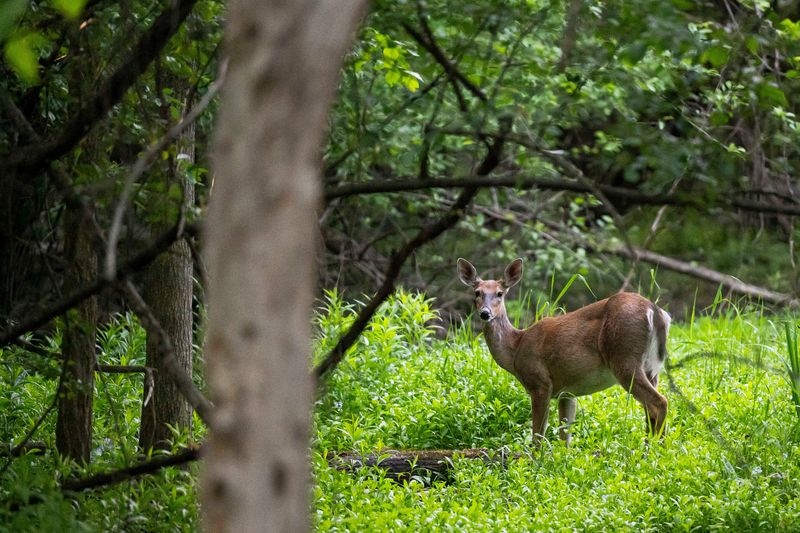
Southeast Michigan’s first regional deer cull resulted in dozens of deer being removed from three cities in Metro Detroit and recommendations to manage the population going forward.
Hunting efforts organized by the U.S. Department of Agriculture across Farmington, Farmington Hills and Southfield resulted in 70 white-tailed deer removed from the three cities. The deer were hunted primarily on city-owned properties at night to ensure safety, according to a Monday news release from the three cities.

The three cities are part of the Southeast Michigan Urban Deer Coalition, a collective of communities and organizations across a seven-county region that aims to manage deer populations while ensuring residential and wildlife safety, according to the news release.
The deer cull “follows several years of data collection, research and planning,” including studies from the University of Michigan School for Environment and Sustainability, the cities said.
Farmington Hills and Southfield used USDA sharpshooters to conduct the culls. Farmington used the adjacent Farmington Hills’ services to conduct its part of the effort.
The culls were projected to cost each community an estimated $10,000 to $20,000, according to local officials.
Prior to the cull, the USDA surveyed several sites within the cities to determine where the deer hunting would be “effective and safe.” The locations were closed to the public and had a documented high deer population, city officials said.
“This regional approach reflects the reality that deer move freely across municipal boundaries,” the Southeast Michigan Urban Deer Coalition said. “By coordinating efforts, the coalition aims to reduce deer-vehicle collisions, improve public safety and address ecological impacts across the broader area.”
The 70 deer removed from the cities resulted in 2,312 pounds of venison donated to local food banks and more than 9,240 meals provided to communities, the release states.
To manage the deer population going forward, the cities are recommended to expand access to private land parcels, consider management tools like urban archery, strengthen enforcement of deer-feeding bans and continuing community education and outreach, according to a report produced from the cull.
The news release noted additional communities are expected to participate in “future phases of long-term strategy” to reduce the deer population in the region but did not specify which communities they were.
Farmington Hills’ decision in 2025 to go forward with the cull was met with resident backlash; some said the city should explore nonlethal options such as sterilization.
City officials and the Michigan Department of Natural Resources argued that deer overpopulation can lead to car wrecks, invasive plant growth and landscape damage.
“We recognize that residents have a range of perspectives on deer management,” the cities said in a Monday joint statement. “This first-year effort represents one part of a long-term, data-driven strategy to reduce collisions, protect natural areas and respond to ongoing community concerns.”
mbryan@detroitnews.com
This article originally appeared on The Detroit News: Cull removes dozens of deer across 3 Oakland County cities, USDA says
Reporting by Max Bryan, The Detroit News / The Detroit News
USA TODAY Network via Reuters Connect