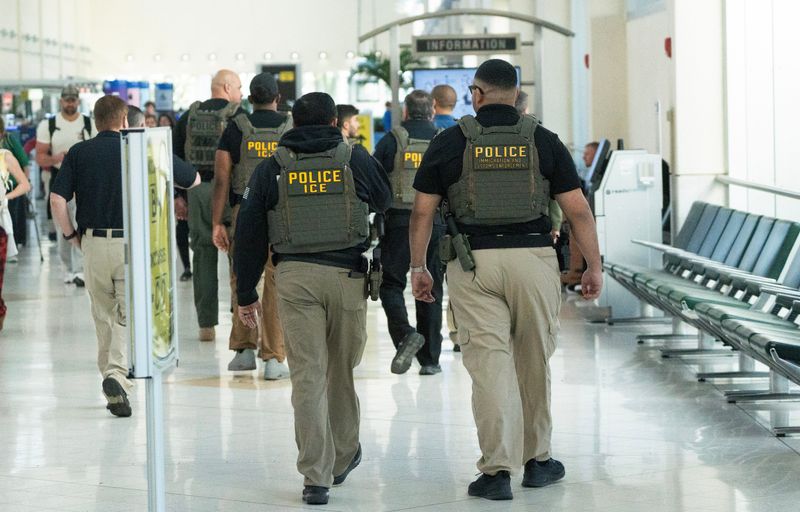
Immigration and Customs Enforcement (ICE) officers have been deployed to airports across the country, including Southwest Florida International Airport (RSW) in Fort Myers, aiming to alleviate long security lines amid a partial government shutdown.
Transportation Security Administration (TSA) worker absences reached their highest levels over the weekend since the shutdown began in mid-February, and the White House said March 22 that more than 400 officers had quit. ICE was sent to more than a dozen airports, including major travel hubs like New York’s John F. Kennedy International Airport and Hartsfield-Jackson Atlanta International Airport, CNN reported.

ICE agents were first seen inside the RSW terminal in Fort Myers on Monday (March 23). It is believed RSW is the only Florida airport with ICE officers.
Lauren Bis, the Department of Homeland Security’s acting assistant secretary for public affairs, declined to confirm to USA TODAY where ICE agents had been deployed, citing “operational security reasons.”
Some people have raised concerns about ICE officers’ qualifications, however. TSA officers – who have been going without regular pay – receive specialized training, and their duties differ significantly from those of ICE employees. Here’s what it would take for ICE officers to perform TSA duties.
On Wednesday (March 25) at RSW, ICE officers could been seen stationed at TSA security checkpoints near Concourse D helping travelers put items in the bins and moving the bins along to the machines used to scan all carry on items.
What does it take to become a TSA officer?
TSOs, or transportation security officers, who operate screening equipment to scan for dangerous objects, carry out searches and control terminal entry points and exits, among other duties, undergo in-depth training.
“What I want people to truly understand is that it takes a long time to become a TSA officer,” Caleb Harmon-Marshall, founder of the Gate Access newsletter and who worked as a TSO for eight years, told USA TODAY.
He estimated it took him five to six months to become certified, which included training at a facility near Miami International Airport and on-the-job training with an experienced TSO. “So you work with them for a few weeks, and then you take several extensive tests to make sure you are certified on every single function,” he said, from the X-ray machine to pat-downs.
Acting TSA Administrator Ha Nguyen McNeill said at a House Committee on Homeland Security hearing March 25 that training for TSOs takes four to six months.
Harmon-Marshall, who spent most of his TSA career at Atlanta’s international airport, noted that “aviation security is completely different than what ICE does.”
“TSA officers are specifically looking for prohibited items,” he said. “They’re looking for knives, guns, bullets, anything that could cause harm, and that takes a skilled eye.” Harmon-Marshall said he became so proficient in X-rays that he could tell the difference between MacBook and HP laptops.
ICE recruits undergo their own preparations, including “56 days of training and an average of 28 days of on-the-job training,” according to a DHS news release in February.
“Just as a 10,000-foot view, one is trained in law enforcement, and the other is not, and then one has a firearm and one does not,” said Cathy Creighton, director of the Cornell University School of Industrial and Labor Relations Buffalo Co-Lab. “So, those are quite different kinds of training.”
The culture of ICE is also “very aggressive,” Creighton said. “And that’s not what a regular civilian going to the airport for business or leisure travel is expecting to encounter.”
Checkpoint personnel must also be integrated into airport security operations, which involves secure airport badging and coordination with airport police and airlines, among other considerations.
DHS’ Bis told USA TODAY in a separate statement that TSA is “extremely grateful” to the ICE officers at airports, adding that “the more support we have available, the more efficiently TSA can focus on their highly specialized screening roles to efficiently get airport security lines moving faster.”
What would have to change for ICE to perform TSA functions?
Passenger and baggage screening at U.S. airports is governed by Title 49 of the U.S. Code, which requires that screening be carried out by federal employees and overseen by the TSA.
If policymakers want ICE agents to help TSA with screening, Congress probably would need to amend the federal statute governing aviation screening to allow another agency to operate checkpoints. Without that change, TSA would remain the legally responsible agency for the screening mission.
What is ICE doing at airports?
Acting Deputy TSA Administrator Adam Stahl said ICE agents would be “conducting nonspecialized security support, manning the exit lanes, crowd management, line control” in an interview on March 23 with Fox News. He also expressed gratitude for efforts to ease the challenges faced by TSA officers and travelers.
White House border czar Tom Homan echoed that in a March 22 appearance on CNN’s “State of the Union.”
“I don’t see an ICE agent looking at an X-ray machine, because they’re not trained in that, but there are certain parts of security that TSA’s doing, and we can move them off those jobs and put them in the specialized jobs and help move those lines,” he said.
The union that represents TSA officers wants to make it clear, though, that they are not being replaced.
“ICE agents are not trained or certified in aviation security,” American Federation of Government Employees National President Everett Kelley said in a statement to USA TODAY. “TSA officers spend months learning to detect explosives, weapons, and threats specifically designed to evade detection at checkpoints – skills that require specialized instruction, hands-on practice, and ongoing recertification. You cannot improvise that. Putting untrained personnel at security checkpoints does not fill a gap. It creates one.”
Early reports from some travelers indicated ICE’s presence wasn’t doing much to improve conditions – and for some employees, it could be more disruptive than helpful.
“The employees that actually work at the airport, they’re afraid of coming to work because they were afraid that their immigration status would cause them to be detained or removed from the airport,” Johnny Jones, secretary and treasurer of the Association of Federal Government Employees local 1040 representing TSA workers in the Dallas-Fort Worth area, said in a news briefing March 24. “A couple of restaurants did not actually open at the airport because they had no workers show up.”
Though Harmon-Marshall doesn’t expect ICE’s presence to pose a risk to aviation security, it could have other consequences: “What I do think their presence is going to do is intimidate the traveling public.”
This story has been updated to add new information.
Contributing: Eve Chen and Zach Wichter
Contributing: Mark H. Bickel, The News-Press/Naples Daily News part of the USA TODAY Network-Florida
Nathan Diller is a consumer travel reporter for USA TODAY based in Nashville. You can reach him at ndiller@usatoday.com.
This article originally appeared on Fort Myers News-Press: Carrying a firearm one big difference between ICE, TSA officers
Reporting by Nathan Diller, Fort Myers News-Press & Naples Daily News / Fort Myers News-Press
USA TODAY Network via Reuters Connect