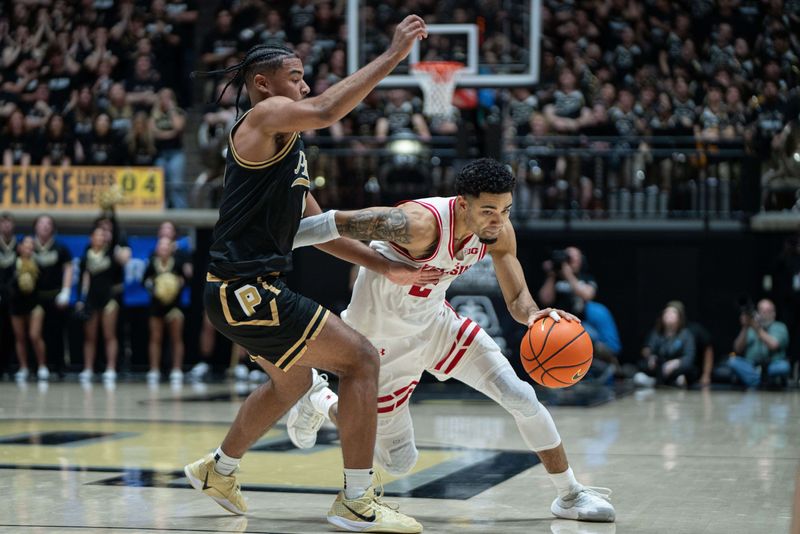
SAN JOSE, CA — As the roars of a second-round NCAA Tournament crowd echoed down the hall, Purdue basketball’s C.J. Cox put his right knee through a battery of tests.
He ran wind sprints, to ensure had the speed necessary to keep up with Miami’s guards. He tried lateral agility drills, to confirm he could plant and cut with confidence and close off the driving lanes the Hurricanes so effectively used in the first half.

The March Madness viewing audience likely focused on Cox’s offense that day, from the three 3s he hit in the final two minutes of the first half to the layup attempt on which he was injured three minutes after halftime.
Cox, though, needed to make sure that knee he hurt – he later called it “like a hyperextension” – would hold up on the other end of the floor.
Purdue can always use Cox’s opportune perimeter shooting and steady ball handling. It absolutely needs his defense. Braden Smith, whose practice battles over the past two seasons helped Cox mature into the defender he is today, called him “the best defender in the Big Ten.”
Buy this Purdue Big Ten title page print!
Cox did not make the Big Ten All-Defensive Team, but he’s probably headed there in coming seasons. He also did not return to that Miami game, he and Purdue content to rest the knee while finishing off a 79-69 victory.
Cox left that game believing the knee will be good enough for him to do his job Thursday against Texas in the Sweet 16. He won’t know for sure until Purdue’s first real practice Wednesday in San Jose.
His teammates already have full trust in him.
“He’s proven he can do it,” Fletcher Loyer said. “Right away when him and Gicarri (Harris) got here as freshmen, they picked me and Braden up full court. They made it hard for us to get to our spots. When you’ve got young guys who go in and do that without having to tell them to do it, it just shows how hungry they are and they’ve got a chip on their shoulder.”
How C.J. Cox, cornerback became Purdue basketball’s lock-down defender
Cox is introduced before every game as hailing from Lexington, Massachusetts. That’s where he was raised, and with two parents raised in inner-city Boston, those origins manifest in the blue-collar identity he brings to the court.
This week, though, Cox returned to the state of his birth. He and his sister, Alex, were born in Los Angeles. The family moved when Cox was only 2 years old.
When the Boilermakers played at USC and UCLA earlier this season, his father drove him to the place he first lived, a place of which he had no memory.
Cecil Cox and his late wife, Lisa, knew they were raising one athlete. Alex went on to become a track and field athlete at Elon. C.J. took a long time to develop the body to go along with his talent and competitiveness.
Dad was grooming C.J. to become a slot receiver and defensive back. It had worked out well for him, an All-Ivy League DB and member of Harvard’s Athletic Hall of Fame. Cox showed up for high school around 5 foot 7, 110 pounds, and was still on his way to that modest frame in middle school.
Cecil, though, thought he had a natural cornerback on his hands.
“His technique was all about press coverage – being right up in the receiver’s grill, getting hands on them, leveraging where you want them to go,” Cecil Cox said. “Locking in on the hip, watching the eyes.
“Some of that was transferrable. He’s stil a little too handsy when it comes to reaching. He doesn’t get called for fouls, because that’s what we love about the Big Ten. They embrace the physicality, so he can be physical with guys.”
Cox’s dad said he was even better in baseball, playing shortstop and center field and pitching. When bigger kids on the opposing team stood at the plate with the latest in rocket-launching alumni bat technology, Cox manned short with his feet on the grass, unafraid to take hard shots off his chest.
By the end of middle school, though, Cox chose his own direction. When the threat of football injuries possibly costing him time away from basketball, he left the gridiron for good. When baseball started interfering with offseason basketball, he put his glove away, too.
Well before he hit that growth spurt, his defensive intensity stomped on egos both in games and in practice.
Michael Crotty, his coach in the Middlesex Magic program, told IndyStar last year Cox would take the ball from opponents mid-dribble multiple times a game. In practice, teammates would give the ball up rather than go head-to-head with his full-court aggression.
“I would always pick them up full court, just pressuring them a bunch,” Cox said of being a workout nuisance. “It helps them get better and it also helps me get better when going into the game. That’s the reason our team was successful, because we were all pushing each other to be better.”
Cox credits his defensive acumen to his father, who emphasized it from a young age while coaching his teams. He remembers a lot of individual drills – shuffling his feet, moving side-to-side, maintaining an open stance – and team drills focusing on not yielding the middle and holding leverage.
Those lessons are paying off more than ever these days.
Purdue trusts Cox to lead the night’s toughest defensive assignment
Cox does not claim these priority defensive matchups all to himself. Gicarri Harris subs in for him in the first half and plays 18 or so minutes a night – usually not sharing the floor with Cox. With how much the Boilermakers switch, every guard might end up with a piece of those big matchups.
Cox, though, is always first through the door, for a reason. He has enough physical strength and quickness to take on a variety of assignments. More than anything, he’s reliable.
“He does his job,” said Paul Lusk, who in conjunction with fellow assistant coach Terry Johnson coordinates the defense. “There’s very few times with the scouting report or we do postgame film breakdown that the coaches are walking in there saying, ‘Man, C.J. didn’t do his job.’”
Each of Purdue’s four Big Ten Tournament wins included Cox in a crucial assignment. Someone needed to match up with 6-7 Northwestern forward Nick Martinelli, whose shooting range made him a tough matchup for big men. Cox has never backed down from those challenges.
“Really, he’s always self-identified as a 4,” Cecil Cox said.
One night later, Cox chased Nebraska’s Pryce Sandfort off ball screens, trying to contain one of the league’s best scorers. In the semifinals he took on a true point guard in UCLA’s Donovan Dent, someone whose dual abilities to explode downhill and facilitate for others had hurt the Boilers on that trip back home to L.A.
Then in the championship, Cox took another shot at Big Ten Player of the Year Yaxel Lendeborg of Michigan. No Purdue players naturally match up with his package – the functional height of a forward at 6-9 but the skill set of a guard. Lendeborg acts as a point forward, and his seven assists at Mackey Arena earlier in the season helped the Wolverines to an emphatic win.
He scored 20 on 14 field goal attempts in the Big Ten Tournament championship game, but with fewer assists (one) than turnovers (two).
Another Michigan matchup of sorts came into play in last week’s Round of 32 in St. Louis. Cox helped defend lead guard Tre Donaldson three times last season when he played for the Wolverines.
Cox played only the first three minutes of the second half before yielding to Harris. But Donaldson needed 15 shots to score his 15 points and managed only three assists.
Every opponent knows Cox will front the defensive strategy to stop their best perimeter player. With that reputation comes an opponent’s alpha eager to show he won’t bend to Purdue’s best man.
That’s an adjustment plenty of premier defenders under Painter have made before – Kenny Lowe, Chris Kramer, Rapheal Davis.
Cox is also still trending up defensively. For one, coach Matt Painter pointed out earlier this season, Cox sometimes locks in on an assignment so completely he’s slow to make his switches. For another, he might be the most soft-spoken player on a team of guys with unassuming personalities.
On defense, voices are weapons. They are essential to playing connected team defense across five positions.
“He’s such a quiet kid, but continuing to grow and have a voice out there,” Lusk said. “He’s so locked into his matchup, and that’s the one thing we’ve talked to him about. He’ll continue to grow in that area.”
Cox’s hearing, though, is just fine. He heard that “best in the Big Ten” comment from Smith last week. It was a big boost of confidence — and a challenge he endeavors to keep meeting this season.
Nathan Baird and Sam King have the best Purdue sports coverage, and sign up for IndyStar’s Boilermakers newsletter.
This article originally appeared on Indianapolis Star: How football upbringing helped Purdue basketball guard become ‘best defender in the Big Ten’
Reporting by Nathan Baird, Indianapolis Star / Indianapolis Star
USA TODAY Network via Reuters Connect