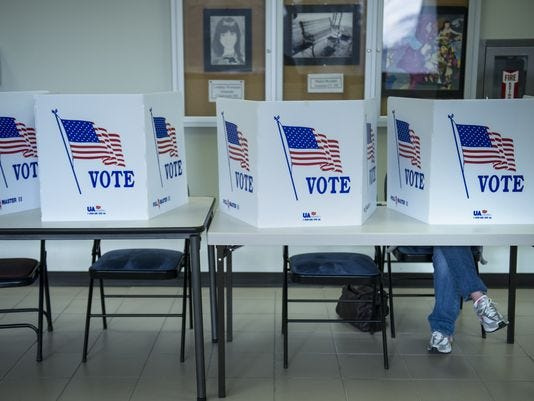
For years, Michigan Democrats have argued that expanding early voting is essential to protecting democracy. At this very moment, however, a situation unfolding in a state Senate special election suggests that principle may have limits — especially when expanding voting access might aid Republicans in tying the Great Lakes State’s upper chamber.
Currently, Democrats hold the Michigan Senate by just one seat, 19-18, making the contest especially consequential. The 35th district includes Saginaw, Bay and Midland counties — three communities that together represent a classic Midwestern political mix. Saginaw tends to vote Democratic, Midland leans Republican and Bay often splits the difference.

Yet a consequential dispute over early voting exposes an uncomfortable reality: Michigan Democrats appear willing to disregard a level playing field when doing so benefits the homegrown Republican candidate and local prosecutor, Jason Tunney. Saginaw County plans to offer early in-person voting for the special election. Bay and Midland counties — both more Republican-leaning — have declined to do so, citing financial constraints tied to the unexpected cost of running a special election.
Local officials have asked the state for additional funding so all counties can provide the same early-voting opportunities. So far, that funding has not materialized, despite the earnest effort of one Midland Republican, Rep. Bill G. Schuette, who recently submitted a legislatively directed appropriations request to fund early in-person voting in all three counties.
The result is a patchwork system where voters in one county may have more opportunities to vote early than those mere miles away.
If Democrats truly believe early voting is essential to democracy, they should support expanding it everywhere — even if doing so could benefit voters in Republican-leaning areas.
Instead, the current situation raises an important question: is early voting a principle, or merely a political strategy? A calling cry from Democrats in Michigan for a decade has been the paramount need to expand voting methods — mail ballots, automatic registration and longer early-voting periods — arguing these measures make elections more accessible.
But accessibility should never depend on partisan, political calculations as we are witnessing in real-time by Gov. Gretchen Whitmer and Michigan Democrats. In the 35th district, early voting in Saginaw is likely to provide Democrats with a turnout boost in their strongest county. Meanwhile, voters in Midland and Bay would have fewer options to cast ballots early. When one party’s strongest base enjoys expanded voting access while the other’s does not, fairness becomes harder to defend.
To be clear, local officials in Bay and Midland are not opposing early voting out of principle. The issue at hand is cost. Special elections require staffing polling places, securing equipment and paying election workers — expenses that can strain county budgets.
That is precisely why Lansing’s legislative leaders should step in, expeditiously.
Michigan’s elections should not depend on whether individual counties can afford the full range of voting options. If early voting is a priority for Michigan — and Democrats have certainly said it is — then the state should fund it consistently across every county carrying out a special election.
Otherwise, the electoral playing field runs the risk of becoming selective. To that end, voters in Midland and Bay deserve the same opportunities as voters in Saginaw. Anything less undermines confidence in the electoral process.
This issue is bigger than one special election; notably, Michigan is at the center of the political universe given the historic statewide slate of open seat races for governor, U.S. Senate, attorney general and secretary of state. Not to mention, the entire Legislature is up for election this November as well.
Michigan’s state government can easily resolve the issue by providing supplemental funding so every county in the district can offer early voting if they choose. Doing so would eliminate accusations of political favoritism and ensure voters across the district are treated equally.
Nationwide, Democratic Party leaders, operatives and activists often proclaim that democracy works best when more people participate in the voting process. If that belief is sincere, then early voting should be made available to every eligible voter in the district — not just the ones who are fortunate enough to reside in the right county.
Greg Manz is GOP consultant at Direct Edge Campaigns and a graduate of the University of Pennsylvania’s Fels Institute of Government.
This article originally appeared on The Detroit News: Manz: Is early voting a principle or strategy for Michigan Democrats?
Reporting by Greg Manz / The Detroit News
USA TODAY Network via Reuters Connect