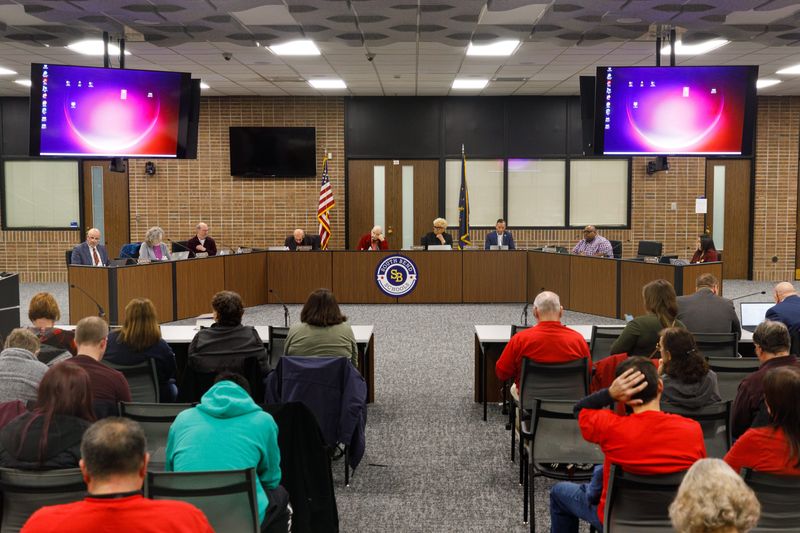
SOUTH BEND — The Indiana State Board of Accounts has released reports from a recent audit of the South Bend Community School Corp., in which auditors identify a “systemic issue” of a lack of internal control within SBCSC during the audit period.

The reports, which cover July 1, 2022, to June 30, 2023, focus on the district’s federal compliance and financial statements.
Auditors said the problems reported stemmed from the need for more internal control within SBCSC. But in the report, district officials said several of the problems noted in the audit — including internal control — have been resolved in the years since, while others are being actively addressed.
On Thursday morning, The Tribune reached out to SBCSC to request an interview about the reports and findings, but district spokesperson Blair Yankey said SBCSC’s Chief Financial Officer Ahnaf Tahmid was out of the office.
“In addition, the audit report is not yet fully published, as there are still portions pending release,” Yankey said in an email. “Given that, we’d prefer to connect once the full report is available so we can provide the most complete and accurate information.”
Yankey added that he believes the remaining portions are still pending finalization from the State Board of Accounts and are expected to be released in the coming days.
Financial statement audit
The financial statement audit “comprises the financial position and results of operations as of and for the year ended June 30, 2023,” the report says.
During the audit period, SBCSC’s receipts totaled $353.1 million, while its disbursements totaled $342.8 million. The report says the district’s ending cash and investment balance was $89.4 million, compared to $67.4 million at the beginning of the audit period.
Over the audit period, SBCSC’s Education Fund went from a beginning balance of $23 million to $29.3 million, according to the report. The Operations Fund went from $10.7 million to $20.9 million, while the Referendum Fund dropped from $11.7 million to $9.5 million over the audit period.
SBCSC had a total of $745.7 million in capital assets during the audit period, and had an ending principal balance of $38.3 million on its governmental loans and bonds.
The report notes several balance deficits because of timing or structure. These include Reimbursable Grant Funds, the result of timing differences between disbursements and the receipt of reimbursements.
It also mentions the Zone School Fund, which opened the year with a deficit balance, and “disbursements continued to outpace state tuition transfers” throughout the year.” The Empowerment Zone closed at the end of the 2023-24 school year, the report says, and SBCSC “is currently addressing the deficit balance by allocating the cost to the Education fund, with plans to allocate the expense over multiple years.” According to the report, SBCSC transferred $13.4 million to the Zone during the audit period.
SBCSC had $13.5 million in lease payments during the audit period, and the district’s building corporation issued $36 million in bonds for costs associated with the 2020 School Building Basic Renewal, Restoration and Safety Project.
“This includes demolition of several outdated facilities including Eggleston Elementary School, Old Marquette School, Greene Intermediate Center, and portion of the Brown Intermediate Center, urgent repairs at Clay High School, and targeted renovations across multiple campuses to enhance educational programming and student safety,” the report says.
And, since June 30, 2023, the report says, expenditures on the Brown Administration Center renovation project totaled $5.6 million.
Federal compliance audit
The federal compliance audit makes it clear that it focuses solely on testing SBCSC’s internal control and compliance. It does not provide an opinion on the effectiveness of the district’s internal control.
The report says, however, the audit did identify “certain deficiencies in internal control … that we consider to be material weaknesses.” The report defines a material weakness as a deficiency in internal control that presents a reasonable possibility that a mistake in the district’s financial statements would be prevented or detected and corrected on a timely basis.
SBCSC received two major types of audit opinions: a financial statement opinion and a federal programs opinion.
Financial statement
The audit found material weakness in the financial statement, but no significant deficiencies were reported.
Primarily, the report said, the issue stemmed from the fact that SBCSC “had not implemented an effective framework of internal controls to ensure the separation of incompatible duties in the areas noted below. As a result, weaknesses in the internal control environment allowed instances of noncompliance to occur and remain undetected during the audit period.”
The report noted several deficiencies, including:
Federal programs
The audit identified material weakness in the federal programs, but no significant deficiencies were reported.
As with the financial statement opinion, the auditors pointed to SBCSC’s lack of effective internal controls as a leading cause of the issues. The report said the district was unable to provide documentation that federal award information entered into Indiana Gateway was formally reviewed and approved before submission.
Auditors said this led to several “significant errors,” including:
The report said inaccurate reporting raised the risk of noncompliance with federal requirements and compromised the reliability of the Schedule of Expenditures of Federal Awards.
“These deficiencies also heightened the risk of delayed federal reimbursements, potential loss of future funding, and reduced transparency,” the report said. “Ultimately, such errors can diminish overall confidence in the School Corporation’s financial management.”
Title I
The six audits conducted on SBCSC’s Title I program found material weakness, once again due in large part to its lack of internal control and segregation of duties, the report said.
In the allowable costs/cost principles audit, SBCSC couldn’t provide contracts of approved payroll rates for six out of 24 employees tested, the report said. As a result, the audit couldn’t verify that the employees were paid the correct rates for hours worked, leading to known questioned costs of over $149,000.
SBCSC is also required to earmark part of its Title I allocation for homeless students, the report said, but the district did not have a formal process to track, monitor and ensure timely use of the money.
The report adds that to remove students from a graduation cohort, SBCSC has to confirm the reason for removal in writing and retain required documentation for each removal type. However, out of 27 students the audit tested, 10 had documentation that didn’t meet state requirements. Nine students did not have documentation at all, the report says.
COVID-19 — Education Stabilization Fund
The Education Stabilization Fund provided money “for the purpose of preventing, preparing for, or responding to the novel coronavirus,” the report said.
However, because of a lack of internal control, the audit found material weakness in payroll costs, vendor expenditures, reports and reimbursement requests relating to grant funds.
For example, SBSC was unable to provide supporting documentation for three vendors the audit tested, including Mamas Against Violence, LTIA and Kingdom Life. The audit also found no evidence that the associated memorandums of understanding were approved by the school board, and auditors did not find itemized vendor invoices or documentation verifying student participation or metrics.
In 10 additional payroll transactions tests, the report says, three employee pay rates could not be verified, resulting in known questioned costs of $38,400.
The report also notes several errors in Elementary and Secondary School Emergency Relief (ESSER) Fund reports SBCSC made to the Indiana Department of Education:
And of eight reimbursement requests, six forms tested weren’t supported by SBCSC’s records. These included the following errors:
SBCSC responses
In documents provided by SBCSC officials, as included in the report, the district acknowledges the findings and outlines changes that have been made or are in the process of being implemented.
For example, officials say, the district has compiled and shared a new internal controls manual that was finished in December 2024. The manual details how to handle and verify deposits/receipts, make purchases, payroll, process payments and other activities, the district says, and updates are shared every six months.
SBCSC also pointed to changes in how the district processes reimbursement requests and reviews and approves records with better documentation.
Overall, the district says, it has and is implementing more oversight and review in its processes to ensure policies are followed and errors are prevented, caught and fixed.
SBCSC board trustee Mark Costello told The Tribune that he was “disappointed” that the public reports did not include any names of responsible individuals. The reports made available to trustees, he said, did include names.
Costello declined to comment on specifics in the reports, saying he plans to address them during his closing remarks in Monday’s board meeting, but he did say the lack of documentation to back up expenditures is concerning.
“When it comes to public funds, we should always be able to say we’re spending them for kids or for teachers or for the educational purposes,” he said. “And some of these expenditures, the auditors were not able to find that.”
Costello said the reports are “not normal” in terms of the amount of time and work put into the audit.
“They never generally go in and be as critical in some areas that they were,” he said of the auditors. “… This, by far, goes way beyond. And the length of it, the time spent on it, you know something was wrong.”
Costello added that the problems outlined in the 2022-23 audit don’t “even come close” to findings from the 2023-24 audit, which is currently underway. He said that audit has uncovered problems in how COVID money was spent.
But as far as the 2022-23 audit, Costello said, the report being released isn’t the end.
“The investigation into some of these areas is just beginning from a legal standpoint,” he said.
Email South Bend Tribune education reporter Rayleigh Deaton at rdeaton@usatodayco.com.
This article originally appeared on South Bend Tribune: ’23 state audit finds lack of internal control in South Bend schools
Reporting by Rayleigh Deaton, South Bend Tribune / South Bend Tribune
USA TODAY Network via Reuters Connect