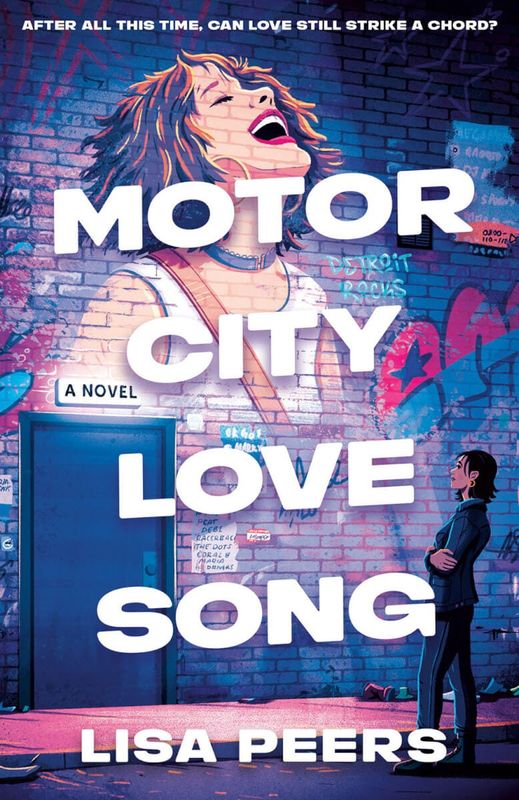
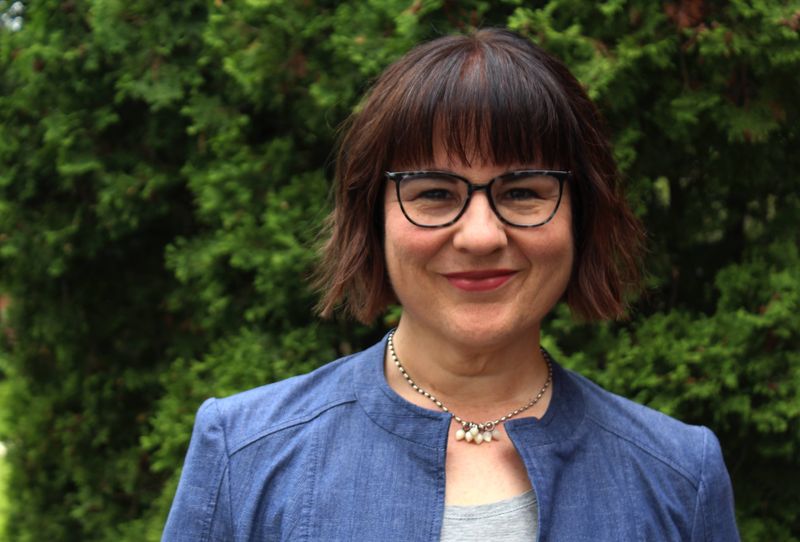
Lisa Peers’ new novel “Motor City Love Song” is a queer romance set in the heyday of the Detroit garage rock scene.
In reality, the late 1990s and early 2000s were a time when all eyes were on Detroit’s bands. The White Stripes had broken through with their third album, 2001’s “White Blood Cells,” and bands that cut their teeth in clubs like the Gold Dollar and the Magic Stick were getting to tour internationally, get record deals and snag ink on pages of glossy magazines around the globe.

In “Motor City Love Song,” which toggles between the late 1990s and the present day, the queen of the fictional version of that scene is Paloma, a singer, songwriter and guitar player who disappears from the public eye just when it seems she could really capture worldwide stardom. She leaves her girlfriend and manager Jace wondering what happened.
This is Peers’ second novel, a follow-up to her 2023 baking romance “Love at 350,” which was a Lambda Literary Award Finalist and named one of Popsugar’s Best Books of the Year. Based in Metro Detroit, Peers is a Harvard graduate with an MFA in acting from the American Conservatory Theater in San Francisco.
“Motor City Love Song” was published Feb. 10, and Peers has local appearances throughout the spring in conjunction with the release.
This Q&A has been adapted from an in-person conversation between this reporter and Peers that took place Feb. 13 at Sidetrack Bookshop in Royal Oak. Questions and answers have been edited for length and clarity.
Q: I like the way this book jumps from two points in time, the late 1990s and a few years following, and also close to present day. What made you want to start the story in 1997 Detroit?
A: That time for indie and garage music here in the Detroit area was just remarkable. I moved here in 2006, so I was kind of right as the White Stripes were cresting and then went their separate ways. I did not know about all the other bands that had been going on during the same time period, many of which Jack White was involved with, too. First off, that music is incredible. Why haven’t I heard more about it? I had a real ‘in’ because my partner’s cousin was a music booker in Ypsilanti at Cross Street Station. He lived the life, putting bands on stage after you have to sweep all the rat poop off the stage. Hearing all that kind of stuff, I really wanted to root it in that particular time.
I think the other thing, though, is that’s the time when our music experience really flipped. You had to buy it. You had to go to a record store to get it. Even though it was now CDs, it was still physical media. You would have to go to a venue to see your band, whereas now you stream everything, you catch them on YouTube, you never have to interact with anybody. So, just that kind of change in what the experience was also interesting to me as well. In present day, you’re still living a lot of those memories, you’re looking back to that, you’re framing your future and what you’ve experienced. After you’ve gone through all of that, 20 years later, what still gives you joy? What makes you want to get up in the morning? This book kind of goes at both ends of that story.
Q: The two main women in this story, we learn right away that they’re in a relationship. Paloma is the rock star, the girl in the limelight. Was there anything about the real-life Detroit scene that inspired you to create that character?
A: Being able to watch footage and some documentaries and talking with people who were around at that time, I realized that there were a lot of bands that were men and women. It wasn’t just an old boy’s club; there was a lot of female presence. For some of them, they were musicians first; it wasn’t about gender, it was about what the music was. I thought that was wonderful to hear. Yet, once you get out of the neighborhood and start playing bigger places or trying to get national attention, things will change, and then the industry starts to push back on a lot of female performers. So seeing that happen was something I wanted to explore.
Certainly, throughout history, there have been so many queer performers, queer musicians, and some led with that, that their identity was kind of the front part of their art. Some of them, that was just part of who they were. But, to kind of explore if somebody was trying to put that out there as a very visible part of their identity as a musician, what kind of reaction would that get?
Q: I also wanted to ask you about the music venues in the story and this landscape that you’ve created. This Detroit is recognizable to me, but all the names are different. The main venue, the Artemis, seems to me like it was inspired a little by Saint Andrew’s Hall, maybe Gold Dollar?
A: The location is the Artemis Club and that’s totally fictional, but in my head, it’s in Cass Corridor. So it’s not too far away from the Masonic Temple, if you go over to Woodward and go down to the Majestic or the Magic Stick, there’s some elements of that. I did want it at first to be one of these clubs where you can barely get an elbow in to the bar, but then I realized in my head I needed more space to choreograph, so it suddenly became like the Majestic.
Q: You actually talked to the owner of the Gold Dollar for this book, Neil Yee. The Gold Dollar’s stage played a big part in the garage scene of this era — the White Stripes played their first show there in 1997 — but Yee also booked a ton of very diverse and untraditional acts. What did you guys talk about and how did it help your story?
A: Neil Yee is the one who basically was the founder of the Gold Dollar in a neighborhood where, he explained, there were only two buildings with running electricity and all the other buildings rigged up cables and stole it from them. And so he bought it for an investment property and because he was looking for something that was behind on the taxes that he could grab before the city took it. He wanted it to be a performance space; it wasn’t necessarily just music. So he was very much into noise music and avant-garde performance and all of this. But what sold was rock and roll, so that’s when they were really getting their fame.
I love learning about musicians. I love reading memoirs. I love reading biographies. But to hear from an actual venue owner what it was like to try to manage everything from security, so people’s cars weren’t broken into too badly, then to also make sure the bands could get in and out. People would come in thinking it was still the drag bar (that it was before Yee took it over) and be surprised. Or cops would come by and say, “I don’t know if anybody should go in there.” So him dealing with all that and running a business was really fascinating to me. He had a billion stories. He has to write his own book.
Q: Anything you want people to know before they read the book?
A: My last book didn’t have any swear words; this one does.
I think part of this is the structure. This is told by two different people. Jace is up top and then you start hearing from Paloma in the second half. It’s very much like a two-CD disc set. Here are Jace’s tracks and here are Paloma’s tracks. And going back to their origin stories in the 1990s and then seeing what’s going on with them these days.
Even if you didn’t grow up here, even if you aren’t going to a lot of concerts or that sort of thing, I feel like every single person has that song, or that performer, that has been there for amazing parts of their lives. And that’s what this story really is about, that sort of connection to something bigger than yourselves. Connection to other people who love what you love, and how music can help us form families. We can take those memories with us our entire lives. Hopefully, you’ll see that reflected as you’re reading.
mbaetens@detroitnews.com
“Motor City Love Song”
Lisa Peers
Dial Press Trade Paperback
Book Signing for Record Store Day
April 18
Found Sound
234 W. Nine Mile, Ferndale
Author Talk with Lisa Peers
6 p.m. May 28
Ferndale Area District Library
222 E. Nine Mile, Ferndale
This article originally appeared on The Detroit News: Q&A: Michigan author Lisa Peers on new novel ‘Motor City Love Song’
Reporting by Melody Baetens, The Detroit News / The Detroit News
USA TODAY Network via Reuters Connect