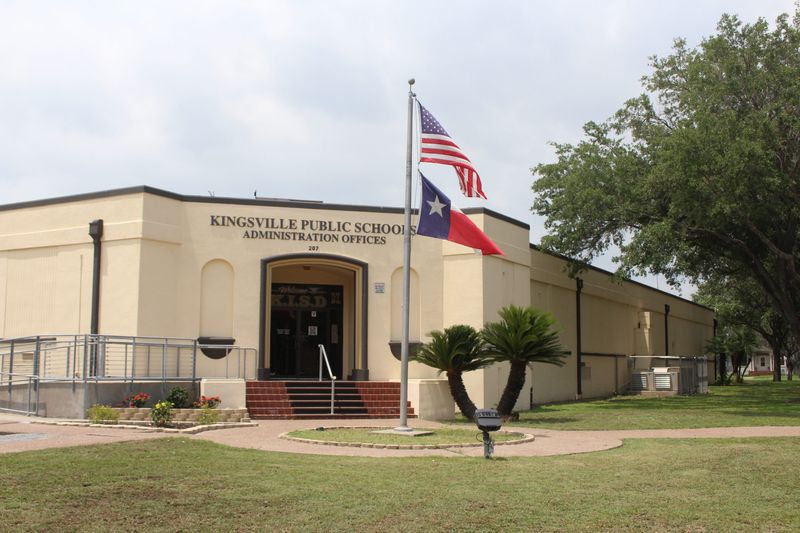
Editor’s note: The Kingsville Independent School District was notified by the state on Feb. 13 that its accreditation status is “Accredited-Warned” after receiving “F” accountability ratings for 2023 and 2025.
The following is the first part of a two-part op-ed.

By now recent news stories have aired about Kingsville ISD receiving a letter of “Accredited Warned.” While there are two more levels lower than Accredited Warned, this is a time for all stakeholders to have deep reflection. KISD is the only traditional public school district in the city; therefore, the district belongs to all of the community. As an alumnus, former superintendent and active member of statewide associations, I have a vested interest in the district and the current state of public education overall. It’s imperative to reflect on the historical context in order to try to move forward.
A thriving past and the seeds of division
In the years before the 1990s, KISD was a flourishing district, large enough to qualify for UIL 5A status. The marching band, just over 100 members strong today, serves as a metaphor for the district’s overall decline in population/numbers. At its peak, the band fielded nearly 400 members.
Students from every section of the city attended and represented KISD. There was tremendous Brahma pride. However, a pivotal decision in the 1990s to create a secondary level at the Santa Gertrudis campus began to divide the student population. Certain populations of students transferred to Santa Gertrudis, and throughout the years several more surrounding districts within the same county opened their enrollment as well, further drawing students away from KISD. (Who would’ve imagined six school districts in a small-town area?) These transfers were selective, drastically changing the demographics, the diversity, the funding, the staffing and the climate of KISD. While assuming it was unintended, the separation that occurred throughout the years appeared reminiscent of social class segregation.
The impact of social media and community discord
As years passed, social media amplified negativity toward KISD. Some community members, often some parents of students with discipline issues, criticized district decisions online, spreading misinformation. These same parents contacted the news media even when their children were the ones causing discipline issues. Privacy laws prevented district leaders from defending their actions publicly; therefore, some of the public foolishly believed the derogatory posts. Negative posts garnered hundreds of comments, while posts about student successes only garnered a fraction of comments — a reflection of misplaced priorities. Instead of collaborating with school leaders, some parents turned to the media at the first sign of trouble, further eroding trust and support.
Leadership instability and board politics
Over many years, KISD experienced a revolving door of superintendents, largely due to lack of support from certain board members and some vocal community critics. Some board members pursued personal agendas, pressuring superintendents to hire, promote and/or create positions for unqualified or ineffective family members, friends, nannies etc. Confidential information was sometimes leaked from closed session board meetings to social media. When superintendents resisted these pressures, sabotage ensued. Politics and personal agendas further drained any possible progress. A revolving door of superintendents created a lack of consistent systems, instruction and supportive culture. The board is the top of every school district, and research indicates that districts who have supportive boards and supportive communities rarely have a revolving door of superintendents.
State policy changes and their consequences
In 2023, the Texas Education Agency abruptly changed testing and accountability rules, resulting in a surge of “F” ratings for schools statewide. These ratings provided ammunition for state leaders advocating for vouchers, threatening the financial stability of vulnerable districts like KISD. (Despite these challenges, leaders from KISD played a key role in advocating legislation — House Bill 8 — that will prevent such abrupt changes in the future, marking a significant achievement for the district and all Texas schools. KISD’s moment of unity during this time was driven by doing what was best for kids.)
The realities behind ‘F’ schools
If people look closely at “F” schools they’d see it represents students facing hardships where on any given day “life gets in their way.” Imagine five siblings being ripped from their drug-addicted parents and placed in foster care the night before their STAAR test. They showed up to school, took their STAAR test and failed. One student working past midnight cleaning restrooms and mopping floors at a local restaurant to support his cancer-stricken mother had to tend to her when he got home. He showed up to school the next morning a little late, took the STAAR test and failed his test by one question.
They failed. And so do many other students who are victims of physical, mental and emotional abuse. Do you think any of these students were in the best mindset to take their STAAR test on that one day?
These are examples of children who had actually been prepared to take their STAAR test, but on the day of the test they failed because life got in their way. Teachers did all they could to prepare these students throughout the year, but in Texas one test on one day significantly defines a school.
What people need to remember is that behind every “F-school” there are real children with real lives. Most often they are in deeply at-risk homes. An Austin CBS news report showed that virtually all “F” schools in Austin are on the east side of I-35, while virtually all “A” schools are on the west side of I-35. (Research indicates that the demographics of the west vs. the east side of Austin are vastly different.) This report clearly reveals that the testing system is indeed broken. It’s NOT that kids from at-risk homes can’t learn; it’s that many face extreme hardships on any given day which disrupts their learning and their testing. School districts who serve high populations of children in these areas have a higher chance of having a “bad day” on STAAR, resulting in higher failure rates, resulting in higher numbers of “F’s.” Do the math!
Cissy Reynolds-Perez is the former superintendent of the Kingsville Independent School District.
This article originally appeared on Corpus Christi Caller Times: State of Kingsville ISD mirrors big picture of Texas schools | Opinion
Reporting by Cissy Reynolds-Perez, Opinion contributor / Corpus Christi Caller Times
USA TODAY Network via Reuters Connect