Remember 3I/ATLAS? Yes, the interstellar comet that made plenty of headlines in 2025 is still romping through our solar system.
But it may not be around much longer.

The otherworldly visitor to Earth’s cosmic neighborhood has steadily been making its exit ever since it had a rendezvous at the end of October with the sun, followed by its closest approach to our planet two months later.
The object became famous in July as the third-ever comet found in our neck of the galaxy that originated from an entirely different star system from our own. It then became infamous when it found itself at the center of a viral alien spaceship conspiracy theory.
If you need a refresher or are simply wondering what’s going on with the interstellar comet, here’s the latest on 3I/ATLAS as it continues its journey out of our solar system.
What is 3I/ATLAS?
The object known as 3I/ATLAS made news in July 2025 when it was confirmed to be the third object ever discovered originating outside Earth’s solar system. A telescope in Chile – part of the NASA-funded Asteroid Terrestrial-impact Last Alert System, or ATLAS – was the first to spot the object whizzing at 137,000 mph, according to NASA.
The object, confirmed to be a comet, was somehow ejected as many as billions of years ago into interstellar space – the region between stars – before it entered into our solar system, NASA says. The interloper into our cosmic neighborhood came from the general direction of the constellation Sagittarius, where the central region of our Milky Way galaxy is located.
How do we know 3I/ATLAS is an interstellar comet?
Scientist who have observed 3I/ATLAS say it shows all the tell-tale signs of being a comet from outside our solar system.
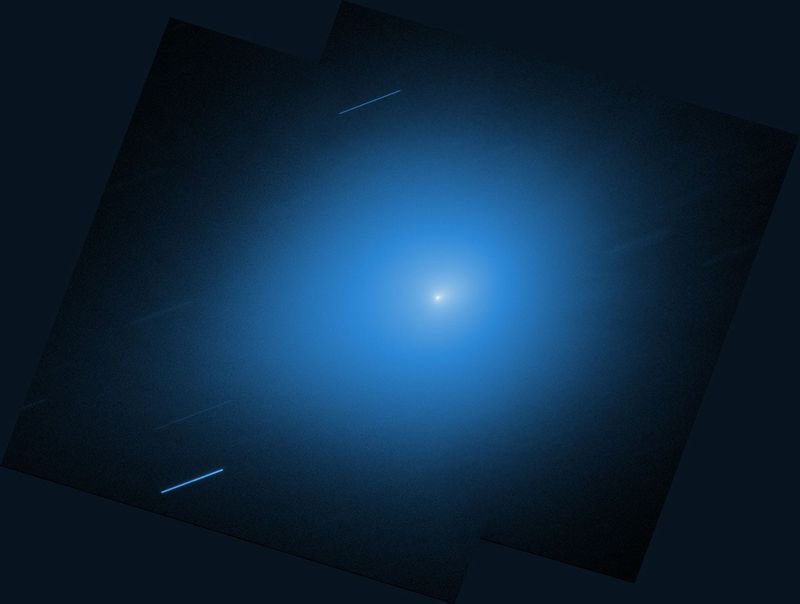
The object has an icy nucleus and is surrounded by a bright cloud of gas and dust known as a coma that defines an active comet. Unlike comets bound to the sun’s gravity, 3I/ATLAS is traveling on a hyperbolic orbit that suggests it did not originate within our solar system, according to NASA.
NASA missions get look at 3I/ATLAS comet
Since it was discovered, the world’s space agencies have been racing to observe 3I/ATLAS with both ground and space-based telescopes.
The observations have led to some illuminating insights about the color, size, speed and trajectory of the interstellar comet. For instance, it was data from the Hubble Space Telescope that helped astronomers estimate the size of the comet’s solid, icy nucleus as anywhere from about 1,400 feet to 3½ miles in diameter.
Most recently, NASA’s Transiting Exoplanet Survey Satellite (TESS) spacecraft was able to reobserve 3I/ATLAS, from Jan. 15-22. Though TESS is designed to spot exoplanets, or world’s beyond our solar system, the data it collected on 3I/ATLAS helped scientists refine their understanding of the comet’s activity and rotation, NASA said in a Jan. 27 blog post.
NASA’s new SPHEREx telescope also recently observed the comet in December for the second time in infrared light, NASA said in a Feb. 4 blog post.
When did 3I/ATLAS approach Earth?
The comet, which is not a danger to Earth, came within about 170 million miles of our planet Dec. 19, 2025. That was nearly twice the distance of Earth to the sun and more than 700 times the distance of Earth to the moon.
Is 3I/ATLAS an alien spaceship? What is NASA saying?
The strange outsider’s jaunt through Earth’s cosmic neighborhood has sparked plenty of conspiracy theories.
One particularly infamous idea – put forth by a Harvard astrophysicist named Avi Loeb – is that 3I/ATLAS could be an alien spaceship.
Scientists and officials at NASA have long sought to dispel the notion that 3I/ATLAS is extraterrestrial in nature – including in a December study that analyzed 3I/ATLAS as it approached Earth.
In a social media exchange with reality TV star Kim Kardashian in October 2025, NASA’s then-Acting Administrator Sean Duffy affirmed: “No aliens. No threat to life here on Earth.”
Nicola Fox, associate administrator of NASA’s Science Mission Directorate, also rejected the alien conspiracy theory at a news conference in November 2025, saying, “We certainly haven’t seen any technosignatures or anything from it that would lead us to believe it was anything other than a comet.”
How long will 3I/ATLAS remain in our solar system?
The interstellar comet is simply passing through our solar system and will eventually exit back into interstellar space, never to be seen again.
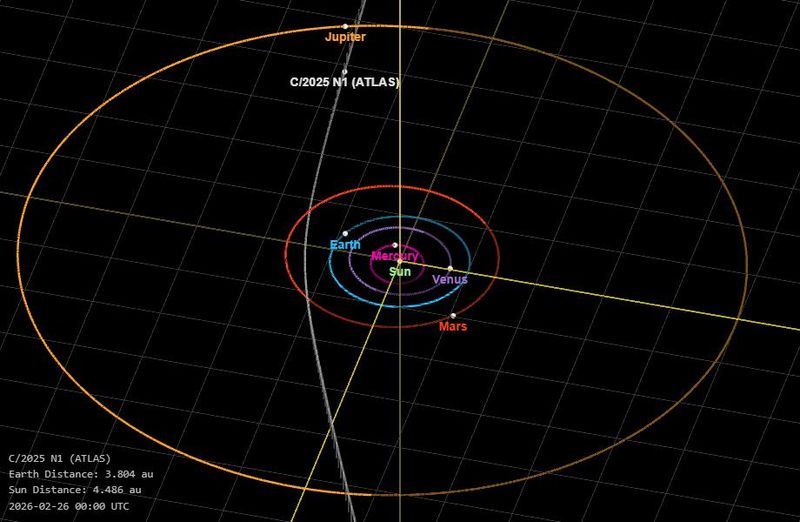
In fact, its path out of our cosmic neighborhood began ever since 3I/ATLAS made its closest approach to the sun at the end of October. As the comet speeds away from the center of our solar system, it can still be observed until spring 2026 in the pre-dawn sky with even small telescopes, according to NASA.
Where is 3I/ATLAS now? How to track 3I/ATLAS with NASA simulator
NASA’s online simulation Eyes on the Solar System shows the location and path of 3I/ATLAS as it moves through our solar system. You can also keep up to date with the comet’s movements where it’s catalogued by NASA’s Jet Propulsion Laboratory in Southern California.
Eric Lagatta is the Space Connect reporter for the USA TODAY Network. Reach him at elagatta@usatodayco.com. Subscribe to the free Florida TODAY newsletter.
This article originally appeared on Florida Today: What’s the latest news on 3I/ATLAS? Interstellar comet makes exit
Reporting by Eric Lagatta, USA TODAY NETWORK – Florida / Florida Today
USA TODAY Network via Reuters Connect