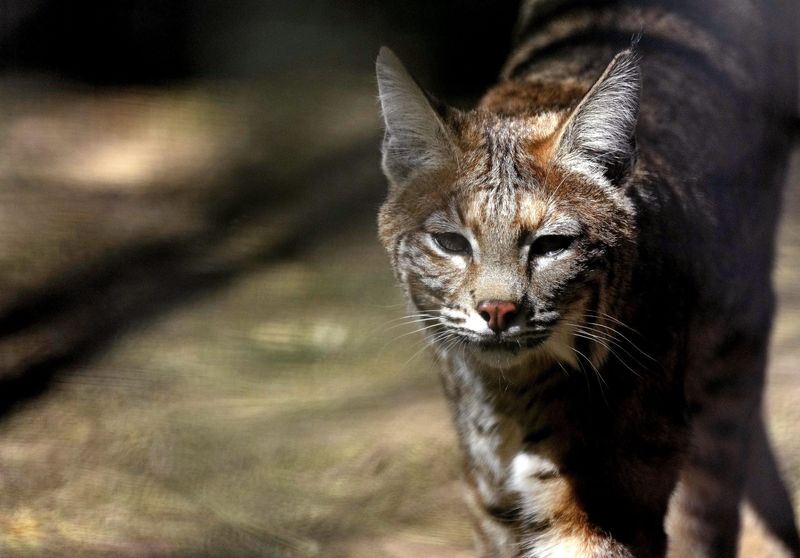
A budding brouhaha in the Ohio outdoors could blossom into quite a catfight.
To trap or not to trap bobcats is the question, and what’s at stake is something wild because if the Ohio Division of Wildlife decides to make such trapping legal, even on a limited basis, opponents may not stand for it.

The so-called antis have made noises that bobcats represent a red line that, when crossed, will spur a ballot initiative to eliminate all trapping in the state.
It’s indisputable that the bobcat, once an apex predator on the Ohio landscape, has replenished itself after decades of exile caused by hunting and habitat loss.
THE GREAT OUTDOORS: More on Ohio hunting and fishing
The wildlife division on its Facebook page in late December described the situation:
“Recorded data shows that bobcat populations are thriving and expanding in Ohio, with more than 500 confirmed sightings by the Ohio Division of Wildlife annually since 2019.”
Although presence is highest in the cat-friendly habitat of the southeast and southern counties, bobcats can be found these days across Ohio, the division wrote.
What’s more, the division asserts, after a multiyear study, “researchers at Ohio University recently concluded that … limited harvest regulations could be implemented in Ohio without negatively affecting the long-term viability of the bobcat population.”
Bobcat capture won’t be part of the 2026-27 hunting and trapping package of proposals, wildlife chief Kendra Wecker said. However, she added it’s possible that, as soon as next year, steps could be taken toward allowing legal bobcat trapping.
Elk update
A report about the possibility of bringing elk to Ohio reported here a few weeks ago brought a response from Tom Vorisek, elk advocate, hunter, Gahanna resident and outgoing Ohio Wildlife Council member.
Vorisek questioned one of the report’s statements.
He disputed the contention that elk restoration in the strictest sense of language isn’t possible because eastern elk that once roamed the Ohio country had been eliminated from the state by 1841 and from the eastern landscape by 1877.
Considered for decades a subspecies of the North American elk, the eastern elk was declared extinct by the U.S. Fish and Wildlife Service in 1880 after the last known specimen was killed in Pennsylvania three years earlier.
The eastern elk long had been considered a subspecies of the North American elk distinct from the Rocky Mountain or western elk.
In Vorisek’s reckoning, the subspecies designation marked a distinction without a difference. In fact, such parsing might not have had merit, it turns out.
Wikipedia, at any rate, says this:
“As of 2017, the International Union for Conservation of Nature (IUCN) has reclassified all North American elk subspecies aside from the Tule and Roosevelt elk as C. c. canadensis. If this is accurate, this means that the subspecies is not extinct, and has returned to the eastern U.S. in the form of the Rocky Mountain elk introduced to the region in the 20th century.”
IUCN, an international organization founded in 1948, maintains a website at iucn.org.
Parting shots
Trapping season for mink and muskrat ends in most of the state, including central Ohio, on Feb. 28. That date also marks the last day to legally trap beavers and river otters in Ohio. … The final day of February marks the last day a 2025-26 annual hunting license is valid. Multiyear licenses, though, remain valid through the purchase date for the term of the license, whether three, five or 10 years.
This article originally appeared on The Columbus Dispatch: Ohio Division of Wildlife considers legalizing bobcat trapping
Reporting by Dave Golowenski, Special to The Columbus Dispatch / The Columbus Dispatch
USA TODAY Network via Reuters Connect