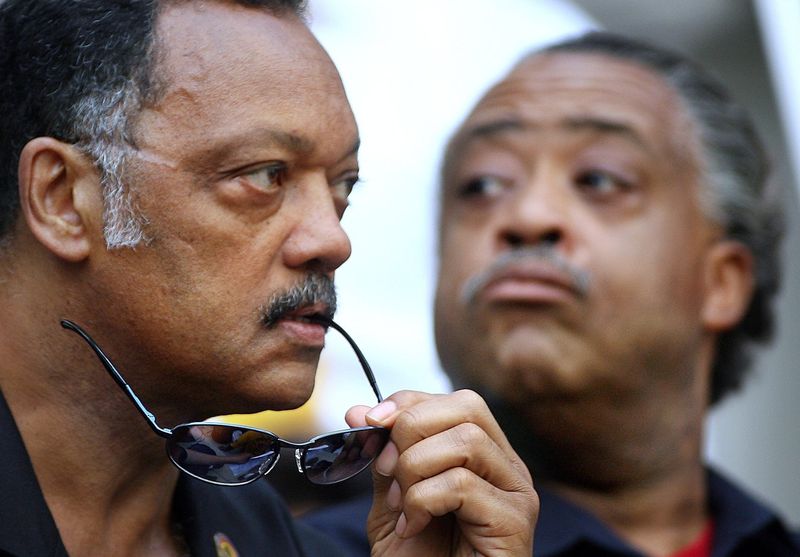
The Rev. Jesse Jackson – a Baptist minister, a civil rights foot soldier and two-time presidential candidate – had a special affinity for Tallahassee because of its role in the Civil Rights Movement and the relationship between Tallahassee minister C.K. Steele and Martin Luther King, Jr., Jackson’s mentor.
Jackson died Tuesday. He was 84.

In Florida, he is remembered as a man who sought to help the oppressed, the voiceless and those with dreams that others are unable to imagine.
Sen. Darryl Rouson, D-St. Petersburg, first met Jackson in Chicago in the 1980s and attended meetings that would eventually become Jackson’s Rainbow PUSH Coalition, which Rouson described as a group with “an unwavering belief in human dignity.”
Rouson attended the 1995 Million Man March in Washington with a group that included Jackson.
“I will never forget seeing Reverend Jackson hold my son, Daniel, during the march. It was a powerful reminder that his work was always about the next generation and the future we leave behind,” Rouson said.
Rouson is chair of the Florida Legislative Black Caucus and the longest-serving member in the Legislature.
He and others say Jackson was a man with powerful rhetorical skills dedicated to fighting for justice and fairness for people of all walks of life.
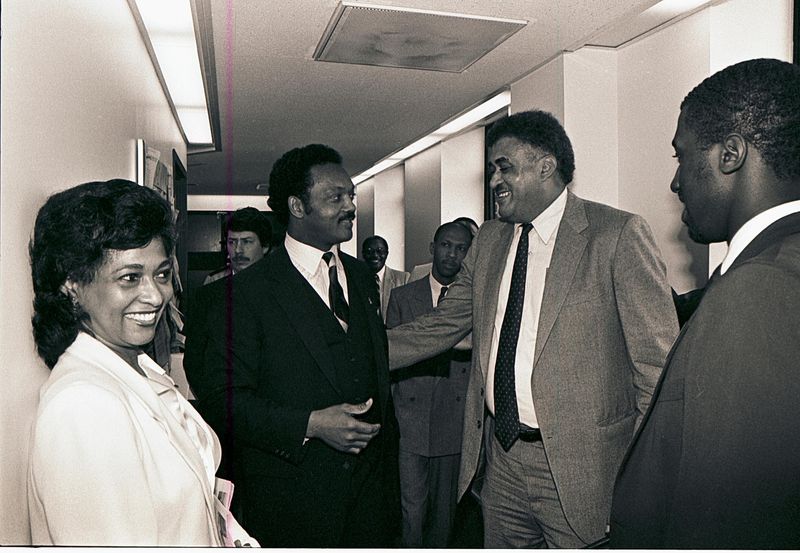
In 2013 during the Dream Defenders’ sit in protest of immigration laws at the state Capitol, Jackson slept overnight on the couch in then Tallahassee Rep. Alan Williams’ office.
Williams called Jackson the most significant civil rights leaders in the past six decades.
“He was all about the dignity of all people. He would challenge us to do better and to keep hope alive,” Williams said.
Like others, Williams spoke of Jackson’s humility.
“He treated me like I was the icon when he was the one,” Williams said. “I consider it a high honor that he slept on my couch.”
Did Jackson first hear ‘run, Jesse, run’ on the FAMU football field?
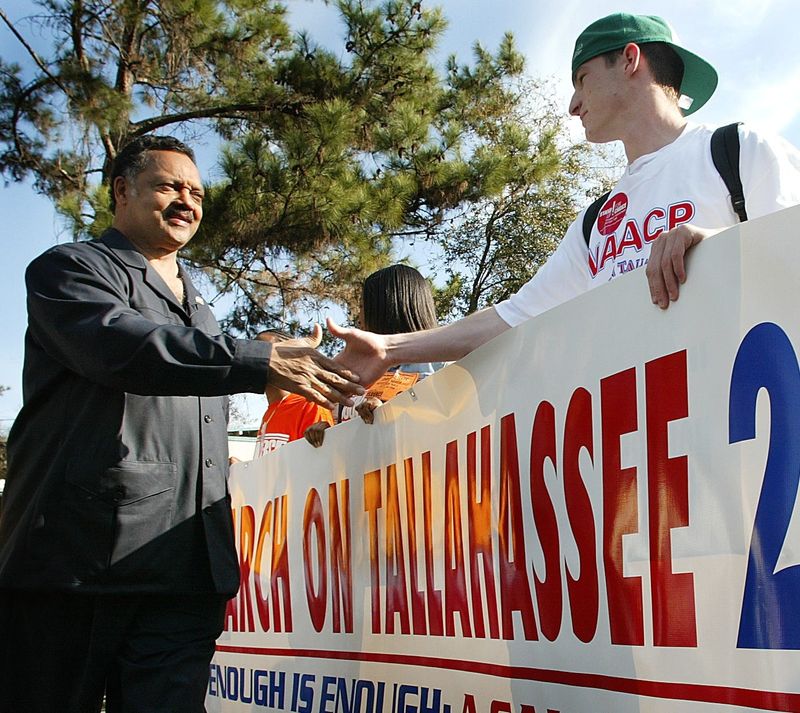
From the 1970s into the 2010s, Jackson was a familiar face at Florida protests, participating in demonstrations in Tallahassee, Miami, Sanford, West Palm Beach and elsewhere.
Between 1984 and 2000 Florida and Tallahassee was a regular stop for Jackson during the presidential campaign season. He was a candidate in 1984 and 1988.
In fact, it’s quite possible the first time Jackson heard the chant, “Run, Jesse, Run” was in Tallahassee, on Nov. 4, 1961. That was the day a Florida A&M University defense overwhelmed a North Carolina AT&T offense quarterbacked by Jackson that lost to the Rattlers by a score of 38-6.
Shortly afterwards, Jackson made a career decision. He went to work for King and became his generation’s leading advocate for expansion of voting rights, economic opportunities, and education to help the poor and underrepresented escape poverty.
Between King’s death in 1968 and the election of Barack Obama in 2008 as President, Jackson was the most visible Black leader, working to build what he called a Rainbow Coalition of the poor and marginalized.
“Without him you don’t get Obama,” Tallahassee’s Rev. R.B. Holmes said.
Holmes said Jackson touched many lives in Florida. Here are some of the stories.
With a spine of steel, Jackson is ‘a legend that will never die’
Gayle Andrews is a campaign consultant and former television news reporter, who covered many of Jackson’s Florida appearances as a journalist and then worked with Jackson as an operative.
She said Jackson had a special affinity for Tallahassee because of the prominence of Bethel Missionary Baptist Church, which was led by King’s civil rights colleague, the Rev. C.K. Steele.
Andrews says Jackson’ beliefs were fortified by a spine of steel.
“He was absolutely committed to the movement. And once he took a position, he dug in and it was hard to convince him otherwise,” Andrews said.
In Florida the heart of the civil rights movement may very well be Bethel Missionary, which organized Tallahassee’s pivotal 1956 Bus Boycott.
The church is now led by the Rev. R.B. Holmes. Holmes led Jackson’s 1984 presidential campaign in Duval County and was the single Florida Jackson delegate to the Democratic National Convention in San Francisco.
“I believe he is one of the most profound voices of the 20th century. He is a legend that will never die,” Holmes said.
Holmes remembers standing next to then-Gov. Bob Graham on the convention floor after Jackson spoke and telling Graham that the “speech literally will change America.”
Holmes called Jackson’s convention speech a testament “for diversity, equality, inclusion and fairness.”
“The Reverend Jackson transformed the Democratic Party in the early 1980s. If not for Jackson, Barack Obama is not President in 2008. He paved the way in the Democratic primaries,” Holmes said.
‘Don’t give in and don’t give up’
In the early 1980s, Brandt Copeland was the lead pastor at First Presbyterian Church and worked a voter registration drive led by Jackson.
“His enduring confidence in the democratic process was remarkable and the way he inspired people who were on the margins of society by repeating the mantra ‘I am somebody,’ he was able to convey the dignity and the respect everybody deserves because we’re all created in the image of God,” Copeland said.
Both Copeland and Holmes remarked that Jackson had the ability to discuss contentious issues without expressing anger. And they recalled how in tense moments where others would despair, Jackson kept a focus “on the dream, the possibilities” and “the imagination to go back into the community and do good,” Holmes said.
Jackson shared that imagination with former Congressman Al Lawson when Lawson was finishing a Ph.D. at Florida State University.
The two crossed paths in 1978 in Atlanta when Lawson was a Florida State University basketball recruiter.
Lawson had his eyes on a player for FSU, and Jackson was looking to bolster the ranks of his civil rights group Operation PUSH.
The two bonded over their college athletic careers. Jackson played quarterback at North Carolina A&T, and Lawson starred in track and basketball at Florida A&M University.
Two years later, Jackson was in Tallahassee and called on Lawson.
Jackson wasn’t interested in retelling their glory days as athletes. He was all business.
“He said, ‘you need to get involved in politics, in this city,’” Lawson remembered.
Lawson was focused on finishing a doctorate and he tried to change the conversation. When that failed, he noted no Black politician had won a North Florida election since Reconstruction.
And like quarterback who sees an opening in the line, Jackson pounced.
“He said, ‘don’t give in and don’t give up. You’re the kind of person who can win,” Lawson said. “I’ll never forget it. He said, ‘you know how to cross the tracks – you know how to cross the tracks.’”
Two years later, Lawson would enter and win a rural white-majority Florida House district and go on and serve 34 years in the Florida Legislature and U.S. Congress.
‘A giant of a man’ who never stopped kicking
Jackson had a charm that former Tallahassee Mayor John Marks said excites people. Jackson called Marks when he was first elected mayor in 2003. They stayed in touch for more than a decade.
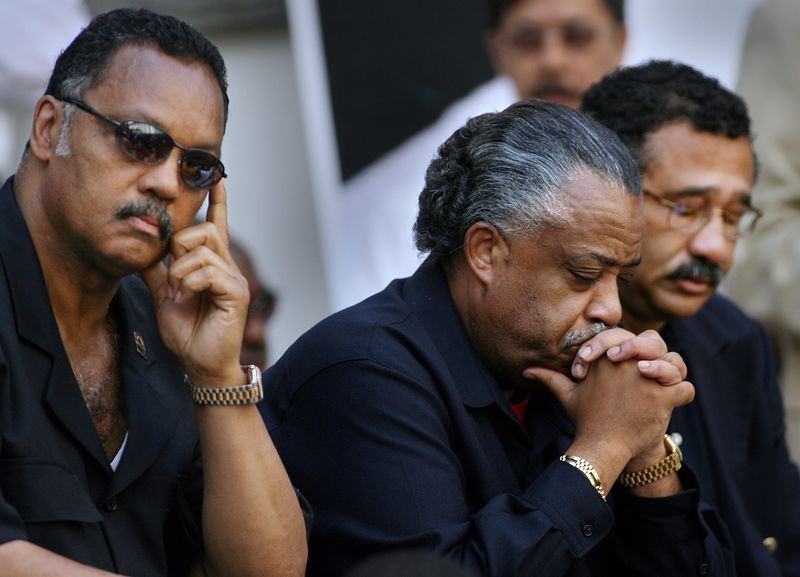
In 2012, Marks watched Jackson and Rev. Al Sharpton lead several hundred on a march on the state capital to protest state boot-camp detention for teens.
“He was a very positive individual about what he could do and what he should do, and what he thought America was about and what should happen with America,” Marks said.
“And I want to say this; in all of those conversations I never heard anything from him that I would consider to be something that could not be said in public. He was not that kind of person,” Marks said.
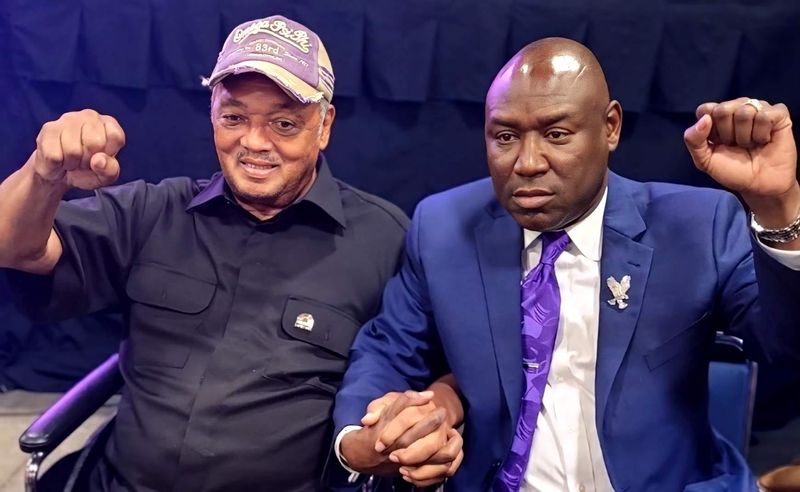
Jackson wanted to uphold the Constitution’s promise of freedom and opportunity to all, according to Ben Crump, one of the nation’s leading civil rights lawyer who represented the family who lost a son in a state boot camp.
A “giant of a man,” Crump said about Jackson’s committment to equal rights.
“He was brilliant and articulate and so knowledgeable on every issue involving civil rights,” said Crump, in an interview with the USA TODAY Network. “For most of my life, he was the standard bearer for civil rights.”
Crump said he’ll never forget being in Ferguson, Mo., and tensions and concerns were high regarding the killing of Michael Brown (an unarmed 18-year-old fatally shot by police).
Jackson’s words are seared into Crump’s memory:
“Brother Crump, you don’t drown because the water is deep. You drown because you stop kicking.”
“Every time, I’m in a tough situation and it seems like the odds are just overwhelming, I think of that proverb that Rev. Jackson shared with me. Don’t ever stop kicking,” Crump said.
A Jackson voter
Ann Bidlingmaier was one of the 254,000 Florida Democrats who voted for Jackson in the 1988 presidential primary. Jackson came in second to eventual nominee Michael Dukakis.
At the time, Bidlingmaier was not sure if Jackson had the experience to be president but was drawn to his efforts to fight poverty and help people on the margins of society.
The day after Jackson’s passing, she credited him for being a political and moral force that seems to be vanishing from political life.
“I see people like Jesse Jackson sort of becoming extinct. People who embrace the idea that people should be free. Free to speak. Free to pursue their livelihoods without being chased by ICE just aren’t thriving today,” Bidlingmaier said.
TaMaryn Waters contributed to this report. James Call is a member of the USA TODAY NETWORK-Florida Capital Bureau. He can be reached at jcall@tallahassee.com. Follow on him X: @CallTallahassee.
This article originally appeared on Tallahassee Democrat: Jesse Jackson’s Florida legacy: From protests to paving the way for Obama
Reporting by James Call, USA TODAY NETWORK – Florida / Tallahassee Democrat
USA TODAY Network via Reuters Connect