I guess we were due to experience a real winter season (Floridian style). And while I am not a fan of freezing temperatures, I have to admit it is not all bad news. At least not for our landscapes. Many of our plants and trees can grow with little to no pause, and I think a little downtime is warranted.
We are a solid month away from the consecutive warm days that spring ushers in. No one likes to wait for that turnaround, especially when our yards are full of brown, unappealing plants. But allowing the dead material to remain in place actually protects your plants from further damage should another cold snap arrive.

While assessing the status of your current landscape, now is the perfect time to consider what can be replaced later on. A smart first step is to check out what plants shouldn’t really be in your yard in the first place. You can find this information at the website https://assessment.ifas.ufl.edu/. To make it easier, you can filter the results for North Florida, and there you will find plant names and pictures.
As Florida’s topography is altered by the effects of climate change, evaluating the health of local plants is essential for sustainability. Some of these exotic plants displace our native species, which then compromise the local ecosystems. And their threat or risk level is grouped into a few categories: no issues, cautionary risk, elevated to high risk and prohibited. It is important to note that sometimes plants can be considered risky in one part of the state and not another. Case in point: the white-flowered Tradescanta fluminensis (not to be confused with the purple wandering Jew/Trandescanta zebrina) is ranked invasive for North Florida at the same time it is regarded as not a problem in South Florida.
Dangerous plants, what I like to refer to as the “red light district,” include those species that have been labeled as prohibited, invasive, and high-invasion risk. Seldom are they identified as such at the plant’s introduction. For example, we have learned that overusing some low-maintenance plants in the urban landscape can become problematic. The enthusiasm of high performance cannot outrun the consequential science from catching up, however. Examples of this include the now-invasive Heavenly Bamboo shrub (Nandina domestica, Gulf Stream and Harbour Belle) and the versatile groundcover/border plant Flax lily/Dianella tasmanica. Continued research and scientific measurement can move the status of plant species on the assessment, so it is wise to refer to it at least yearly.
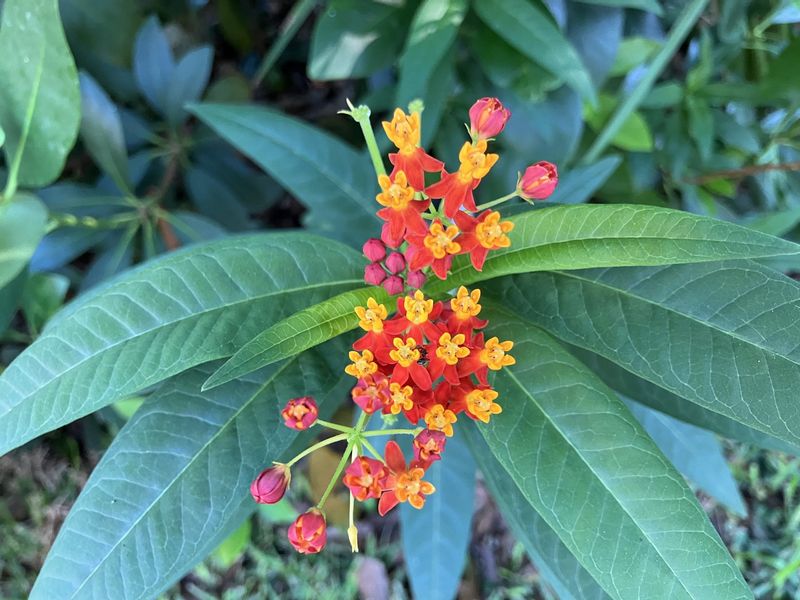
And that brings me to some of the 2025 revisions that would surprise most folks in North Florida. Probably the most relevant being the tropical milkweed plant/Asclepias curassavica, now considered invasive statewide due to its lack of dormancy and massive parasite production.
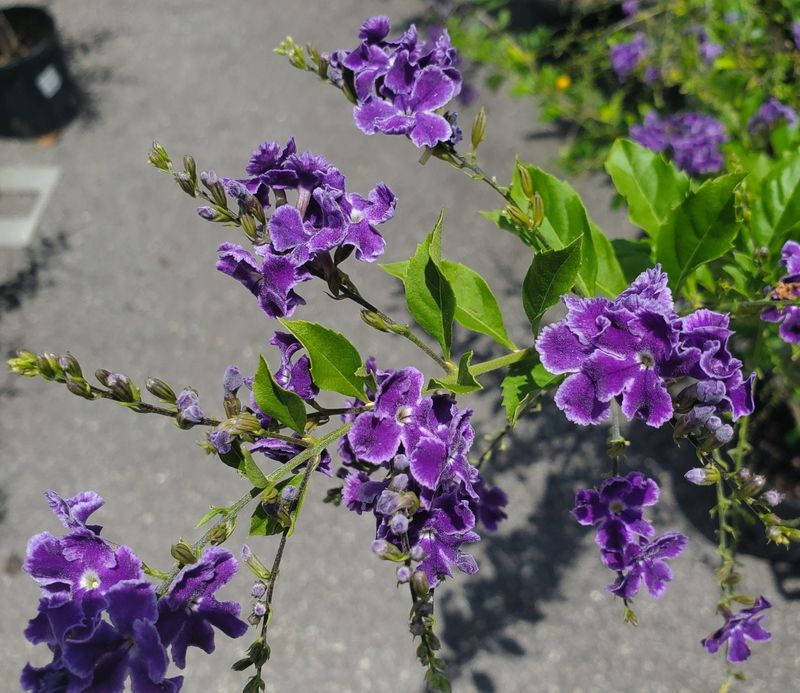
The Polka Dot plant/Hypoestes phyllostachya and Busy Lizzie Impatiens walleriana are new upgrades to the high invasion risk level, regardless of where they are planted outdoors. Both the spider plant/Chlorophytum comosum and the spider flower/Cleome hassieriana are considered high risk alongside shade-loving ground and wallcovers such as creeping or climbing fig/Ficus pumila and English Ivy/Hedera helix. A few succulents were not spared either, like the Century plant/agave angustifolia and Kalanchoe xhoughtonii or Mother of Millions. I love a fall-blooming tree, but unfortunately, both the Popcorn cassia (Senna didymobotrya) and the Candlestick or Christmas cassia (Senna pendula var glabrata) are now considered high invasion risk. The popular daisy bush/Euryops chrysanthemoides and Golden dewdrops or Sky-Flower/Duranta erecta were upgraded last year to the list, not to mention the iconic Weeping willow tree/Salix babylonica.
The vibrant red blooms of bottlebrush trees are real magnets for bee activity, but last year’s assessment has yielded concern. Originally assigned to the genus Callistemon, native to Australia, all but four varieties were reclassified into the Melaleuca genus nearly 20 years ago. This was done after researchers determined the DNA difference between the two species was too weak to list them separately. In the fall of 2025, the reclassified trees labeled Melaleuca citrina were assessed as high invasion risk for the entire state. They include the Little John Dwarf, Weeping, and Red or Crimson varieties.
The good news is that many of these plants have relatives and hybrids that are not listed on the assessment. But identifying what you have can be challenging if you did not purchase them from a responsible nursery, or you inherited a landscape with the purchase of a home. I encourage you not to give in to the confusion and instead reach out to your local extension office for help. Informative websites such as https://www.fnai.org/ and https://invasivespecies.ifas.ufl.edu/plants/ are also excellent resources. For a nationwide search of invasive plant species, please go to https://plants.usda.gov/.
So, if you end up losing some “red light district” plants/trees as a result of the winter freezes, consider it as nature’s way of helping you weed out the bad to make space for the good. Your property, the community and the environment will be better for it in the long run.
Candace Barone is a Master Gardener Volunteer with the Duval County Extension Service and the University of Florida/IFAS. For gardening questions, call the Duval County Extension Office at (904) 255-7450 from 9 a.m. to noon and 12:30 to 3:30 p.m. Monday-Friday and ask for a Master Gardener Volunteer.
This article originally appeared on Florida Times-Union: Many common Florida landscape plants are now considered risky
Reporting by Candace Barone, For the Jacksonville Florida Times-Union USA TODAY NETWORK / Florida Times-Union
USA TODAY Network via Reuters Connect