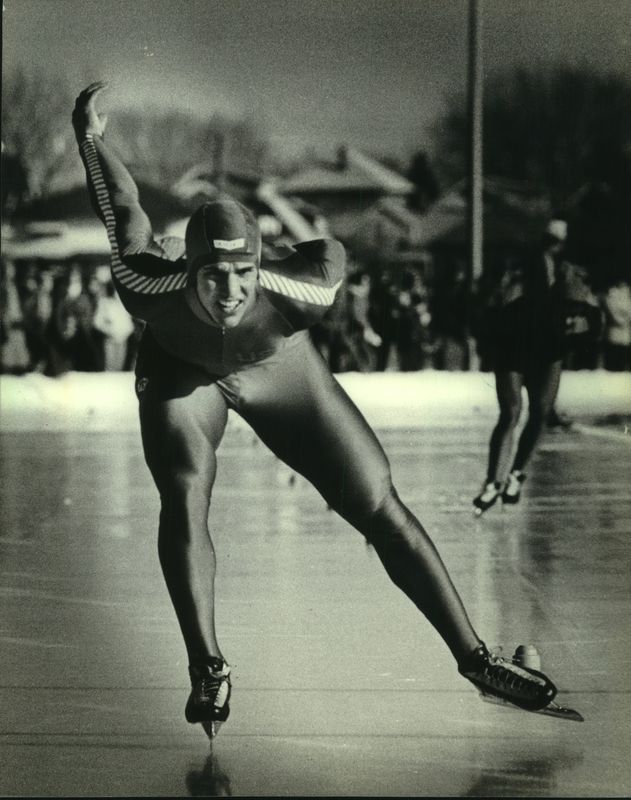
For Eric Heiden, one of those in the crowd at Field House International Ice Rink in Lake Placid, New York, during one of the most famous sporting events in American history, the “Miracle on Ice” game was perhaps an even greater benefit than a transcendent moment in American sports.
For one thing, there was the celebration that followed — Heiden famously got back to his room late and slept through his alarm clock the next day, meaning he got a late start on his own date with history.

For another, it meant the 1980 Olympics wouldn’t be remembered as the Eric Heiden Olympics.
Yes, he was on his way to winning his fifth gold medal, achieving something no Winter Olympian had done before. Yes, the Madison native was speed skating royalty, basically a rock star in Norway and the Netherlands, countries that held speed skating in high regard. Yes, he established Olympic records in all five of his races. But Heiden didn’t want to be a celebrity and made that fact abundantly clear during those Olympics.
“I don’t want people following me around, putting me on a pedestal,” Heiden said then. “I just want to be Eric Heiden.”
When the average person thinks of the 1980 Olympics, they think of the United States beating the Soviet Union in hockey. But what the 21-year-old achieved was too special to simply fall below the radar.
More than 45 years later, another Wisconsin 21-year-old has a chance to invoke Heiden’s name at the 2026 Winter Olympics in Italy.
Kewaskum’s Jordan Stolz has one gold medal already and, with potentially three more events to come, has a chance to approach Heiden’s haul of gold in one Games.
When the athletes were visiting the White House following the 1980 Olympics, Representative Frank Annunzio of Illinois was quoted as saying Heiden’s performance “ranks with Babe Ruth’s 60 home runs, Joe DiMaggio’s 56-game hitting streak, Wilt Chamberlain’s 100-point game and the ground-gaining records of O.J. Simpson and Jim Brown. In fact, it ranks with every accomplishment in sports.”
Here’s a look back at Heiden’s transcendent performance at Lake Placid:
‘Nobody thinks he can beat him. He is the greatest skater that has ever been’
The 10,000 meters wasn’t Heiden’s best event, but all eyes were on him at the James B. Sheffield Olympic Skating Rink on Feb. 23, 1980. Heiden was one of the biggest Olympics storylines heading into the games, where fans and media were already wondering if he could capture five gold medals. After winning the 500; 1,000; 1,500; and 5,000, the stage was set for history.
Talk of an unprecedented fifth medal intensified when Heiden won the first gold in the 500, an unpredictable sprint race and, again, not one of Heiden’s signature events. In fact, he’d been upset by another 21-year-old, Tom Plant of West Allis, in that event at the World Sprint Speed Skating Championships earlier in February, even though Heiden cruised to the overall sprints title.
Heiden was paired with the USSR’s Evgeni Kulikov, the world-record-holder in the 500 and the gold medalist at the 1976 Olympics. But Heiden edged Kulikov by two-tenths of a second and established the first of his five Olympic records with a time of 38.03 seconds.
“I am very happy to have won a gold medal, but the most important thing to me is that I skated a good race,” Heiden said. “It is nice to be paired with Kulikov because throughout the race, I know where I stand.
“There is a lot of pressure on me right now, but since winning this race, I am a lot more relaxed. I feel I can cope better with the pressure after today.”
In the 5,000 meters, Heiden struck gold again with a time of 7:02.29, fighting through the wind and snow that kept him short of his goal of 7 minutes even. Speed skating wasn’t moved indoors until the 1988 Winter Games in Calgary.
“Did I think I could beat Heiden?” said Kai Arne Stenshjemmet, who took second place in the 5K. “Well … to tell you the truth, no. Nobody thinks he can beat him. He is the greatest skater that has ever been. I know him well. He is my friend. I often wonder what makes him so good.”
In the 1,000, Heiden won in 1:15.18.
Stenshjemmet, who hailed from Norway, where songs had been written about Heiden and he’d appeared on milk cartons as a celebrity, appeared to have an inside track on the 1,500 meters title when Heiden slipped. Heiden nonetheless caught himself and registered 1:55.44 for yet another Olympic record.
“I thought nothing when Heiden slipped,” Stenshjemmet said. “You think nothing when Heiden slips because you know it will not matter.”
“Sometimes, a slip can cost you dearly – time-wise it cost me about two-tenths of a second, but mentally, it didn’t cost me anything,” Heiden said. “A slip can often make you tighten up, but the whole incident passed pretty fast and I didn’t think about it again.”
Heiden’s fourth gold tied him with the Soviet Union speed skater Lidiya Skoblikova, who won four in 1964, for the most golds in a single Winter Olympics. One gold remained.
Heiden capped his run in the 10,000 meters mere hours after ‘Miracle on Ice’
Knocks came at Heiden’s door at roughly 7:40 a.m. He’d been scheduled to rise more than an hour earlier. With the world still buzzing from the United States hockey team’s win over the Soviets the previous evening, Heiden had to move quickly to get to his races.
It wouldn’t matter, although Heiden said he was scared when he saw early skaters like Norway’s Tom Oxholm and South Milwaukee native Mike Woods surpass the previous Olympic record in the 10,000 meters.
“I didn’t expect the times to be as fast as they were today and, after seeing Woods and Oxholm, I was scared,” Heiden said. “Conditions didn’t seem that good for a world record.”
Heiden was paired with Russia’s Viktor Leskin, who went out at breakneck pace.
“I was concerned whether to attack and go after (Leskin),” Heiden said. “I started to, but Dianne (Holum, his coach) said, ‘Relax. Skate your own race.'”
Heiden’s time was 14:28.13. It was a whopping 6.2 seconds better than the previous world record and 15 seconds better than Heiden’s previous best.
Fans chanted “Er-ic!” as he rounded the oval, and some skaters had yet to compete when Heiden began talking to reporters in a victory press conference.
“I thought I could win one or two, but I thought five was out of the question,” Heiden said. “This is the best race I could have won. I skated well and gave it all I had. It’s a neat race to win because it’s so long and everyone in it has trained and worked so hard. The last five laps, you think you know how tired you are and how nice it will be to stand up again.”
Heiden elects to remain out of the spotlight after his Olympic achievement
Just don’t expect Heiden to be impressed with the medals.
“I’d rather get a nice warmup suit or something,” Heiden said at the time. “Then I could use it. The medals don’t mean that much. The effort I put into the races is what’s important. The medals will probably sit where all the rest are, in my mom’s dresser, gathering dust.”
Heiden’s best finish at the 1976 Olympics as a 17-year-old was seventh place in the 1,500 meters, but he suddenly achieved dominance when he won the world championships in 1977, becoming the first American man to win that title since 1891. Heiden repeated the feat in 1978 and 1979, with some World Sprint titles and Junior Worlds crowns to accompany.
His sister, Beth Heiden, was also a world-renowned speed skater who endured frustration in Lake Placid, finishing out of the medals in three races before capturing bronze. In the postrace press conference, she tearfully chastised media for their preoccupation with medals.
During the games, local print news outlets were critical of family members for remaining unavailable, and the Heidens hired 33-year-old agent/lawyer Arthur Kaminsky to facilitate – or forbid – interaction between the family and the press.
The media had another interesting quandary on their hands after Heiden won his fifth gold just before ABC began broadcasting at 11:30 a.m. Announce the results or wait for a primetime broadcast? It was a similar issue that faced ABC the day before with the U.S. hockey team’s win.
“We’re not going to be able to give you the highlights now, but the basic responsibility of a primary source of news is to let you know what’s going on,” ABC’s Jim McKay said. “So in this case, I’m going to tell you — Eric did it.”
True to the sentiments he expressed, Heiden moved away from the spotlight after his incredible run, pursuing medical school. He had started his schooling at the University of Wisconsin-Madison but transferred to Stanford. Today, he’s an orthopedic surgeon in Park City, Utah, where he can work with Olympic-caliber athletes.
County Executive William O’Donnell tried to honor the Heidens by suggesting to Gov. Lee Dreyfus that the Olympic ice rink at State Fair Park be renamed in honor of the Heidens; instead, the outdoor venue was replaced by the Pettit National Ice Center in 1993. It’s the center where many other speed skating luminaries like Bonnie Blair, Dan Jansen and Shani Davis trained for their own Olympics experiences.
Heiden hasn’t remained a highly public figure since his sports days, but no winter Olympian has matched his feat of five golds in a single Olympics.
Wisconsin gold
Heiden won his fifth gold medal one day after Wisconsinites Mark Johnson and Bob Suter won gold with the Miracle on Ice team. They’re not the only Wisconsin gold medalists since 1972.
A version of this story first appeared during the Milwaukee Journal Sentinel’s 2020 series chronicling the 50 best moments in the preceding 50 years of Wisconsin sports.
This article originally appeared on Milwaukee Journal Sentinel: Eric Heiden won 5 gold medals in 1980 Olympics. Here’s his story
Reporting by JR Radcliffe, Milwaukee Journal Sentinel / Milwaukee Journal Sentinel
USA TODAY Network via Reuters Connect