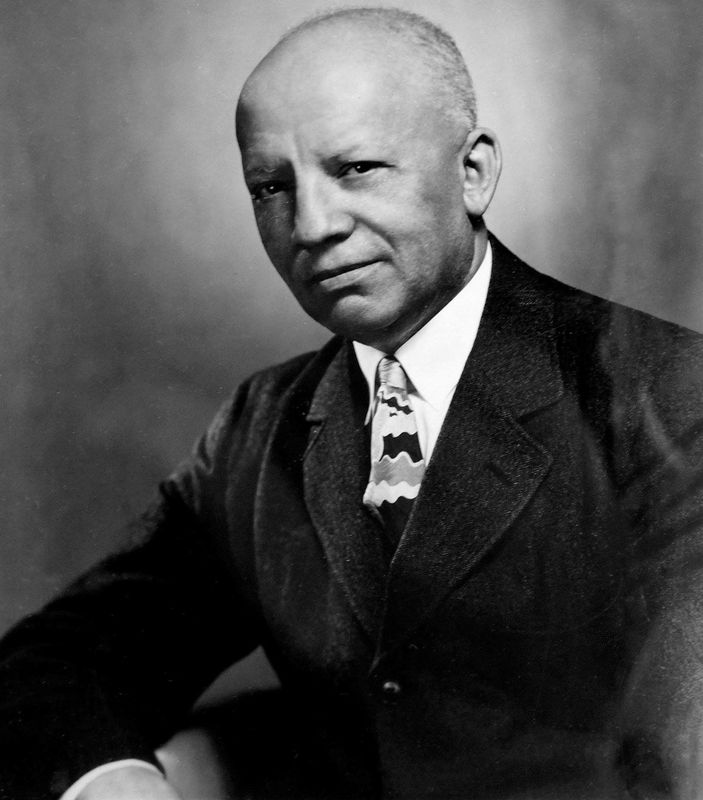
February is Black History Month, a time to honor Black people and the Black experience. It began as Black History Week, the brainchild of one man, 100 years ago this year.
State and national observance of Black History Month has been a little rocky lately, although a 1994 Florida law mandates the teaching of Black History in schools and the Department of Education promotes it.

In Florida, the DOE and Volunteer Florida once again invites students to submit art and essays for its annual Black History Month contests, with the theme “Celebrating Black History.” Four statewide winners will be selected, and each winner will receive a $100 gift card for school supplies and a 1-year pass to Florida State Parks.
“Black History Month is a time to celebrate the profound contributions of African Americans to Florida’s rich history and culture,” Commissioner of Education Anastasios Kamoutsas in a release. “I hope every student takes this opportunity to learn about the ways Florida has been shaped and strengthened by these contributions.”
Four statewide art contest winners from kindergarten through third grade will each receive a $200 gift card for school supplies and a 1-year pass to Florida State Parks. In the essay contest, two elementary school students (grades 4-5), two middle school students (grades 6-8), and two high school students (grades 9-12) will receive a 2-year Florida College Plan scholarship provided by the Florida Prepaid College Foundation and a $200 school supplies gift card.
In other areas, Black history advocates have brought up concerns over the state’s direction.
Black history facing challenges
In 2022 Gov. Ron DeSantis signed the “Stop WOKE Act” (CS/HB 7) which prohibits any teaching that could make students feel they bear personal responsibility, guilt, anguish, or “other forms of psychological distress” for actions in the past committed by members of their own race. It also blocks any instruction that suggests that anyone is “either privileged or oppressed” based on race or skin color.
DeSantis and the Florida Board of Education came under fire the next year for banning a pilot course in Advanced Placement African American Studies for conflicting with the Stop WOKE Act and approving a new K-12 curriculum. Critics blasted it, saying it whitewashed slavery and Florida’s role in it and downplayed racial atrocities committed in the state.
In the federal government, President Donald Trump on Feb. 3 issued a proclamation in the first year of his second term to honor “countless black American heroes.” He wrote that “‘black history’ is not distinct from American history — rather, the history of black Americans is an indispensable chapter in our grand American story.”
Last year, his proclamation came just a few days after the Defense Intelligence Agency issued a memo pausing all activities and events related to Black History Month, Martin Luther King Jr. Day, Juneteenth, LGBTQ Pride Month, Women’s History Month, National Hispanic Heritage Month, National Disability Employment Awareness Month, Holocaust Remembrance Day and other “special observances” as part of Trump’s orders to eliminate diversity, equity and inclusion (DEI) programs.
Every federal department and agency was required to purge any materials or policies that could be considered DEI-related. The Department of Defense removed several articles and photos linked to Black History Month, including one about Army Maj. Gen. Charles Calvin Rogers, the most senior Black soldier ever awarded the Medal of Honor. A story about engineering pioneer Hattie Peterson was taken down from the U.S. Army Corps of Engineers website. At Arlington National Cemetery, content and links about notable African Americans, Hispanic Americans and women buried there were removed or hidden. Several of these deleted items were restored after public pushback.
Here’s what to know about Black History Month.
What is Black History Month?
Black History Month grew out of a week created 100 years ago to honor two of the most important people in the history of Black emancipation in the United States. It is a month in which schools traditionally feature Black people and their contributions to history and culture, the history of slavery in the United States and the struggle to end it, the Civil Rights era, and the lasting effects in American life today.
Who created Black History Month?
Dr. Carter Godwin Woodson, a sharecropper and the son of formerly enslaved and illiterate Virginia parents, was a self-made man. He taught himself enough to start high school at the age of 20 and quickly went on to earn a bachelor’s degree in literature from Brea College and a master’s degree from the University of Chicago. Woodson became the second Black American (after W. E. B. Du Bois) to obtain a Ph.D. from Harvard University and he joined the faculty there, eventually becoming Dean of the College of Arts and Sciences.
Woodson saw that African-American history was being “overlooked, ignored or suppressed.” White institutions and textbooks seemed to have little to no interest in including any Black history curriculums, he said, and he devoted much of his life to encouraging Black Americans to learn more about their own heritage and accomplishments.
After seeing thousands of people lining up in 1915 to see a Black history display at a national anniversary of emancipation, Woodson founded the Association for the Study of Negro Life and History (later renamed the Association for the Study of African American History (ASALH). The next year he founded The Journal of Negro History to publish scholarly articles and book reviews on the African American experience. The journal is still going strong today as The Journal of African American History.
“If a race has no history, if it has no worthwhile tradition, it becomes a negligible factor in the thought of the world, and it stands in danger of being exterminated,” Woodson said.
Woodson died of a heart attack at the age of 74 in 1950. Two schools in Florida are named for him: Carter G. Woodson Elementary School in Jacksonville and Dr. Carter G. Woodson PK-8 in Tampa.
Why did Black History Month start? Why is Black History Month in February?
It started as a week.
Woodson had urged his Omega Psi Phi fraternity brothers to promote Black achievements, according to an essay by Daryl Michael Scott, a Howard University history professor and former ASALH national president, and in 1924 they created the Negro Achievement Week.
But Woodson wanted to go bigger.
He established Negro History Week in February 1926 to coincide with days that Black Americans already were celebrating, the birthdays of President Abraham Lincoln (Feb. 12) and abolitionist and orator Frederick Douglass (Feb. 14). With the help of Black newspapers and civic leaders, Woodson promoted a week of Black history to the traditional celebrations and it caught on.
“Rather than focusing on two men, the Black community, he believed, should focus on the countless Black men and women who had contributed to the advance of human civilization,” Scott wrote.
The demand for Black literature and culture rapidly grew in the 1920s and 30s and classrooms across the country demanded Black history curriculums. Woodson continued to promote celebrations but pushed schools to teach Black history all year and use the week to demonstrate what students had learned.
When did Black History Month begin?
Some people in West Virginia expanded the celebration to the whole month as early as the 1940s, and others in Chicago followed in the 60s. Interest grew nationwide during the civil rights era as Black college students were becoming more conscious of their links with Africa, Scott said.
In 1976, on the 50th anniversary of the first Negro History Week, ASALH changed it to Black History Month.
How to celebrate Black History Month 2026
“The history of the United States is certainly taught and conveyed all year long, but its greatest symbolic celebration occurs on one day, the Fourth of July,” Scott said. “Black History Month, too, is a powerful symbolic celebration. And symbols always stand for something bigger — in our case, the important role of Black History in pursuit of racial justice and equality.”
Black History Month is a time for everyone to celebrate and learn more about Black history and the achievements of Black Americans. Schools from K-12 to universities devote time for all students to study Black history studies, essays, presentations, songs, documentaries and more, and there are multiple public events and festivals.
What is this year’s Black History Month theme?
The theme of this year’s Black History Month is “A Century of Black History Commemorations.”
Does Florida celebrate Black History Month?
Black History Month is not a recognized state holiday, although the governor often issues a proclamation recognizing it and the Department of Education encourages it in schools.
Florida does observe Martin Luther King Jr. Day and Juneteenth, the day commemorating the date in Galveston, Texas, when the last enslaved people in the U.S. were finally informed they were free, two and a half years after the signing of the Emancipation Proclamation.
This will also be the second year Florida honors Tuskegee Airmen Commemoration Day as a state holiday, to commemorate the first Black military aviators in what wasn’t yet the U.S. Air Force. The day lands on the fourth Thursday in March, or March 26, 2026.
However, Florida also still honors three Confederate state holidays: Robert E. Lee’s birthday (Jan. 19), Confederate Memorial Day (April 26) and Jefferson Davis’ birthday (June 3).
Is Black History Month a federal or legal holiday?
No. But every U.S. president since Gerald Ford has issued a statement honoring the spirit of Black History Month and in 1986 the U.S. Congress designated the month of February as “Black History Month.”
C. A. Bridges is a journalist for the USA TODAY Network-Florida’s service journalism Connect team. You can get all of Florida’s best content directly in your inbox each weekday day by signing up for the free newsletter, Florida TODAY.
This article originally appeared on Tallahassee Democrat: Black History Month turns 100 this year. Is it taught in Florida?
Reporting by C. A. Bridges, USA TODAY NETWORK – Florida / Tallahassee Democrat
USA TODAY Network via Reuters Connect