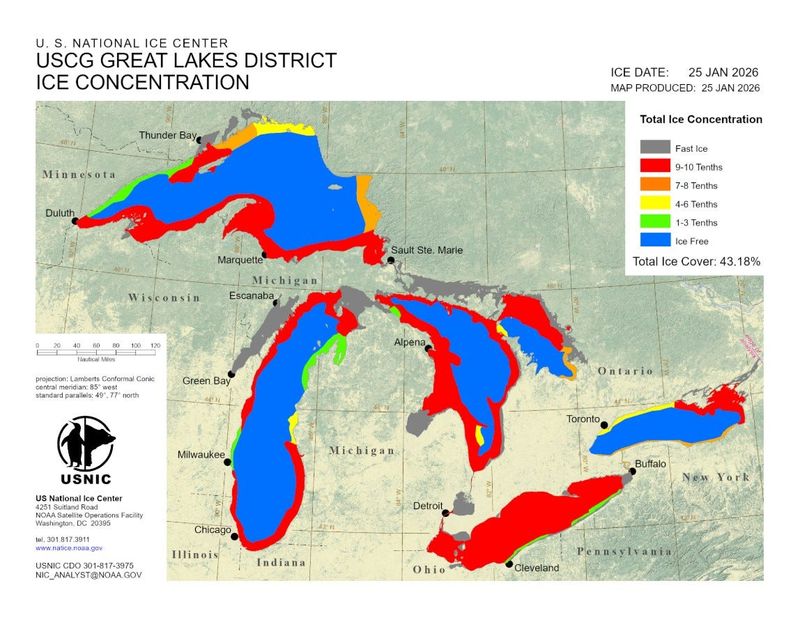
After a deep freeze across the Great Lakes region, Lake Erie is nearly completed iced over and the rest of the lakes have seen significant increases in coverage.
Researchers on Sunday, Jan. 25, reported the Great Lakes were 43.18% frozen over — about an 18 percentage point increase from last week. The jump coincides with a surge of Arctic air that moved in Thursday, Jan. 22, according to the National Oceanic and Atmospheric Administration’s Great Lakes Environmental Research Laboratory.

Lake Erie was nearly frozen over at 92% coverage. Ice ranged from 2-12 inches, with the thickest along shoreline. Lake Huron was 51.61% covered, researchers said.
The thickest ice has formed along Lake Superior’s shorelines — 12-28 inches in places — with lakes Erie, Michigan and Huron reporting thickness from less than 2 inches up to 12 inches.
The Arctic temperatures are forecast to linger in Michigan through the work week, so ice is likely to expand further.
Lake Superior is forecast to see above-normal ice conditions this winter. Lake Ontario is forecast to see slightly below-normal ice; and lakes Huron, Michigan, Erie and St. Clair are predicted to see near-normal ice, according to the North American Ice Service’s seasonal outlook, issued on Dec. 1.
Last season, the Great Lakes experienced ice levels that were near normal, rebounding after the historic winter low in 2023-24. Lake Erie recorded the highest amount of coverage in 2024-25, reaching 95.8% (which is typical as it is the shallowest of the Great Lakes) and Lake Superior had the second-most coverage at its peak, 71.1%.
As the 2025-26 ice season continues, researchers will track ice percentages daily. To track the progression, the U.S. National Ice Center posts ice charts every Tuesday and Wednesday.
Here’s more ice on Michigan’s Great Lakes:
How much ice is on Michigan’s Great Lakes?
Great Lake researchers reported 43.18% coverage on Sunday, Jan. 25, according to the U.S. National Ice Center’s twice-weekly updates.
According to the center’s thickness chart, the thickest ice — 12-28 inches — is found along Lake Superior’s northern shore, near Thunder Bay, Ontario, Canada, and southwestern shore near Ashland, Wisconsin. In addition, thick ice continues to grow along Munuscong Lake, located in the eastern U.P.
Which Great Lake sees the most ice coverage?
Here’s the ice coverage for each Great Lake as of Jan. 25:
Do the Great Lakes freeze over completely?
Yes. Though, it is rare for the entire lake system to freeze over, ice coverage can still reach 90% or more.
According to GLERL’s records, two lakes have frozen over completely: Lake Superior in 1973 and 1996; and Lake Erie in 1978, 1979 and 1996.
Lake Superior almost froze over — at 92-96% ice coverage — during the 2013-14 ice season, according to Northern Michigan History.
When do the Great Lakes have the most ice?
Maximum ice coverage takes place later in the winter season. In the lower lakes, peak ice is seen from from mid-February to the end of February; and for the upper lakes it is from the end of February to early March, according to the GLERL.
The overall highest percentage of ice coverage for all the Great Lakes took place in 1979 when they were 94.7% covered, NOAA said.
When does ice develop on average on Michigan’s Great Lakes?
According to the NOAA’s GLERL, here is 2025 data:
Lake Michigan
Lake Huron
Lake Superior
Lake Erie
Lake Ontario
Which Great Lake gets the most ice during winter?
Historically, Lake Erie freezes and thaws the quickest due to its shallow depth, the shallowest among the Great Lakes.
The average depth of Lake Erie is about 62 feet, 210 feet, maximum — with 871 miles of shoreline, the Great Lakes Commission said.
How deep are the Great Lakes?
Here are the other average depths for the Great Lakes, from deepest to shallowest from the U.S. Environmental Protection Agency:
Contact Sarah Moore @ smoore@lsj.com
This article originally appeared on Lansing State Journal: Lake Erie is nearly frozen over. How much is covering Great Lakes?
Reporting by Sarah Moore, Lansing State Journal / Lansing State Journal
USA TODAY Network via Reuters Connect