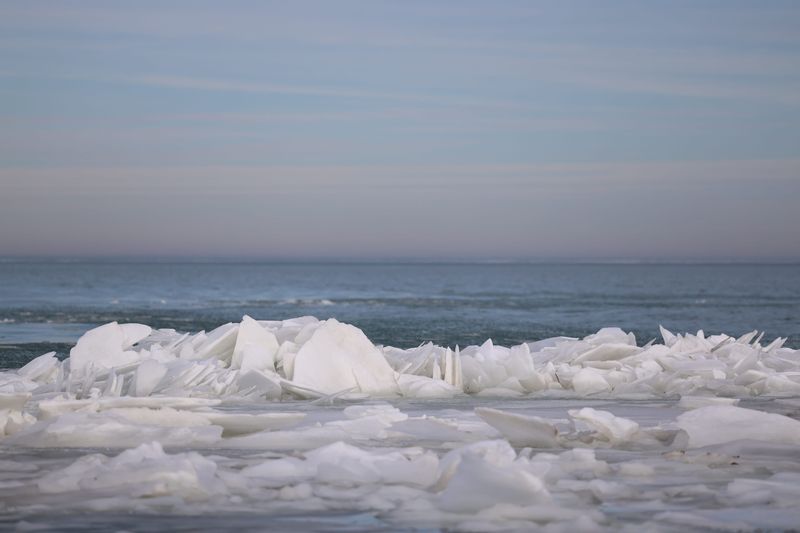
A powerful winter storm — stretching across the entire eastern half of the United States — is gripping Michigan and the Great Lakes region, coating Lake Erie in ice and sleet while dumping snow across the state.
As the Arctic blast moves through, Lake Erie already has extensive ice cover, with 75% of the lake frozen and only a narrow stretch of open water from Conneaut, Ohio, to Dunkirk, New York, according to the National Oceanic and Atmospheric Administration. Strong winds across the lakes are pushing ice, creating jagged ridges along the shoreline and contributing to shifting ice sheets on the water.

These conditions can also trigger seiches, briefly exposing lakebeds, piers and other features before the water surges back. Rapid ice formation and breakups along the shore highlight how massive bodies of water respond to Arctic air and changing wind patterns.
As the storm continues across the region Sunday, Jan. 25, these effects are expected to intensify, with expanding ice cover, shifting ice sheets and dramatic winter conditions across the Great Lakes.
What is glass ice?
Glass ice forms when extremely cold air moves over relatively calm, shallow water, allowing ice to freeze rapidly before air bubbles or snow become trapped inside. The result is ice that appears clear rather than cloudy or white.
This type of ice is most likely to develop along shorelines, bays and harbors — especially during Arctic outbreaks, when temperatures drop well below normal and winds briefly ease.
Unlike thicker, opaque lake ice, glass ice is often thin and fragile, even when it looks solid.
Why Lake Erie is more prone to creating glass ice and freezing
Lake Erie is the shallowest of the Great Lakes, which makes it more responsive to sudden temperature swings. During strong Arctic outbreaks, surface water can cool and freeze more quickly than in deeper lakes like Superior or Michigan.
That shallow depth is also why Lake Erie is the Great Lake most likely to freeze extensively during winter — though full ice cover still requires prolonged cold.
Will Lake Erie get a seiche this week?
A seiche is a sudden rise or fall in a lake’s water level caused by strong winds or shifts in air pressure, according to NOAA. On the Great Lakes, seiches can make water levels along the shoreline fluctuate by several feet in just a few hours.
They happen when sustained winds push water toward one end of the lake, causing it to pile up, then the water sloshes back once the wind eases or changes direction. During a blizzard over Thanksgiving weekend, a seiche-like event even revealed a sunken shipwreck on Lake Erie, believed to date from before the 1900s.
For the current winter storm, a major seiche is unlikely.
That’s because surface winds across Lake Erie are forecast at 10–25 knots, shifting from northeast today to northwest tonight, then west to southwest Monday, Jan. 26. Gusts at 100 feet reach 20–35 knots in some areas, according to the National Weather Service. While these winds are moderate to strong, most of Lake Erie is ice-covered, which suppresses wave formation and limits water movement.
Seiches generally require strong, sustained winds along the full length of the lake. The combination of ice, variable wind directions and only moderately strong winds means the potential for a significant surge is low. Small fluctuations along exposed shorelines are still possible, but a dramatic rise or drop in lake levels is not expected during this storm.
Lake Erie webcams
Port Huron, Michigan
Detroit River, Detroit, Michigan
Lakeside Landing, Lorain, Ohio
Barcelona Harbor, Westfield, New York
Current Michigan weather warnings, watches, advisories
Michigan Upper Peninsula Doppler radar
Stay informed. Get weather alerts via text
Brandi D. Addison covers weather across the United States as the Weather Connect Reporter for the USA TODAY Network. She can be reached at baddison@gannett.com. Find her on Facebook here.
This article originally appeared on Detroit Free Press: Winter storm covers Lake Erie in ice and snow. See live cams
Reporting by Brandi D. Addison, USA TODAY NETWORK / Detroit Free Press
USA TODAY Network via Reuters Connect