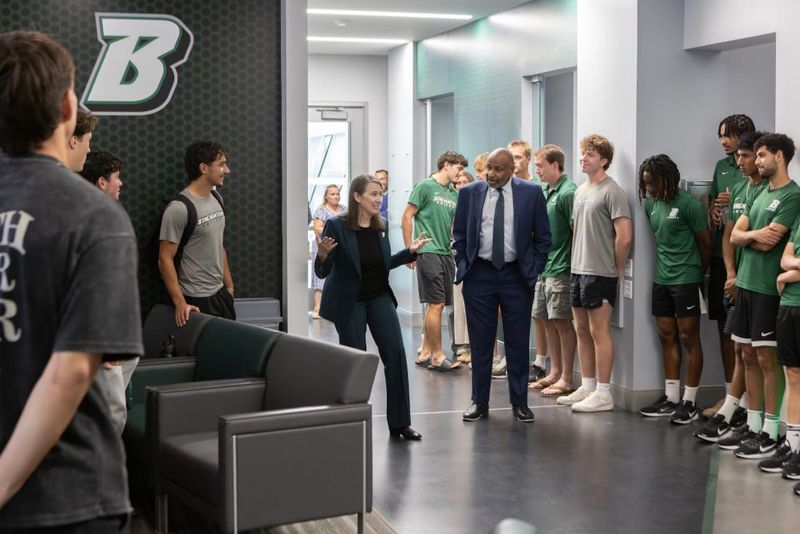
On a frigid winter day, Binghamton University’s newest president took to the stage to deliver her first State of the University address.
President Anne D’Alleva’s address focused on insights gained throughout her listening tour, a look into the University’s future and the sense of community D’Alleva wishes to continue cultivating. D’Alleva began her work as president in November 2025, taking over for former president Harvey Stenger.

Throughout her first few months in the position, D’Alleva conducted a “Listening to Lead Tour,” consisting of meetings with students, faculty, staff, alumni, community partners and local government.
AI at the forefront for Binghamton University
One focus of the State of the University was the establishment of Binghamton’s Center for AI Responsibility and Research. On Jan. 13, Gov. Kathy Hochul announced $55 million in funding for the new AI research center.
The funding is supported by a $30 million donation, the largest academic gift in University history, from a group of donors led by alumnus Tom Secunda. The center will also be funded by $25 million in SUNY research capital investment.
The center, which will be the first independent AI research center at a public university, will focus on responsible AI research with a focus on advancing the public good. It is expected to attract top industry talent to campus.
Binghamton earns Carnegie classification for community engagement
During her address, D’Alleva referenced the Carnegie Elective Classification for Community Engagement given to Binghamton University in January. The recognition is given to universities that build and maintain meaningful partnerships with their surrounding communities.
D’Alleva emphasized Binghamton’s efforts surrounding community engagement, and said the university would continue to focus on engaging and supporting the local Binghamton community.
“We are embedding this work — and this way of thinking — into the curriculum as well as co-curricular activities so that all students gain experience in asking how they can solve real-world problems and serve others,” she said.
Binghamton University continues to grow in Broome County
D’Alleva’s listening tour consisted of 38 meetings in 44 days, with consistent updates posted to the Listening Tour Blog page. Following the conclusion of her listening tour, D’Alleva said she plans to post a new blog post every Monday, ensuring university partners are constantly up to date.
D’Alleva’s address showed a distinct focus on celebrating and maintaining Binghamton’s history while ensuring the university continues to advance and prepare for the future. In 2026, Binghamton University will celebrate its 80th anniversary.
“Despite how Binghamton has grown, it hasn’t deviated from its original mission,” said D’Alleva. “For 80 years, this place has been driven by the core mission of giving talented students the opportunities and resources they need to make our world a better place. Our commitment is to continue to grow and amplify that mission into the next eighty years.”
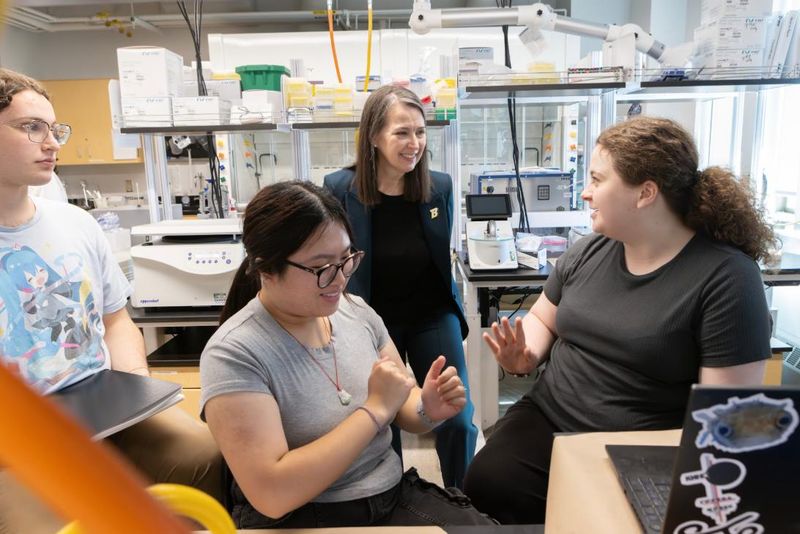
Throughout her listening tour, D’Alleva found many university members found immense value in research opportunities — and want even more. D’Alleva said Binghamton’s size leads to a perfect space to advance research — Binghamton is large enough to support many different programs, but not so large to create a strict divide between programs.
At the State of the University, D’Alleva announced a new ten-year goal of doubling the university’s annual research expenditures to around $180-$200 million per year.
“In order to grow, we’re going to need more dedicated space for research,” said D’Alleva. “We also need to continue to work with industry partners to maximize the potential for tech transfer, entrepreneurship and economic development. And we need not only additional faculty and staff, but also more graduate students to assist in these efforts.”
D’Alleva also said the University needs to work to improve its already excellent graduate student experience by fostering a sense of community, supporting career development and addressing material needs such as graduate student housing.
D’Alleva said another focus on the university is increasing available spaces, both in a residential and academic sense. A new lecture hall and classroom building will be completed in 2027, with a total of 1,900 new seats created.
The University has also purchased the former Columbian Financial Group office building on Vestal Parkway, and plans to relocate back of house staff to the building, allowing for increased research space, clinical and student services at the main campus. D’Alleva also announced a new residence hall, Grace Hall, which will open in 2027, adding 350 beds to the university.
D’Alleva also said a top priority for the university is the addition of a new research building to campus in the future.
Binghamton not a ‘hidden gem,’ will rebrand for more visibility
D’Alleva said another focus of the university moving forward is increasing national visibility through a rebranding effort.
“One of the phrases I heard often during the tour is that Binghamton is a hidden gem,” said D’Alleva. “I appreciate the sentiment — Binghamton is certainly a gem — but there’s broad consensus that we don’t have to be hidden.”
D’Alleva clarified that the university’s logo and colors won’t change, but that the rebrand will center on sharing Binghamton’s story outside of just New York state.
“We’re doing this in part to reach prospective students, especially those from other states and from other nations,” she said. “Another important goal is making sure our peers in higher education are aware of the great things happening at Binghamton.”
D’Alleva shares strategic planning for Binghamton University’s future
During her address, D’Alleva provided a timeline for Binghamton’s strategic planning. D’Alleva said the university’s plans would align with the Middle States Commission on Higher Education self-study process in preparation for the 2028-29 accreditation cycle.
D’Alleva emphasized former president Stenger’s Road Map, which outlined the university’s focus on its future, setting the stage for a new strategic plan.
“What you can expect is a further commitment to excellence across the four pillars of our work: teaching and learning, research and scholarship, economic development and community engagement,” said D’Alleva. “You’ll see a tangible and realistic pathway to achieving Binghamton’s goals of continuing to grow into one of the nation’s best public universities.”
Between January and March, the university will gather information from students, faculty and staff to outline the school’s strategic priorities. In March and April, five-year actions and the metrics to evaluate them will be determined, with the plan finalized by the end of the spring 2026 semester.
For more information regarding Binghamton University’s strategic planning process and timeline, visit binghamton.edu/strategic-plan-process/index.html.
As part of its strategic planning, the school will also be updating its mission, vision and value statements, with final statements expected to be ready in the near future.
This article originally appeared on Binghamton Press & Sun-Bulletin: New Binghamton president outlines plans in 2026 State of the University
Reporting by Riccardo Monico, Binghamton Press & Sun Bulletin / Binghamton Press & Sun-Bulletin
USA TODAY Network via Reuters Connect