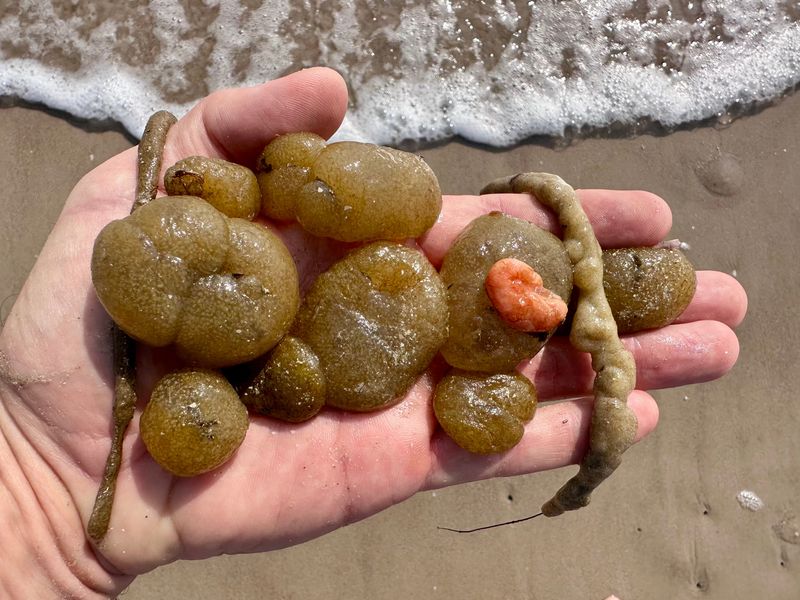
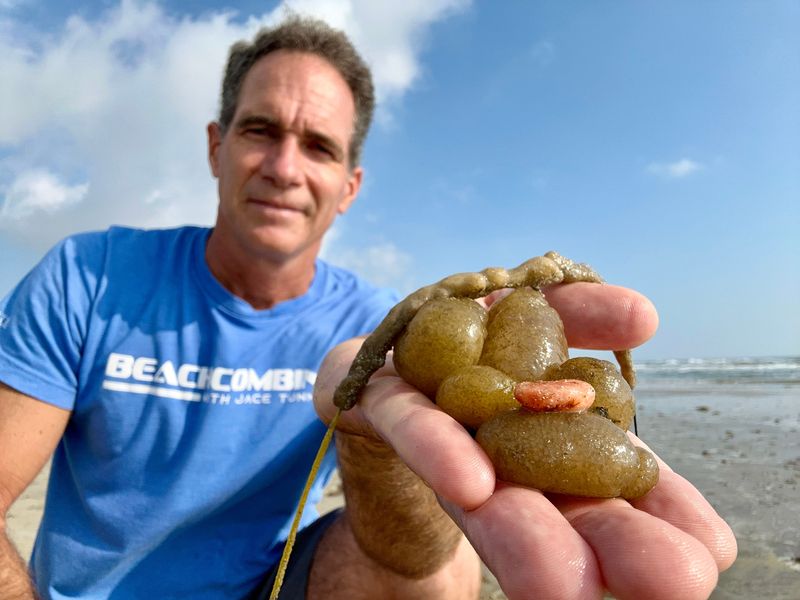
Beachcombers along the Texas Gulf Coast may have paused mid-walk this week after spotting unusual orange, green and brown blobs scattered along the shoreline. These squishy surprises are known as sea pork, a type of tunicate, part of the group commonly called sea squirts.
At first glance, sea pork doesn’t look like much more than a blob of goo. Some of this week’s finds were still attached to sea whip soft corals, while others were free-floating, likely torn loose by waves or rough seas.

Their lumpy, rubbery texture and muted colors make them easy to mistake for something artificial, but they are very much alive (at least when freshly washed in).
All tunicates, including sea pork, are sea squirts, and yes, sea pork does have siphons like other tunicates. These small openings act as inlets and outlets for seawater. Sea pork are filter feeders, pulling water in through one siphon to trap microscopic plankton, then pushing the water back out the other. If handled, they can suddenly expel that water, earning their memorable “sea squirt” nickname and occasionally surprising curious beachcombers.
Identifying sea pork is fairly simple: Look for a soft, squishy body with a bumpy or wrinkled surface, usually shaped like an irregular lump rather than a neat oval. They don’t sting, bite or move around, making them harmless to observe, though they may feel like a wet stress ball.
And now the question many Texans are wondering: Does anyone eat sea pork along the Texas coast? The short answer is no. While tunicates are eaten in some parts of the world, local seafood lovers wisely stick to shrimp and oysters. Between the rubbery texture, strong ocean smell and overall “blob factor,” sea pork remains a beach curiosity rather than a menu item.
So, if you encounter sea pork on your next beach walk, enjoy the oddity. The Gulf Coast always has a few surprises squished between the shells.
Jace Tunnell is the director of community engagement for the Harte Research Institute at Texas A&M University-Corpus Christi. His Beachcombing series appears on YouTube, and you can follow Jace at harteresearch.org, or Facebook (facebook.com/harteresearch), Instagram (@harteresearch) and X (@HarteResearch).
This article originally appeared on Corpus Christi Caller Times: What are those orange and brown blobs on the beach? Meet sea pork
Reporting by Jace Tunnell, Harte Research Institute / Corpus Christi Caller Times
USA TODAY Network via Reuters Connect