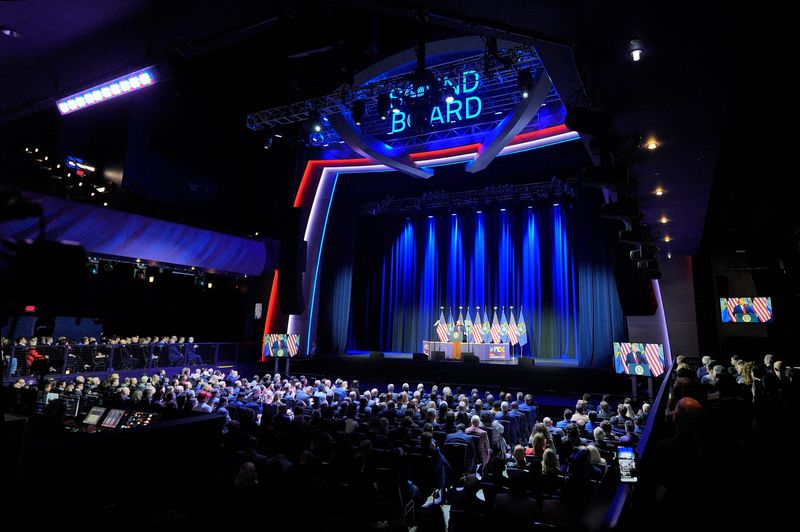
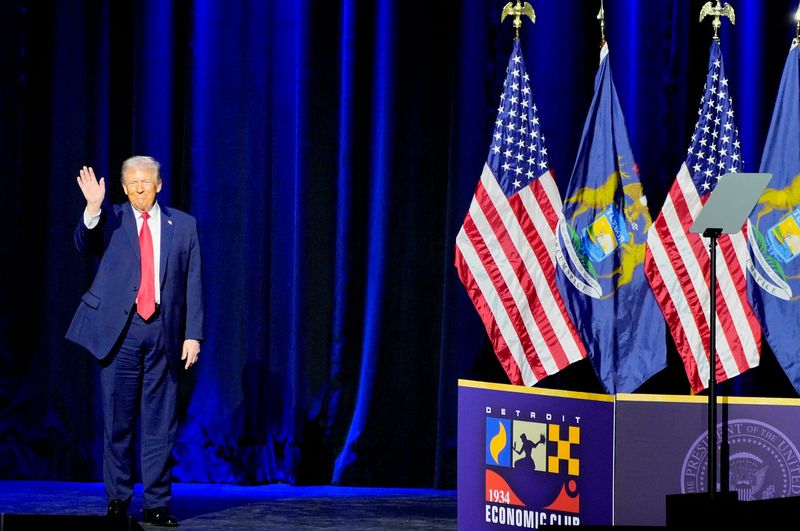
President Donald Trump visited Detroit on Tuesday, Jan. 13 to declare that the economic boom he promised Michigan during the 2024 campaign is well underway, but his perception is not shared by many Michiganders or supported by recent economic data.
Trump, in an hourlong speech to the Detroit Economic Club as protesters demonstrated at two nearby locations, said the impact of his aggressive tariff policies has exceeded even his own optimistic expectations.

“One year ago, we were a dead country,” Trump said during a speech in which he repeated familiar phrases from other addresses and few lines drew more than tepid applause. “Now, we are the hottest country anywhere in the world.”
In fact, though growth in U.S. gross domestic profit exceeded expectations in the third quarter of 2025, it slowed more than expected in December amid business caution about hiring because of import tariffs and rising artificial intelligence investment, Reuters reported Jan. 9, while the U.S. unemployment rate dipped to 4.4% from 4.5% in November.
The most recent Bureau of Labor Statistics figures from November also show the number of auto and auto parts jobs combined down in Michigan and across the nation compared with December 2024, the month before Trump took office.
At a business panel discussion that preceded Trump’s appearance, Mary Buchzeiger, CEO of Lucerne International, a global auto supplier based in Auburn Hills, voiced a view shared by many business leaders that tariffs will hurt U.S. competitiveness.
“Tariffs are a tax on U.S. citizens,” Buchzeiger said. “People don’t realize that.”
Trump pointed to lower gas prices, a booming stock market, and signs that the U.S. trade deficit might be shrinking, along with his administration’s efforts to reduce fraud related to government social programs.
Trump arrived in Detroit for his first Michigan visit of 2026 amid continued concern among automakers and consumers about his tariff-focused trade policies, and amid recent controversies about the Jan. 7 fatal shooting of 37-year-old Renee Good by an Immigrations and Customs Enforcement officer in Minneapolis, the Jan. 3 U.S. military extraction of Venezuelan President Nicolas Maduro, and the Jan. 11 disclosure that the U.S. Justice Department has launched a criminal investigation of Federal Reserve Chair Jerome Powell, all as Trump mulls possible military strikes against Iran and has renewed talk about taking over Greenland, a semiautonomous territory of NATO ally Denmark.
Michigan automakers, who were encouraged under President Joe Biden to invest heavily in electric vehicle technology and manufacturing, have faced costly adjustments amid policy reversals under Trump, while at the same time responding to tariffs. On Dec. 15, Ford said it will record $19.5 billion in special charges related to restructuring its business, including pulling back its all-electric vehicle investments. GM has pegged its loss related to pivoting away from EVs in 2025 at $7.6 billion. Stellantis in October announced a $13 billion investment in U.S. manufacturing, including significant investments at two Michigan plants and moving production of the Jeep Compass away from Ontario, as earlier planned, to Illinois.
Michigan will be a crucial state in the November midterm elections, as Trump hopes to hold or expand Republicans’ narrow control of Congress amid 2.7% inflation in December and low approval numbers. Michigan’s 2026 calendar includes an open U.S. Senate seat to replace Democratic U.S. Sen. Gary Peters, who is stepping down after two six-year terms, and several competitive U.S. House elections. Trump has stressed the importance of the midterms and pushed some states to redraw district lines to improve GOP chances. He has talked about the need to ban absentee voting by mail, raising concerns about voter suppression under the guise of election security. In September, the Trump administration sued Michigan and five other states for refusing to turn over complete voter registration data that Michigan Secretary of State Jocelyn Benson says includes personal data the U.S. Justice Department isn’t automatically entitled to under the law.
After Trump’s speech, Democratic National Committee Chair Ken Martin accused the president of trying to mislead Michiganders. “Under Donald Trump’s failed economic policies, Michiganders are seeing their paychecks get tighter, and jobs disappear. And today, Trump tried to gaslight Michigan families once again — but they weren’t fooled — because new polling shows that Donald Trump is disastrously unpopular in Michigan,” Martin said in a statement.
Earlier on Jan. 13, Trump toured Ford’s Dearborn Truck Plant, where the popular F-150 pickup truck is manufactured. Trump was joined on the tour by Ford Executive Chairman Bill Ford, Ford CEO Jim Farley, and U.S. Treasury Secretary Scott Bessent.
Trump addressed the Detroit Economic Club twice before, during his 2016 and 2024 campaigns, but Jan. 13 was his first speech to the business group as president. Trump’s 2024 remarks drew criticism when he said, in a comment not seen as complimentary, that the whole country would look like Detroit if then Democratic Vice President Kamala Harris won the election.
Just down the street from the Jan. 13 event, at Trumbull and Temple, The Drop Trump Coalition assembled a crowd of over 100 to protest the president’s visit as cars driving down Trumbull honked regularly in sporadic bursts of support.
Sam Poirier, 21, had the day off work and drove down from Adrian to protest on behalf of her siblings, some of whom she said are Latino and have voiced fear over getting pulled over or taken by ICE agents regardless of their status as American citizens.
Poirier said regardless of where someone stands on the political spectrum, government agents acting aggressively against their own citizens should be concerning. “When it happens to one person, it opens the door up for it happening to others,” she said.
Protesters also gathered at Detroit’s Cass Park.
Ann Smith, a 52-year-old Ypsilanti resident, said she joined the protest because she believes “everything going on in the world right now is unacceptable.”
Smith said she was alarmed by the police response as officers repeatedly ordered demonstrators to move and warned of possible force if they did not comply.
Free Press staff writers Beki San Martin and Darcie Moran contributed to this report.
Contact Paul Egan: 517-372-8660 or pegan@freepress.com.
(This story was updated to add a video and remove a location marker.)
This article originally appeared on Detroit Free Press: In Detroit speech, Trump touts an economic boom invisible to many
Reporting by Paul Egan and Todd Spangler, Detroit Free Press / Detroit Free Press
USA TODAY Network via Reuters Connect