Pensacola’s 2025 began with a historic snowstorm and ended with the city fully committing to the redevelopment of the old Baptist Hospital—the largest project the city’s taken on since Community Maritime Park.
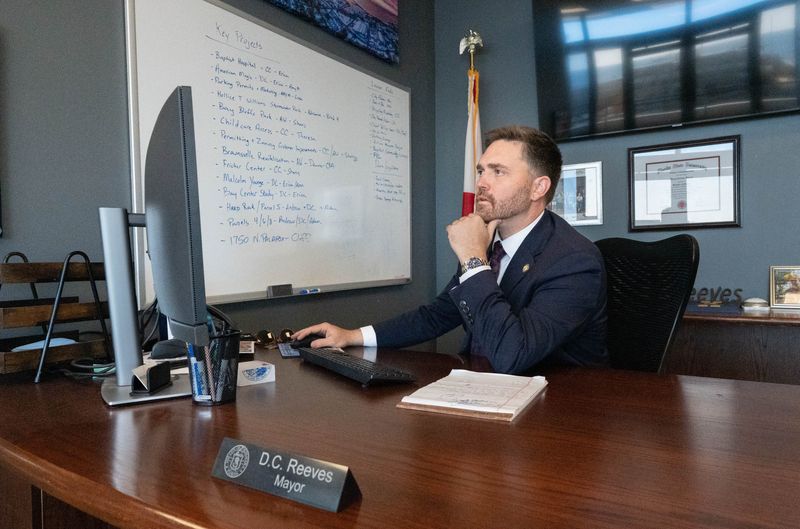
The News Journal sat down with Pensacola Mayor D.C. Reeves as the year came to a close to discuss the city’s last year and what it’s facing in 2026.

It’s been Reeve’s third year in office, and as the third mayor under the strong-mayor form of government, he’s become the face of the city.
The last year was marked by both successes for the city and increased criticism as the city faced the forced resignation of a police chief, scrutiny from state officials over city spending in a larger statewide anti-property tax push, and City Hall becoming a battleground in the culture wars as a drag show at the city-owned Saenger Theatre became the target of conservative activists.
“This year was a test for us,” Reeves said. “There’s no doubt. A test for me personally, test for our staff, but as I’ve shared with our 880 employees, I feel as positive as ever about where we’re going.”
Reeves on filing for reelection
The coming year is also an election year, and on the same day Reeves talked to the News Journal, he also filed for reelection.
Reeves has previously said he believes the job of mayor is an eight-year job.
“Whether you agree with something that we’ve done, or you disagree, I can certainly say that we have fulfilled the promise that we would work with urgency, and that’s what I believe the strong mayor format requires,” Reeves said. “Whoever is the mayor after me, they’ve got to be ready to buckle up and get after projects with real urgency and real intentionality. Because if you don’t, then you’re really giving away the value of the strong mayor format to begin with. And part of the advantage of this format is that government can move quicker and we can get behind ideas together, both the council and myself.”
Reeves said many of the projects he began in his first year in office, such as a massive airport terminal expansion, American Magic headquarters’ move to Pensacola, development of the $41 million Hollice T. Williams Greenway, redevelopment of the old Baptist Hospital site, salary reform in the city, and Palafox Street renovation, are now becoming a reality.
“That’s not going to be something that can take place in a four-year term,” Reeves said.
Redeveloping Baptist Hospital
The redevelopment of the old Baptist Hospital will likely be a multi-decade commitment from the city, and it has started to take shape in the final months of 2025.
The decision to table the city’s selection of a redevelopment advisor after strong pushback from members of the public during a Dec. 11 council meeting indicates how important the issue will be in the coming year.
“When this year started, we weren’t sure what the price was going to be, or if it even could be done,” Reeves said. “And I think even in recent conversation, that gets lost.”
Reeves said he’s proud of what the city staff has accomplished on the old Baptist Hospital project.
“To think two years ago, there was no funding, no future of demolition. It could have sat there for years like so many other cities. And … our biggest issues now are how we’re going to meet and talk about it as a community, because we’re taking for granted that a $13 million demolition is funded and going to be taking place in 2026.”
Nevertheless, Reeves said he believes that a lot of the criticisms of the Bayou District Consulting were based on misinformation.
“Really, every consequential fact that was stated about me, about the Bayour District folks, was nonsense,” Reeves said.
Reeves pointed to misleading narratives, like the Bayou District Foundation was responsible for the displacement of people in New Orleans, and that he had unduly influenced the selection committee.
The decision to close the St. Bernard public housing complex was made by the Housing Authority of New Orleans in 2006 when it was under the control of the U.S. Department of Housing and Urban Development, according to public documents. Bayou District was chosen to redevelop the site after the decision as part of a broader federal policy to shift to mixed-income housing instead of developments made up of only public housing.
Reeves said he hired Bayou District as a consultant because he promised the community would drive what comes next at Baptist Hospital.
“That was what my promise was, because I didn’t want the misperception that a wrecking ball, figuratively speaking, was going through the hospital and we didn’t know what was coming after it,” Reeves said.
The decision on how to move forward is entirely in the hands of the City Council, Reeves said, while adding he knows two council members are asking Bayou District Consulting to come back to the table.
“I brought forward my proposal and what I had promised,” Reeves said. “It didn’t go that way. I’m happy to continue to collaborate with them, but at the end of the day, this was their vote of no. And so whichever direction they want that to go, whether it be with Bayou District Foundation or someone else, that’s their baton to pick up at this point.”
Will the redevelopment of the old Baptist Hospital displace anyone?
One of the biggest fears cited by speakers at the Dec. 11 meeting was the fear that people would be displaced by the project.
While no one lives in the area that will be demolished, there is the fear of rising property values and rents causing the neighborhood to become unaffordable for the long-time residents of the predominantly Black neighborhood.
“Gentrification is a big word that is used and weaponized sometimes,” Reeves said. “I think there are real scenarios of it, in an extreme scenario. I certainly don’t think that that is necessarily the case around this campus.”
Reeves said he doesn’t know of anyone who says the old hospital should not be redeveloped in some form, so the question is what will replace it.
Reeves said short of leaving in a 38-acre green field, he doesn’t know what the city could do not to increase property values in the surrounding area—and that might still lead to an increase in values.
“So I think where we are right now is, let’s decide as a community, what we think brings the most value,” Reeves said. “You know that Save Our Homes exists. If you are homesteaded anywhere in our city, your property tax can only go up 3% per year. If you live in it for 30 years, then you’re paying a taxable value of probably 10% of the value of your house, and it’s only been going up 3% a year. That gets left out in this conversation as well.”
Reeves said that’s why he believes it was important to hire experts like Bayou District Consulting to take in the community’s ideas and concerns and create a “realistic” vision of what is possible.
“For the folks like Councilman Wiggins who say, ‘We want to take another look at it,’ — great,” Reeves said. “Let us know when you’re ready to take a look at that. If the idea we had wasn’t going to work and there’s something else that’s out there, then we’re happy to take a look.”
Affordable Housing
This last year also saw the city partner with the Northwest Florida Community Land Trust, with Pensacola Habitat for Humanity, and the Northwest Florida Home Builders Association to bring three homes into the trust, and more are on the way.
With the land trust, the affordable homes are sold to buyers, but the trust continues to own the land. Because of the ownership structure, when the homeowner sells the home, they get their equity out of the home, but it remains affordable for the next buyer.
The CLT has been a small but bright spot for the city’s affordable housing efforts that have otherwise slowed down. Reeves has seen the city buy different properties for future affordable housing projects like the Pensacola Motor Lodge, but most of those projects are likely years from coming to fruition.
Reeves said to make housing affordable in the city, there needs to be building all levels across the “spectrum of affordability” from homeless transitional to workforce to full market rate.
“The problem is these projects are judged and evaluated in silos,” Reeves said. “A new project gets built. ‘I can’t believe you’re not doing affordable.’ OK, this affordable project gets built. ‘Well, wait, that isn’t affordable for me.’ ‘Hey, I don’t qualify for that.’ And so we always leapfrog negatively from one to another, when the reality is that the grand picture is we need housing at every level to attack this problem.”
One of the bigger problems is that a lot of the new housing activity is happening at market-rate levels and higher, while the affordable housing projects wait for state and federal funding opportunities.
“Absolutely, the wheels of government are the hindrance to affordable housing, period,” Reeves said. “You need two things for affordable housing to happen at scale. You need private or nonprofit interest, meaning, the city is not going to construct housing on its own, right? We aren’t going to be the contractor. You need a partner, be it a private partner, which happens, and we have some that are moving now, or a nonprofit, like a Habitat for a Community Land Trust, Home Builders, these nonprofit organizations.”
The second thing you need to get affordable housing is a subsidy, Reeves said. He added that he believes the best subsidy the city can provide for affordable housing is the land itself.
Reeves pointed to the Baptist Hospital project as an example, and the city is spending $16 million to demolish the hospital so it will be left with property that is worth about $10 million that can be put toward whatever type of affordable housing project the community can support.
“So in essence, all of this time going to County Commission and go to the state and go to Tallahassee, what was that for? It was for us to create the subsidy that is absolutely required if we ever want to have housing affordability,” Reeves said. “It will not appear out of thin air, from a private developer. And the city is not going to get in the business of building apartment buildings on their own. We don’t have the funding for that. Nor do I really believe that it’s the local government’s responsibility. It’s our responsibility to catalyze affordable housing growth.”
Property tax amendments in 2026
Exactly what the city can afford could change radically depending on the outcome of the Legislature’s decision on property tax changes, and if those changes are approved by voters in the fall.
Despite many of the proposals currently pending before the Legislature banning cities from cutting spending on public safety, Reeves questioned the legality of those kinds of bans, but even if they were deemed legal, then city governments would be radically altered with massive cuts to other city services.
About a third of the city’s general fund comes from property taxes, which, depending on the year, is $25 million to $27 million.
“The cost of us funding Police and Fire is well north of $40 million,” Reeves said. “So when you hear folks say, ‘Oh, well, we’re going to run this piece of legislation, or we’re going to put it on a constitutional amendment, but cities aren’t going to be able, they’re not going to touch police and fire.’ Well, then my natural—maybe rhetorical—next question is, then which department would you like to eliminate?”
Reeves pointed out the city hasn’t raised its property tax rate since 1994, but he’s always open to new ways of looking at things. He said he agrees that the homestead exemption needs to be raised to keep up with inflation, but the idea that it won’t have a cost to the community is also wrong.
“Because the reality is that money won’t be there for Parks and Rec, for sidewalks, for how many police and firefighters (we need),” Reeves said. “The reason we’re a top 1% Fire Department is because we can invest in it. The reason that we’re the fourth safest city in the United States is because we want to invest in it. So don’t be fooled by the value proposition that this is merely a decision of whether you would like to pay or not pay property tax.”
More free parking coming downtown?
Downtown parking is another issue that will continue to land on the mayor’s desk in 2026 — especially in the first half of the year as the city undertakes the New Palafox Street project.
As part of that project, the city is making 412 city-owned paid parking spaces near Palafox Street free until the project is complete.
While that free parking will be temporary, Reeves said he expects to announce a review next year of whether some currently paid areas will be changed to free parking or paid only on weekends based on the data the city has been collecting over the last few years.
“Councilwoman (Allison) Patton and I have already talked about this,” Reeves said. “We’ll probably have something more formalized in January of just really having a review, and I’ll curb expectations that we would be going back to free parking. What we’re saying is, ‘Hey, we’ve got this downtime for these next several months for a significant portion of our paid spaces—well over 25% of our paid spaces are going to be free—that’s probably a good pause button time. And we have enough runway of data from the changes from going to midnight, going to $1 an hour. So it is our duty to take a look at that.”
The city rolled out new discounts to its paid parking program last year, including a resident discount that eliminates the transaction fee for paying for parking with your phone if you’re a city resident.
Reeves added that the top complaint he still receives about parking is when someone is upset over the price they’re being charged in a private lot that the city has no control over, but it was one of the reasons he pushed for an ordinance to make it clearer that the city doesn’t own the private lots.
Reeves said the city is also looking into other changes, such as a warning for first-time ticket violations or adding an “extra strike” to the number of tickets someone can get before the fine goes above the $25 level.
Reeves said the city has been charging to park on downtown streets since the 1970s.
“The goal needs to be for us to be able to continue to reinvest in our downtown like Palafox like parking garages,” Reeves said. “That is the goal here, but we are not immune to making sure that we’ve got it done right. And making sure that if there are solutions out there to make life easier on people, that we absolutely want to entertain those.”
This article originally appeared on Pensacola News Journal: From snowstorm to Baptist takeover, D.C. Reeves reflects on Pensacola’s 2025
Reporting by Jim Little, Pensacola News Journal / Pensacola News Journal
USA TODAY Network via Reuters Connect