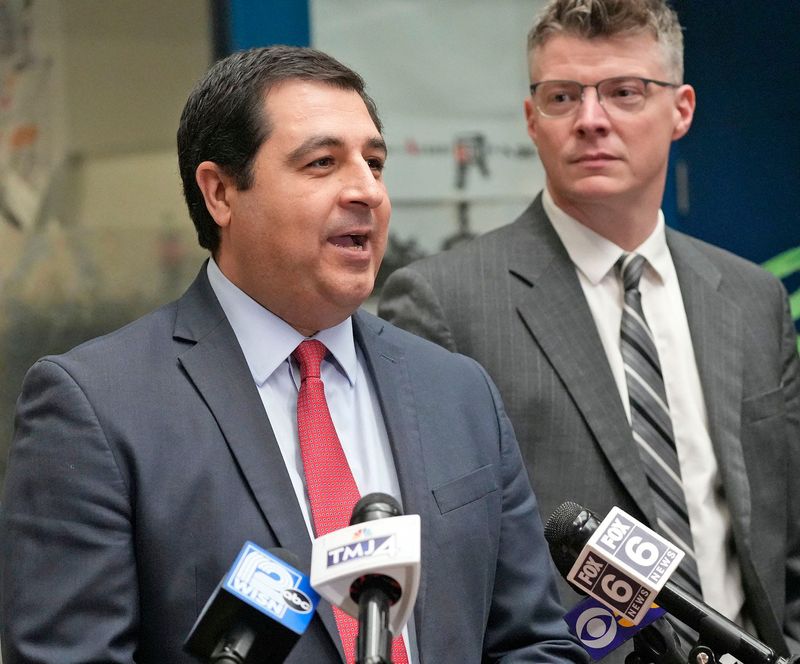
Wisconsin joined a multistate lawsuit on Tuesday, Dec. 23, to block the Trump administration from stripping federal funds from hospitals that provide gender-affirming care to minors, a move that would effectively shut down hospitals that chose not to comply.
Attorneys general from California, New York and Oregon are co-leading the lawsuit.

The lawsuit comes less than a week after U.S. Health and Human Services Secretary Robert F. Kennedy Jr. announced at a press conference the proposal of new rules that would bar health care providers from participating in Medicare, Medicaid, and other federal health care programs if they treat any children or adolescents with gender-affirming care treatment.
Referring to the move as “The Kennedy Declaration,” the coalition of 19 states, as well as the District of Columbia, argues that Kennedy’s rules overreach his authority as health secretary and “substantially violate” federal healthcare program statutes and the Administrative Procedure Act, a foundational U.S. law that sets standards for rulemaking.
“Congress has not given the Secretary the authority to define the professionally established standard of care. The Kennedy Declaration cites no statute authorizing the Secretary to do so by ‘declaration,'” the lawsuit stated.
Instead, the lawsuit states, Kennedy issued the proposed rules as “pursuant to the authority vested in the HHS Secretary” and informed by “professionally recognized standards of care.”
The lawsuit argues Kennedy is not authorized to define what those standards of care are.
“Agencies cannot grant themselves power that Congress has not conferred,” the lawsuit stated.
In the lawsuit, Wisconsin Attorney General Josh Kaul argued the state’s Medicaid program, which helps more than 1 million Wisconsinites, is administered by the Wisconsin Department of Health Services. Kaul cited a landmark ruling from 2019 that overturned a ban on Wisconsin Medicaid from providing coverage for gender-affirming treatment, including individuals 19 and under.
That final court order has been in effect since Oct. 31, 2019.
In a statement to the Milwaukee Journal Sentinel, Democratic Gov. Tony Evers slammed the Trump administration and Republicans more generally for spending time “making it harder for parents to get their kids the medical care they need” instead of addressing soaring health care costs.
Next week marks the end of Affordable Care Act credits, a looming expiration that caused the Democrats to lead the longest government shutdown in U.S. history without success.
Between 40,000 and 60,000 Wisconsinites who buy health insurance through the Affordable Care Act could lose coverage, according to estimates from the Wisconsin Insurance Commissioner.
“Republicans are consistently trying to insert partisan politics and their political beliefs into personal medical decisions, and that’s a problem,” Evers told the Journal Sentinel in an emailed statement. “Doctors and hospitals should be able to provide medically accurate care for their patients without fear of political retribution or criminal prosecution, and parents should be able to get their kids medical care when they need it. This is basic stuff.”
Gender-affirming care for minors has been a major flashpoint in the Trump administration and has generated fierce debate and litigation across states and courtrooms. An underpinning of Kennedy’s argument, that progressive ideology has interfered with the standards of pediatric health care, has been challenged by professional U.S. medical associations like the American Academy of Pediatrics.
In response to Kennedy’s announcement, the American Academy of Pediatrics released a scathing letter urging federal officials to rescind the proposed rules, calling them “a baseless intrusion into the patient-physician relationship.”
The Department of Health and Human Services recently terminated seven grants to the American Academy of Pediatrics totaling millions of dollars, citing a fundamental clash with the Trump administration’s mission and priorities.
In minors, gender-affirming care rarely involves surgeries. Prior to puberty, the only gender-affirming care available to young people is through counseling. During prepubescence, patients can opt to go on puberty blockers, which can delay the onset of puberty and give patients more time to make decisions.
Much of this time is spent on social transitioning, which typically involves wearing clothes and changing one’s appearance to more comfortably align with the patient’s gender.
Notably, Kennedy’s proposed rules make exceptions for children who are not transgender who could still receive gender-affirming care, such as intersex children or those who enter puberty early.
“If this were really about safety, then we’d be having a very different discussion about these medications outside of transgender young people,” said Kellan Baker, senior advisor for health policy at the Movement Advancement Project, an independent think tank that tracks LGBTQ+ laws and policies.
Wisconsin’s lawsuit was joined by California, Colorado, Connecticut, Delaware, Illinois, Maine, Maryland, Massachusetts, Michigan, Minnesota, New Jersey, New Mexico, Oregon, Pennsylvania, Rhode Island, Vermont, and Washington, as well as the District of Columbia.
This article originally appeared on Milwaukee Journal Sentinel: Wisconsin sues Trump over rules restricting gender-affirming care
Reporting by Natalie Eilbert, Milwaukee Journal Sentinel / Milwaukee Journal Sentinel
USA TODAY Network via Reuters Connect