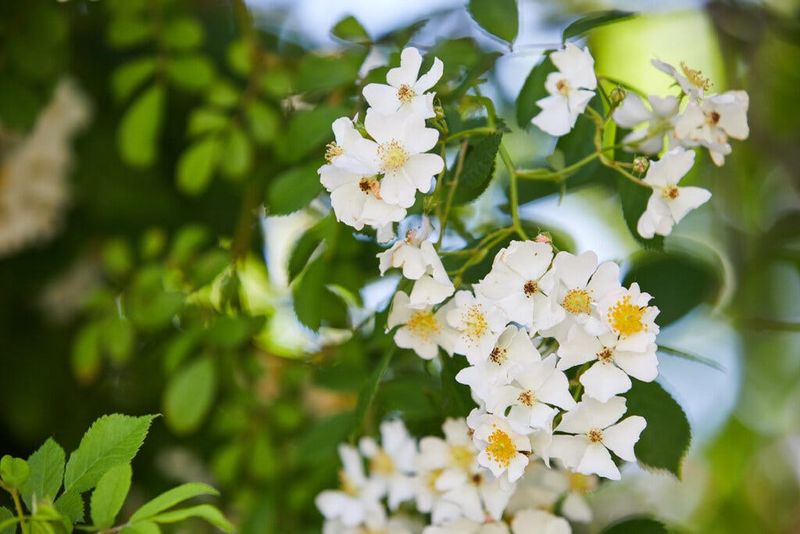
Before Hoosiers found multiflora rose (Rosa multiflora) to be a thorn in their side, unsuspecting land managers planted the species widely across Indiana — sometimes even at the behest of the federal government.
The plant, now considered an invasive species, forms dense, prickly thickets, so the United States Department of Agriculture (USDA) encouraged states to plant it as a hedge against erosion during the 19th and 20th centuries.

Multiflora rose grew in popularity: Indiana farmers planted it across their properties to fence in livestock, and homeowners decorated front lawns and backyards with the rose variety, which bears dainty white flowers in late spring. Some transportation departments packed highway medians with the species to reduce headlight glare and cushion drivers against crashes.
Like many invasive species with enticing berries and fruit, multiflora rose has since been spread widely across the state by hungry birds who nip at the plant’s leathery rose hips, fly away with pieces and strew them miles away.
Now, the invasive plant is just about everywhere.
“We can see it growing along roadsides, forest edges, interior forests, old fields, pastures. Basically anywhere,” said Will Drews, a nursery inspector and compliance officer in the Indiana Department of Natural Resources’s entomology division. “This is one of the species that is throughout the entire state. You can find it in any county.”
Wild and unruly roses
As brambly thickets of multiflora rose proliferate across Indiana, they make it almost impossible for other species to thrive.
The invasive plant can grow up to 15 feet tall as it snakes up trees, and its large floppy stems often crowd and shade out nearby native plants, which can lose their foothold on the landscape.
Multiflora rose is also notorious for its bite. Both the plant’s stems and leaflets have small barbs and wading through a sea of these prickles is not fun, Drews said.
On some Indiana landscapes, even a few DNR properties, the invasive plant has spread into areas hikers frequent. Wildlife and livestock, too, can be constricted by multiflora rose’s aggressive takeover of Indiana farms and forests.
“It is considered one of the top three invasive plants for how commonly it is distributed throughout the state,” Drews said.
Managing the beast
The growth of multiflora rose is now highly restricted in Indiana; without a permit, it is illegal to buy, sell or move the species.
Land managers and state officials like Drews are tasked with managing the damage that has already been done.
We’re “basically trying to undo the many years in the late 19th century where it was promoted and planted widely,” he said.
The USDA’s Environmental Quality Incentives Program helps land managers fund brush management practices. In Indiana, applicants often use this money to remove multiflora rose, Drews explained.
“It is being controlled actively,” Drews added, but “it takes the impetus of the landowner, knowing the problem, and seeking out that assistance in order to do it.”
To learn more about removing invasive species in Indiana, contact your regional specialist at the State of Indiana Cooperative Invasives Management.
IndyStar’s environmental reporting is made possible through the generous support of the nonprofit Nina Mason Pulliam Charitable Trust.
Sophie Hartley is an IndyStar environment reporter. You can reach her at sophie.hartley@indystar.com or on X at @sophienhartley.
This article originally appeared on Indianapolis Star: Invasives: This rose was planted on purpose in Indiana, but has since gone rogue
Reporting by Sophie Hartley, Indianapolis Star / Indianapolis Star
USA TODAY Network via Reuters Connect