The Michigan State hockey program has transformed from Big Ten bottom-dweller to one of the country’s elite teams under fourth-year coach Adam Nightingale, and this season the expectations were as big as ever.
With key contributors returning and a slew of highly-touted NHL picks coming into the fold, Nightingale had assembled his deepest roster to date. And after a blistering start to the season and just a few hiccups, the Spartans find themselves at 12-4 and ranked No. 3 in the nation during the holiday break.

MSU, which is coming off a series split with top-ranked Michigan to wrap up the first half, will resume play on Dec. 28 at the Great Lakes Invitational, where it will face Ferris State in the first game. Outside of an exhibition with the U.S. National Team Development Program on Jan. 4, the rest of the schedule will be all Big Ten games as MSU looks to win both the league’s regular-season and tournament titles for the third straight season.
Here’s a look at some of the biggest contributors to MSU’s first half, and some of the keys for the Spartans looking forward to the second half.
First half MVP
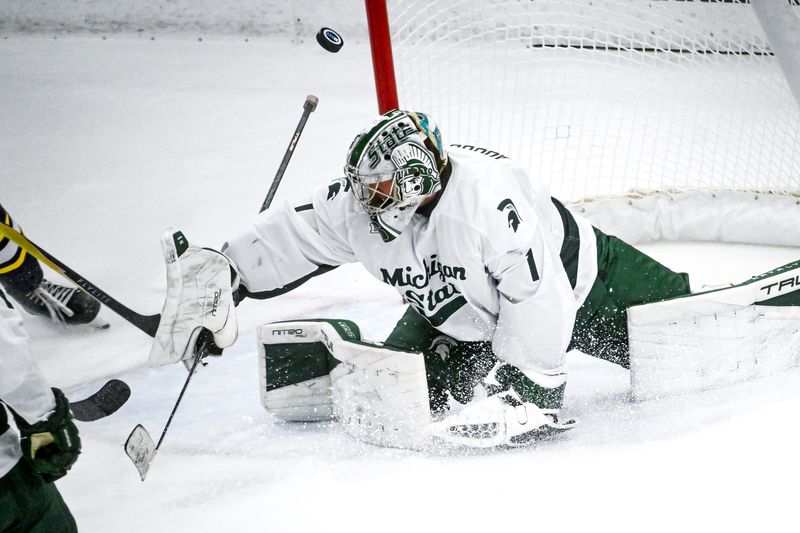
Junior Goaltender Trey Augustine: Augustine has taken another leap in his third season with the Spartans after deciding to come back and play another collegiate season, noting his quest to backstop MSU’s run at a national championship.
He has started 14 games, allowing just 1.71 goals per game, which leads the NCAA among goaltenders who have played in at least 10 games. That mark is improved from 1.97 in his sophomore campaign, and his .937 save percentage is second in the NCAA for qualified goaltenders. His three shutouts to date put him halfway to his sophomore mark of six.
Augustine will again be a leading candidate to win the Mike Richter Award, given to the NCAA’s top goaltender, after finishing second last year.
Memorable moment
Overtimer game-winner at Boston University: Following a split with New Hampshire in the season’s opening weekend, MSU was thrown into the fire with a relatively new group traveling to then-No. 1 ranked Boston University. The Spartans handled the Terriers the first night in a 4-2 win and looked to complete the sweep.
MSU was in control in the third period, but BU scored two late goals to force overtime. Then in the extra session, with both sides trading great chances, it was the Terriers who had an odd-man rush, and the potential game-winning-goal on the stick of first-round pick Cole Eiserman.
Eiserman’s shot leaked through Augustine, but sophomore forward Shane Vansaghi swept the puck off the goal line at the last second with his stick, and started a 2-on-1 break the other way for the Spartans.
Freshman forward Ryker Lee then set up senior defenseman Matt Basgall for the game-winner on that rush, and MSU left as the new No. 1 team in the country, sparking another six straight wins to follow.
Most impactful newcomer
Freshman forward Porter Martone: Martone leads the Spartans with 20 points (11 goals, nine assists) and has made an immediate scoring impact while replacing last year’s Hobey Baker winner, Isaac Howard, on MSU’s top line with senior forwards Charlie Stramel and Daniel Russell.
Martone, who was taken sixth overall by the Philadelphia Flyers in the 2025 NHL draft, has had seven multi-point games, and he’s doing it primarily in even-strength situations with just three goals on the man advantage. Martone’s presence is felt on every shift, and it’s helped MSU’s top line continue to be the offensive driving force with 50 total points and a combined plus-43 rating.
Lee deserves an honorable mention in this category, with six goals and seven assists on the season. Lee leads the team with 70 shots on goal, 20 more than the next closest in Martone, and is mesmerizing at times with the puck on his stick and when he has the space to navigate. He has flourished in recent games on a line with Vansaghi and fellow freshman Eric Nilson.
Biggest surprise
Sophomore defenseman Owen West: West appeared in 34 games as a freshman last season, recording three assists, but primarily skating as the seventh defensemen, filling in when necessary but not seeing regular ice time.
He appeared likely to be in a similar situation this season with the transfer additions of Colin Ralph and Travis Shoudy, as well as a late freshman addition in Sean Barnhill. But West has come on strong and shown improvements in all areas. He’s now regularly on the third defensive pairing with Barnhill and has taken over the role of quarterbacking the team’s second power play unit, which he began in MSU’s series against Notre Dame.
West has already tied his mark last season with three assists and scored his first collegiate goal against Colgate in late November. West has also committed just two penalties all season, the second-lowest mark among the defensemen behind Basgall.
Keys to success in the second half
Avoiding penalties: Nightingale has always preached that he wants his team to play to the edge, and in the Big Ten, the physicality from night to night is evident. The Spartans have killed off 52 of the 64 opposing power plays faced, with a couple of those conceded goals coming during a five-minute major kill.
MSU ranks third in the nation, averaging 18.5 penalty minutes per game. As the season churns along, that number is simply too high given the amount of dangerous power-play units that exist in the Big Ten. Penalties not only give the opposing team a quality scoring opportunity, but can deflate momentum as much as a good penalty kill can lift it back up.
The Dec. 5 game against Michigan was a good example. The Spartans were all over the Wolverines at the start of the game, with multiple scoring chances, but an offensive zone penalty negated it. Although Michigan didn’t convert on the ensuing power play, it put the Spartans back on their heels, and U-M would score just two minutes later in an eventual 3-0 win.
Boosting the power play: MSU’s power play is currently 10-for-43 through 16 games, a .233 conversion percentage which sits 19th in the NCAA. Last season, the team converted 25 percent of its chances. In Nightingale’s second season, it was at 27 percent.
A slight decrease from year-to-year on the man advantage isn’t alarming, but MSU’s two units have too much talent not to be taking advantage of power-play opportunitiers. MSU’s first unit of Basgall, Martone, Lee, Russell, and Stramel is, on paper, one of the strongest groups in the country. And the second unit has scored three of the 10 goals, with freshman forward Anthony Romani netting two of them.
Expect MSU to be more aggressive on the power play in the second half, putting more pucks on net, generating more traffic in front and converting at a higher rate.
Specials teams often make the difference in games against the other elite teams so small improvements in both the penalty kill and power play could be key to the Spartans making a long postseason run.
Key series remaining
Minnesota, Jan. 23-24, March 5-6: MSU has yet to see Minnesota this season, and while the Gophers are having a slight down year, it is still a talented roster with playmakers across the board.
Wisconsin, Jan. 15-16: MSU’s return trip to Madison may be the most influential in the standings, as the Badgers are ranked No. 2 in the country and sit atop the Big Ten after sweeping the Spartans in East Lansing.
Penn State, Jan. 30-31 and Michigan, Feb. 6-7: Two marquee series in the second half will be the games at Penn State, including the outdoor game at Beaver Stadium, and the two remaining games with rival Michigan, including “Duel in the D” at Little Caesars Arena in Detroit. Both series will likely be critical to the Spartans’ Big Ten title hopes, with all four games away from Munn Arena.
Contact Nathaniel Bott at nbott@lsj.com and follow him on X @Nathaniel_Bott
This article originally appeared on Lansing State Journal: MSU hockey midpoint analysis: Spartans among nation’s best but have room to grow
Reporting by Nathaniel Bott, Lansing State Journal / Lansing State Journal
USA TODAY Network via Reuters Connect