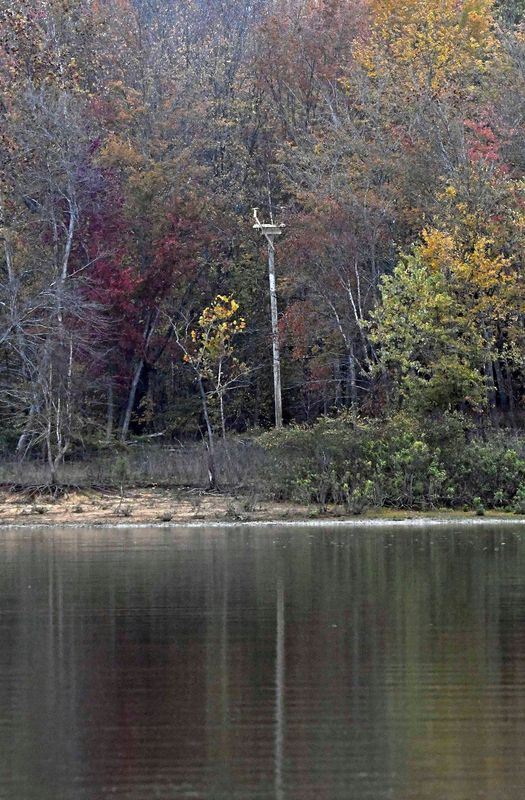
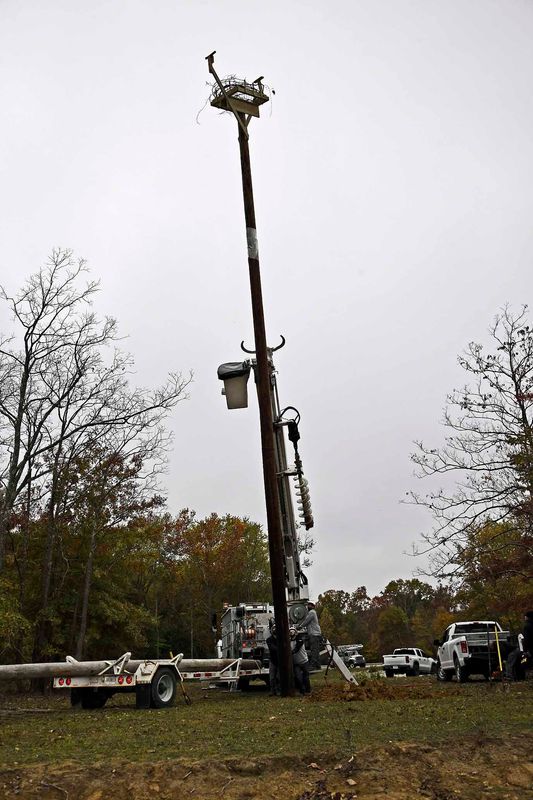
Efforts to help one of Indiana’s raptors have more nesting spots as its numbers increase got a huge boost on Oct. 28, when three telephone poles measuring between 35 and 50 feet were erected near Lake Monroe.

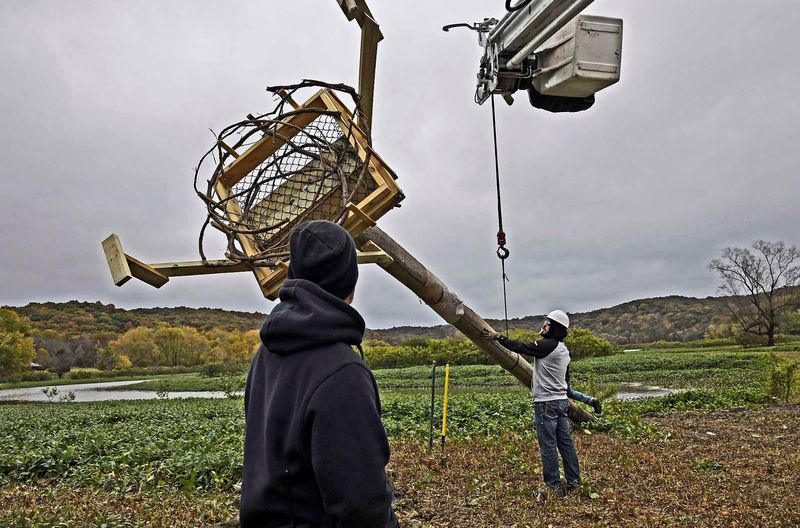
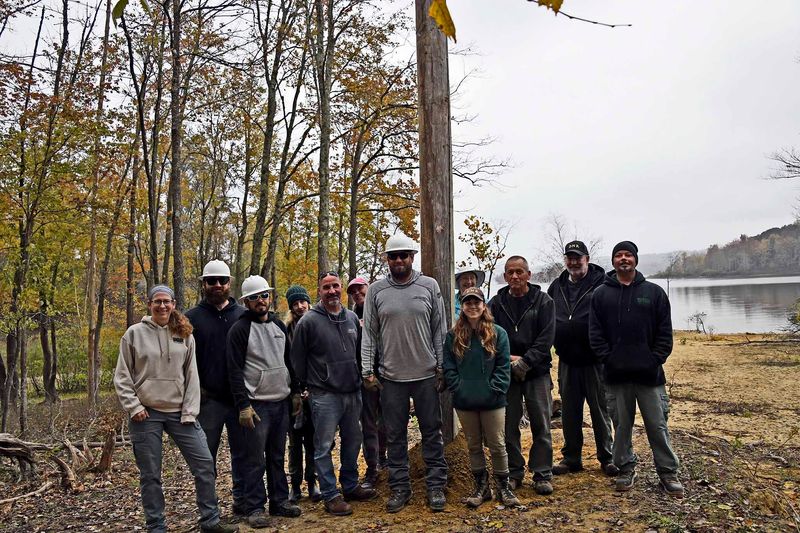
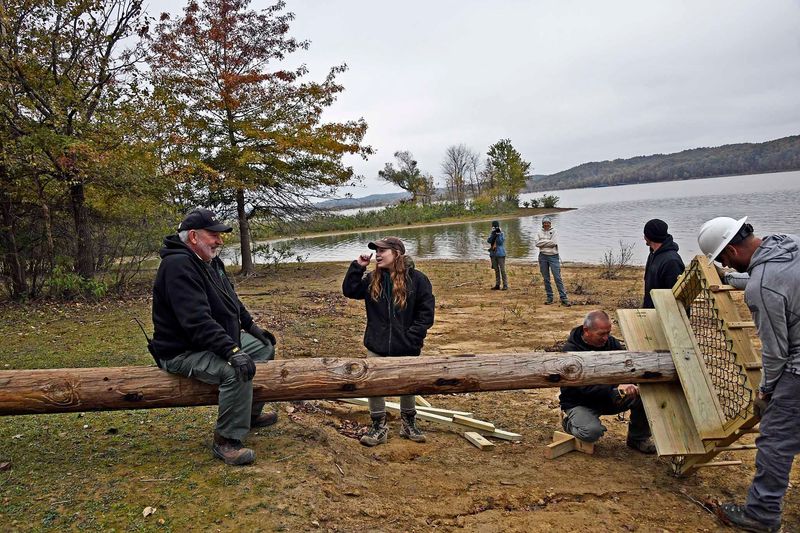
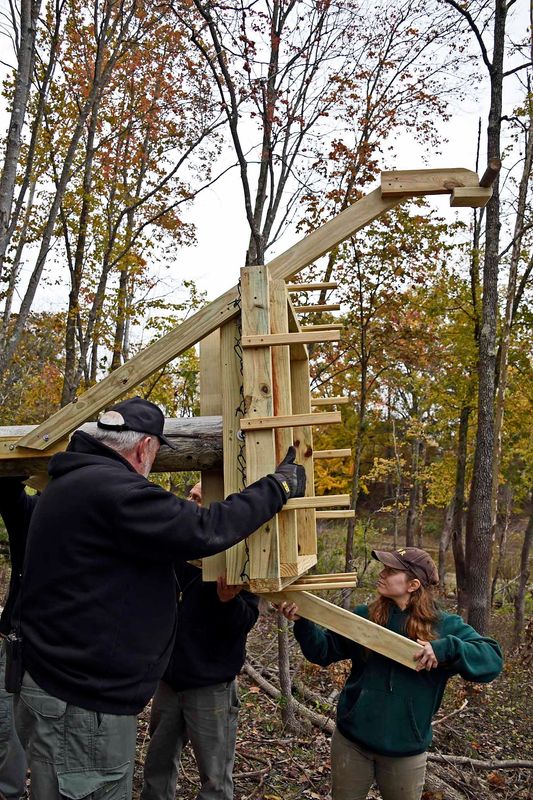
A crew of five from Utilities District of Western Indiana REMC along with Indiana Department of Natural Resources staff and volunteers spent the morning erecting nesting towers for osprey in three locations at Lake Monroe. The nesting platforms atop the poles were 3-by-3-feet square with fencing lining the bottom.
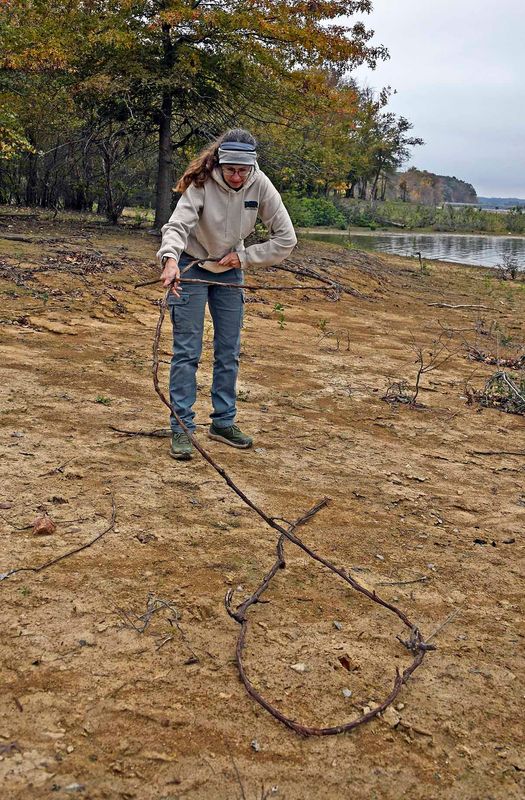
Each platform had two perches above them and were lined with circles of grapevine, that made them look like they had a grapevine wreath inside. The crew members removed any wires that were attached to the poles and then wrapped a metal band around the middle portion of the pole to keep predators from reaching the nests.
Placing nesting platforms in one day
The REMC team from Bloomfield arrived at Northfork area of Lake Monroe at 8:45 a.m., traveled to Cutright State Recreation Area and finished their work at Paynetown State Rec Area at 12:45 p.m., just as rain began to fall.
The three sites for the nesting poles were selected by DNR interpretive naturalist Jill Vance with help from some DNR staff and volunteers who have helped with the lake’s Eagle Watch and Osprey Watch projects. The sites provide osprey with a high nesting platform in a clearing that’s close to the water’s edge.
Vance said the locations were scattered around the lake, offering three more nesting spots for osprey. The one platform at Fairfax State Recreation Area was installed by Duke Energy in October 2020, replacing a more public nesting site at the state rec area that was too close to people walking nearby. The first nesting site had birds nest there for three years before it was abandoned.
Vance said there’s increasing osprey activity at Lake Monroe, making more nesting platforms necessary. If the platforms weren’t erected, she said the raptors might look for cell towers and other man-made structures for building nests — a common practice for osprey. The birds can’t use dead trees in or near the lake because when the area floods, it makes the nests unsuitable for the birds.
Volunteers work with DNR to keep up with osprey
One of the volunteers watching the action was Nancy Szakaly, who knows each of the Lake Monroe osprey by sight. The color of the eyes and other characteristics are different enough for her to identify the birds, oftentimes through birding scopes or from photographs she takes.
“Our original dad has green eyes,” Szakaly said. Most osprey have have deep orange or amber colored eyes when they are juveniles. The color changes to yellow for most as they mature and are ready to breed.
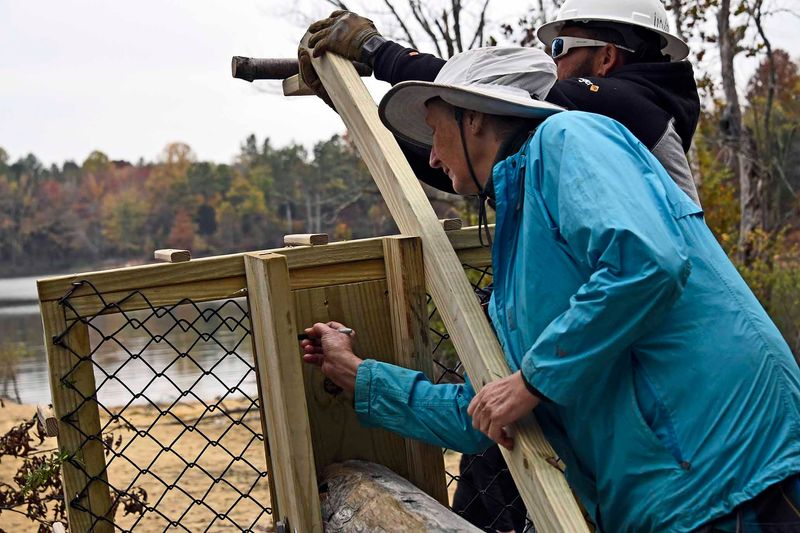
Szakaly was one of the volunteers who signed the third nesting box before it was raised into position. She’s named all the osprey, even the chicks. She often gets good looks through a scope or with her Canon camera fitted with a 800 mm lens.
The volunteers and DNR staff worked for the nine months before the platforms were raised to coordinate the REMC and DNR crews as well as construct the nesting boxes and locate suitable sites for each of the platforms.
Nancy Lightfoot is another volunteer. She began helping monitor eagle’s nests at the lake in 2018 and then began helping with the osprey watch program a few years later.
“They are perfect fishing machines,” Lightfoot said of osprey. She talked about how they have special oil glands and bones so they can fly feet-first into the water to catch fish and then come out of the water, flying, holding a fish in their talons. Osprey have an opposable toe that allows them to better grasp fish.
By the end of nesting season this year, there were 30 osprey chicks who have fledged. Most of those birds will return to the Lake Monroe area when they become adults, which is the reason more nesting platforms are needed.
Volunteer Ellen Popodi explained that osprey prefer a nesting site that’s 30 feet or higher and within view of water, in a clearing. She said this year, osprey were seen fighting over the current nesting platform, a sure sign more platforms were needed.
With the new nesting platforms in place, some of the volunteers were jokingly taking bets on when the first osprey chicks will be found in the nests. Will it be in 2026, or take a year or more? No one is certain but now there are more options for ospreys at Lake Monroe.
Contact Carol Kugler at ckugler@heraldt.com.
This article originally appeared on The Herald-Times: 3 more nesting platforms erected at Lake Monroe for growing population of osprey
Reporting by Carol Kugler, The Herald-Times / The Herald-Times
USA TODAY Network via Reuters Connect