A solar storm could push the northern lights into Ohio tonight, Tuesday, Nov. 11.
The Space Weather Prediction Center, a branch of the National Oceanic and Atmospheric Administration, has issued Geomagnetic Storm Watches for Nov. 11, 12 and 13 after several coronal mass ejections (explosions of plasma and magnetic fields) erupted from the sun on Nov. 9 and 10. The center warns that a moderate geomagnetic storm, level 2 out of 5, could impact the Earth on Nov. 11 and strengthen to a strong storm, level 3 of 5, by Nov. 12. By Nov. 13, the storm is expected to weaken to a minor event, level 1 of 5.

And if those storms hit as strong as expected, or stronger, they could push the aurora borealis into Ohio.
Here’s what to know.
Can I see the northern lights tonight in Ohio? NOAA aurora borealis forecast
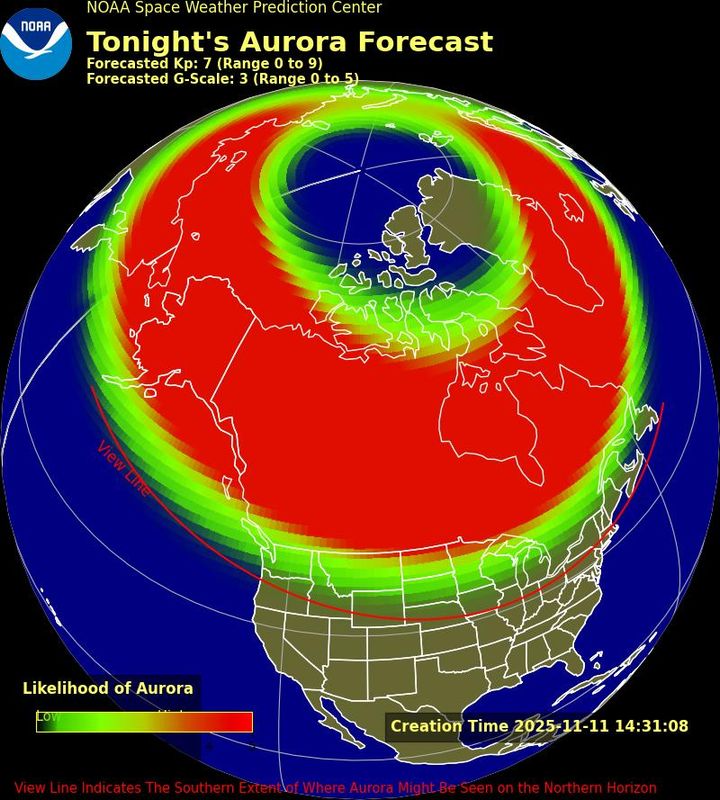
According to the NOAA, the aurora is expected to be visible tonight across Canada and the northern portion of the United States into Ohio. The aurora may be visible from Northern Ohio, according to the map, and perhaps farther south.
According to the NOAA’s scales for the strength of a geomagnetic storm, the northern lights are visible as far south as Illinois and Oregon (around 50 degrees of latitude) for a strong storm, level 3 of 5. If the storm strengthens, that can push the aurora as far south as Alabama.
What causes the aurora borealis?
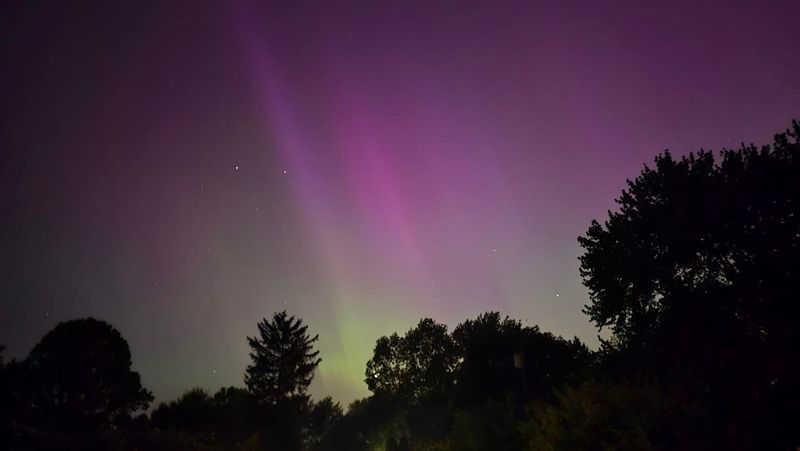
Auroras are ribbons of light weaving across Earth’s northern or southern polar regions, according to NASA. They are caused by magnetic storms that have been triggered by solar activity, such as solar flares or coronal mass ejections. Energetic charged particles from these events are carried away from the sun by the solar wind.
These energized particles hit the atmosphere at 45 million mph and are redirected to the poles by the Earth’s magnetic field, according to Space.com, creating the light show.
During major geomagnetic storms, the aurora expand away from the poles and can be seen over some parts of the United States, according to the NOAA.
What is a coronal mass ejection?
NASA describes coronal mass ejections as “huge bubbles of coronal plasma threaded by intense magnetic field lines that are ejected from the sun over the course of several hours.” The Akron Beacon Journal reports that the space agency says they often look like “huge, twisted rope” and can occur with solar flares, or explosions on the sun’s surface.
When is the best time to see the aurora borealis?
During times of high geomagnetic activity, which pushes the northern lights further south, the aurora may be visible directly overhead in the northern United States, according to the prediction center.
For the best viewing, the center recommends that it be very dark. Move away from city lights and avoid trying to see them on the night of a full moon. The best time to view the aurora is within an hour or two of midnight, or 10 p.m. to 2 a.m.
Akron, Columbus, Cincinnati weather forecast for the aurora
Will Ohio’s weather cooperate to see the aurora, should it shine over the Buckeye State?
Not really. The National Weather Service is calling for mostly cloudy skies and snow over Akron the night of Nov. 11, with mostly cloudy skies continuing the night of Nov. 12.
In Columbus, mostly cloudy skies overnight Nov. 11 will give way to partly cloudy skies Nov. 12. And that same pattern will hold true in Greater Cincinnati, too.
How to photograph the northern lights
If you’re looking to photograph the aurora, National Geographic has some advice.
The article recommends using a tripod to keep the camera stable. Shooting at night means keeping the camera shutter open longer. That could create a blurry image if the camera is bumped or not held steady. Also, use a wide-angle lens to capture as much of the sky as possible. And, don’t just take a photo of the sky. Compose a better photograph by getting the horizon, or a tree or building, into the image with the aurora.
If you’re using a smartphone, the article still recommends a tripod. Use a remote or set the camera’s timer so you won’t have to tap the screen to take a photo. Also, turn off the flash and set the camera to night mode.
This article originally appeared on Akron Beacon Journal: Will Ohio see the northern lights tonight? Check out the NOAA aurora forecast
Reporting by Chad Murphy, Akron Beacon Journal / Akron Beacon Journal
USA TODAY Network via Reuters Connect