(Editor’s note: This story has been updated with the latest numbers from early voting.)
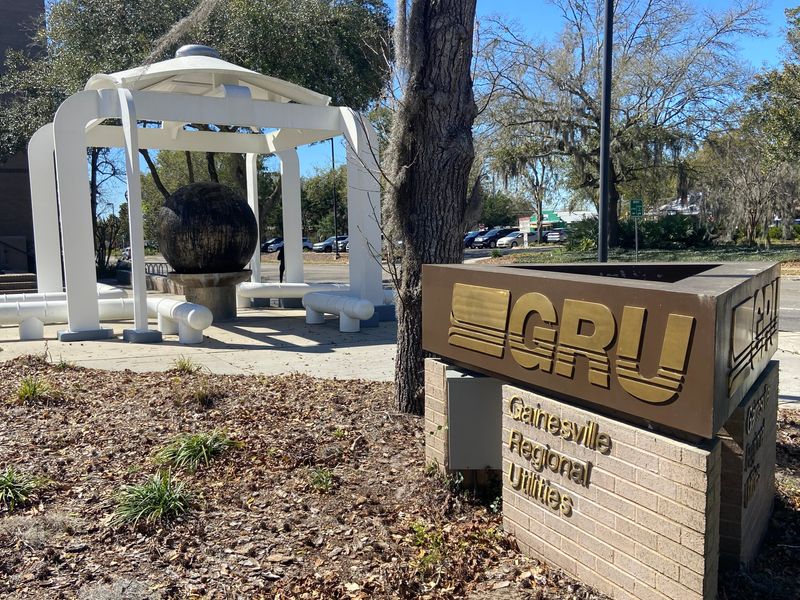
On Nov. 4, Gainesville residents who live within the city limits will head to the polls to determine who should control Gainesville Regional Utilities: the locally elected City Commission or the governor-appointed GRU Authority.

The authority was given control over the city-owned utility after the Florida Legislature’s passing of HB 1645, a bill filed by then-Rep. Chuck Clemons, R-Newberry. Gov. Ron DeSantis signed the bill establishing the governor-appointed GRU Authority board on June 28, 2023.
Many critics of the bill called it undemocratic since voters previously rejected a 2018 referendum that called for a board. A similar 2017 bill from state Sen. Keith Perry, R-Gainesville, also was previously vetoed by then-Gov. Rick Scott.
Clemons at the time said he filed the bill to give a “voice” to GRU customers who live outside the city limits and can’t vote in city commission races.
That point has been trumpeted by both the authority and GRU CEO Ed Bielarski, who also argues the special election disenfranchises non-city ratepayers who are unable to vote on the issue.
The percent of GRU customers who live outside city limits varies by service. According to GRU, the number is 30% for electric, 36% for wastewater, 38% for water, and 42% for natural gas.
An Alachua County judge on Oct. 29 denied a last-minute request by the GRU Authority for a temporary injunction on the special election in part because he did not find it disenfranchised voters because it relates to customers, rather than residents.
The authority also believes the special election violates the special act of the Florida Legislature that created the board. It believes the Legislature’s passing of HB-1645 supersedes any decisions made at the local level.
Gainesville City Commissioner Bryan Eastman on his TikTok account encouraged voters to support the referendum and restore local accountability by giving local elected officials managerial power back over the utility.
Gainesville Mayor Harvey Ward hit on that point during an Oct. 28 town hall on the special election that included Bielarski.
“There are four of us on the Gainesville City Commission who are up for re-election. You could choose to fire all of us. You don’t get any say in hiring and firing of the GRU Authority,” he said.
Bielarski during the town hall said the authority has helped to lower electric rates and incorporate a more business-like approach to lowering the general fund transfer and putting that money toward the utility’s debt.
The authority last year slashed the government services contribution (GSC) — a pot of money given to the general government each year from the utility, voting to pay the city around $8.5 million while withholding $6.8 million each year for the duration of 10 years in order to recoup a sum they feel was overpaid to the general government in the past.
“Keeping the general fund transfer down is not being punitive to the city. It’s a way in which we will become a healthier utility,” Bielarski said in May. “It’s paying huge dividends for the organization.”
According to GRU, all of the GSC withholding is being used toward the utility’s debt. The utility’s debt as of October 2025 stands at $1.672 billion, down from $1.849 billion in October 2023, when the authority members were seated.
Much of that debt — $754 million — stems from the city’s 2017 purchase of the Gainesville Renewable Energy Center (biomass plant). The deal was executed to exit a binding 30-year contract that called for the city to pay GREC $1.9 billion — about $70 million annually — over the next 26 years, even if the city didn’t use the available energy.
Bielarski, who spearheaded the biomass plant purchase as a way to reduce the longterm debt, at the town hall also touted the utility’s reduced electric rates.
“When we were the highest in the state back in March of 2023, we were $182 for an average residential bill. We’re at $136 now, and we’re No. 14 in the state,” Bielarski said.
Florida Municipal Electric Association data shows in September 2023, the month before the GRU Authority held its first meeting, GRU ranked second highest among municipal utilities and fifth overall in the state. In September 2025, GRU ranked eighth highest out of the state’s 32 municipal utilities and 13th overall.
The total bill for a GRU customer using 1,000 kWh in September 2025 was $136.50, down from a $152.63 in September 2023. Much of that savings, however, comes from a reduction in the fuel adjustment — a number the authority does not control — from $35 in September 2023 to $15 in September 2025.
The bill for someone using 2,500 kWH in September 2025 was down by about $20 from September 2023; however, the base rate without the fuel adjustment added in increased by almost $18.
The special election — expected to cost the city about $250,000 — will be the second time in a year that voters will be asked to weigh in on the authority. The result of a 2024 referendum on the issue passed overwhelmingly but the results were nullified by a judge due to misleading ballot language.
The judge, however, also ruled that Florida statute gives the city “home rule of an admissible corporation.” Both the city and GRU have appealed the ruling.
Despite the appeals process still in the works, city commissioners on June 12 unanimously voted to hold another referendum with updated ballot language.
The ballot measure for the Nov. 4 special election reads:
“Shall the City of Gainesville charter be amended to delete Article VII, eliminating the governor-appointed Gainesville Regional Utilities Authority and its authority-appointed chief executive officer/general manager that manage, operate, and control the City of Gainesville’s local public utilities, so that the elected City Commission and its City Commission appointed charter officer have that responsibility; and eliminating limitations on the Government Services Contribution and Utility Directives, as proposed by Ordinance No. 2025 -416.”
According to the Alachua County Supervisor of Elections Office, there are 76,338 eligible voters. As of 8:20 a.m. on Nov. 2 — the final day of early voting — 3,632 mail-in ballot had been received and 2,309 people voted early.
On Nov. 4 the polls will be open from 7 a.m. to 7 p.m. Voters are advised to check their polling location on the Alachua County Supervisors of Elections Office website, as some locations have changed.
This article originally appeared on The Gainesville Sun: City of Gainesville voters set to determine fate of GRU Authority
Reporting by Elliot Tritto and Alan Festo, Gainesville Sun / The Gainesville Sun
USA TODAY Network via Reuters Connect