

By Jim Bloch

The St. Clair Historical Museum may soon be expanding and making its second story more accessible with the addition of an elevator.
The city council voted unanimously at its regular meeting Sept. 15 to approve the hiring of InFuz Architects for $28,119 to design the renovation and expansion of the museum.

“The museum renovation/expansion project would provide additional space for interactive programming, display development, family history research, public outreach activities and to make all public and staff space handicap accessible through the additional of an elevator,” said City Superintendent Steve Duchene in his recommendation to approve the project.
InFuz was the architectural firm that designed the renovation of the St. Clair Inn and the building of the Boardwalk Theatre southwest of Riverview Plaza in downtown St. Clair. Local resident Vince Cataldo owns the company.
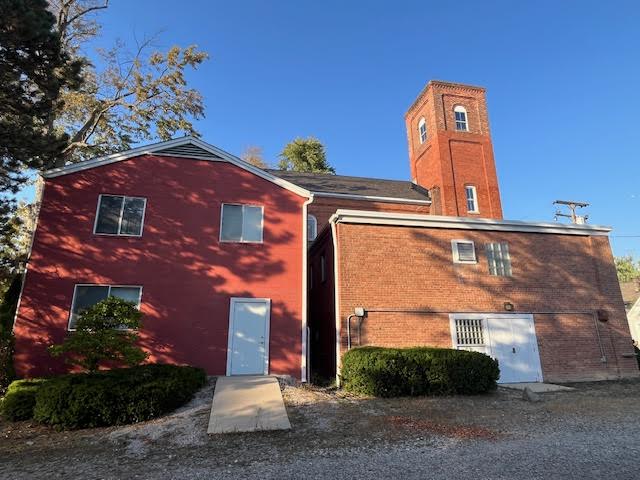
The museum is located on the upper floors of the former First Baptist Church, built in 1873 and registered as a Michigan Historic Site in 1991. The ground floor serves as a community center.
The construction of the addition is estimated to cost $1,050,000. Most of the funds will come from a private donor, with grants and a matching capital campaign filling in the gaps.
The museum board recommended either of two approaches to the project.
The first is to demolish and replace one or both annexes on the south side of the building, aligning the floors with those of the former church and relocating the customs house as the western entry to the facility; the historical commission indicated that it would prefer demolishing the east annex and retaining the west annex for storage. The second is to build a new two-story building on the north side of the church, aligning the floors, using the customs house as the western entrance, and moving and attaching the annex that now houses the old cannon to the main building for use as a small theater.
Now, the museum operates on six different levels between the main building and annexes, , interlinked by a series of stairs, according to its chair Bob Freehan.
Altogether, the museum would gain 3,400 square feet over the two floors.
On the first floor would be an enclosed 350 square foot “salt room,” dedicated to an expanded history of Diamond Crystal Salt, the predecessor of Cargill; 250 square feet for a mini theatre; 740 square feet of display space and 60 square feet for merchandise and a sales counter.
The second floor would feature an enclosed 325 square foot work room, an enclosed 250 square foot research room and 1,125 square feet of exhibit space.
“Over the past several years we’ve probably lost six or seven volunteers, and I would guess 25 visitors because they cannot make it up and down the steps,” said Freehan, as heard on the CTV-Channel 6 recording of the council meeting posted on YouTube. “We are the tour for Diamond Crystal Salt. What we’re envisioning in there is a salt room that engages people with more interactive things.”
The museum has several themed rooms in addition to the Salt Room. The newest major installation is Belle Reve Room that features the recreation of a room in George Moore’s now-demolished mansion on North Riverside and its 200-year-old oak paneling imported from an English manor house. The Shoe Room holds memorabilia from Brenner’s Shoe Shop in the city’s pre-urban renewal downtown. The Kitchen Room features a kitchen circa 1900, and a coal stove manufactured by the Kalamazoo Stove Company. The tool room contains a history of useful implements in the city, including a bean sorter manufactured by Maytag. The Maritime Room holds artifacts, photos and models of the Langell Shipyard, which built wooden ships on the Pine River, 1862-1900, and Great Lakes Engineering, which built steel ships, 1903-1910, just south of town. It includes a deck chair from the Tashmoo Steamship, the passenger ferry boat that ran from Detroit to Port Huron, 1900-1936.
The goal of the expansion is to transform the historical collections into an easily accessible destination museum.
“It becomes a tourist attraction for the city of St. Clair,” Freehan said, “to engage the residents and visitors in the stories of St. Clair, because that’s what history is all about.”
Jim Bloch is a freelance writer based in St. Clair, Michigan. Contact him at bloch.jim@gmail.com.
