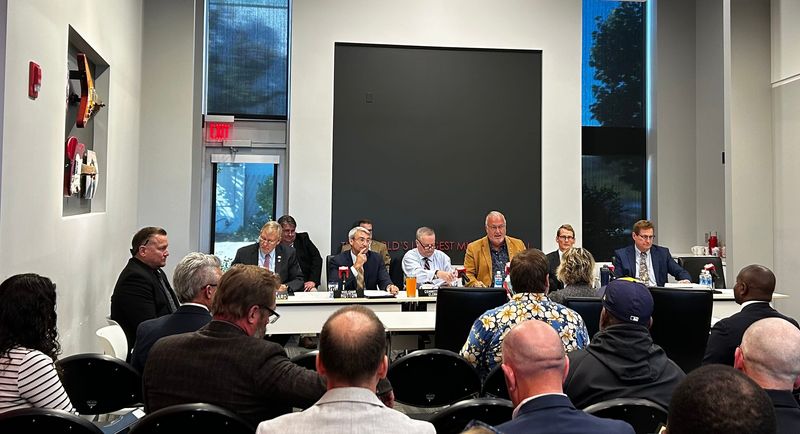
Over two hours of public testimony was heavily in support of a bill meant to institute cameras in Milwaukee that automatically cite speeding drivers, in a legislative hearing that marked progress in the repeated attempts to pass it previously.
The bill, dubbed Safe Roads Save Lives Act, would allow for the installation of traffic and speed cameras on intersections with high rates of car crashes and automatically cite those who speed at a specified rate. Officials and residents spoke strongly in support of the legislation, calling it a tool to crack down on the city’s notorious reckless driving issue.

“This legislation is in the mindset we have a culture problem and this is a way to address it,” said Sen. Dora Drake, D-Milwaukee, at the Oct. 7 hearing, who co-authored it.
Milwaukee Police Chief Jeffrey Norman was among local officials, including Mayor Cavalier Johnson and council members Peter Burgelis and Mark Chambers Jr., who spoke in support of the bill. Norman called the cameras another “tool in the toolbox” for his officers.
This is not the first time the bill has been brought forward, but it never came to a vote because of the concerns of its effectiveness and its impact on residents. Drake and the bill’s co-authors have attempted to address many of its earlier criticisms in this iteration of the bill.
So far this year, 48 people have died in car crashes, according to Milwaukee police data.
Here’s what to know about where things stand with the legislation:
How would traffic camera bill would work?
The bill allows for five traffic control cameras in each of the city’s aldermanic districts, meaning 75 total. Those cameras would have to be placed in intersections that have a high accident rate.
Those stipulations do not apply to the speed cameras, but those cameras cannot cite a driver unless they are driving more than 15 miles per hour over the speed limit.
Any ticket issued through the traffic control camera system would be between $20 and $40 on first offense and between $50 and $100 on second offense.
The bill would allow the cameras for only five years, which authors say is meant to allow the idea to be reassessed after it’s been implemented.
What did Milwaukee residents have to say about the traffic cameras?
Tina Ortiz was struck by a drunk reckless driver in 2018. She lost a leg and recalled the pain she felt at not being able to support her daughter following the crash. Ortiz decided to begin to work to stop reckless driving and advocates regularly on the issue.
“I need people to see me phsyically to see the dos and don’ts you do when you reckless,” she said. “This is a don’t.”
Ortiz was one of many residents who spoke out in support of the cameras and, like her, many shared personal stories of how they’ve been impacted. Others made the point that the cameras could’ve provided key evidence to find the reckless driver or shared the sentiment something needed to be done about the city’s reckless driving issue.
“I just feel deep down inside, a little change will go a long way,” Ortiz said. “I just want us to make a good choice.”
Few residents spoke against the technology.
Ron Jansen, a Milwaukee activist and frequent opponent of police technology, spoke in opposition to the cameras and the investment it would take to implement them. Another spoke against it, calling it an expansion of surveillance technology.
What are the concerns surrounding red light cameras and speed cameras?
Concerns from Jansen and others who spoke against the cameras come as they’ve been criticized in other cities that have implemented them.
In 2022, news organization ProPublica reported that Chicago’s traffic camera system disproportionately tickets Black and Latino drivers. Other cities have discontinued the usage of the cameras over concerns they are ineffective and simply act a revenue generator.
Houston’s City Council discontinued their use in 2011 over those concerns.
Drake pushed back on the idea the cameras were a revenue generator due to stipulations in the bill. The bill’s language requires any funds be used to pay for the system itself, while leftover dollars go to traffic safety or enforcement programs and infrastructure.
Mayor Cavalier Johnson previously said that in cities with a surveillance program, crashes have been reduced by 54% and injuries from crashes by 47%. However, those figures were disputed by some on the Senate committee.
Sen. Chris Larson, D-Milwaukee, is not in support of the cameras, said his spokesperson Justin Bielinski. He opposed the bill for the way it specifically targets Milwaukee; the burden it puts on residents who may not be the driver; and the possibility it could criminalize people of color.
“He just is not at a place where he would support unless there was significant changes,” Bielisnki said.
What happens next with the traffic camera bill?
There have been many past attempts to pass a traffic camera bill in Wisconsin.
A bill introduced in 2019 and 2021 by lawmakers from both parties would have accomplished many of the same goals as this year’s iteration, but those did not receive a public hearing or a floor vote. In 2019, the same proposal was advanced to a floor vote by an Assembly public safety committee, but the legislation died just before the coronavirus pandemic hit the state.
Sen. Van Wanggaard, R-Racine, was a previous opponent of the bill and that appeared unchanged on Oct. 7. The retired police officer and traffic investigator said more police officers was a better answer to the city’s reckless driving issue.
“I don’t see how taking pictures is a way to solve it,” Wanggaard said.
The bill has lost some sponsors recently, but that original support may have been due to a clerical error incorrectly adding them on, according to Larson and a spokesperson for Rep. Christian Phelps, who also dropped off.
The bill will have to be considered for a vote at the Senate committee before moving forward to the full state Senate and, later, the state Assembly for passage.
David Clarey is a public safety reporter at the Milwaukee Journal Sentinel. He can be reached at dclarey@gannett.com.
This article originally appeared on Milwaukee Journal Sentinel: What to know about a traffic, speed camera bill that would automatically cite Milwaukee drivers
Reporting by David Clarey, Milwaukee Journal Sentinel / Milwaukee Journal Sentinel
USA TODAY Network via Reuters Connect