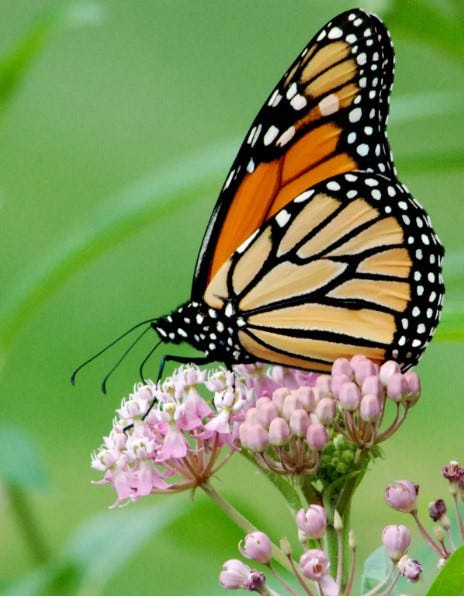
Following the shorelines of the Great Lakes, monarch butterflies are gradually leaving Michigan as their instincts take them south.
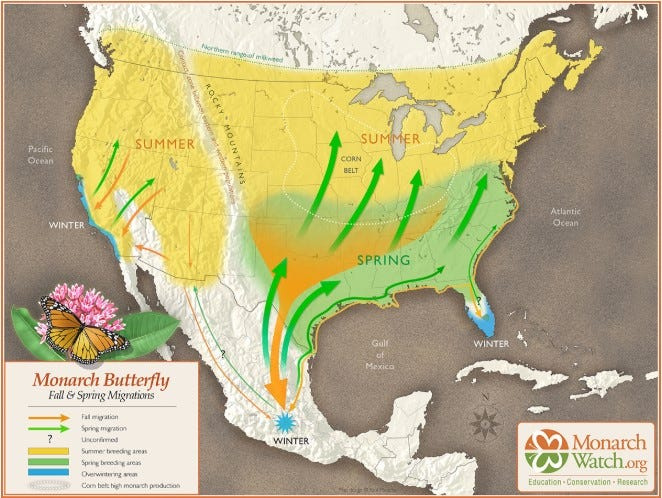
Millions of monarchs migrate from Mexico and the Gulf Coast each spring to the U.S. and Canada where they breed and die. The final summer generation, once temperatures begin to drop, begin a migration to spend the winter in California, Florida or Mexico.

Monarchs inhabiting areas east of The Rocky Mountains — including Michigan — will winter in the Trans-Mexico Volcanic Belt of central Mexico and southern Florida, according to MonarchWatch.org.
In Michigan, monarchs spent their summer breeding and sipping nectar from flowers, but now many use the Great Lakes as a tool to safely leave the state.
“It is not uncommon that Great Lakes boaters or fisherman may site monarchs far offshore using the winds on the Lakes — much in the way a sailboat might — to aid in their journey,” Michigan State University’s Extension said. “Yet as all travelers must, these migrations also require shoreline habitats that serve as resting (or roosting) and feeding (or refueling) stations.”
Monarchs follow shorelines to avoid getting lost over open water, according to Journey North — a website that tracks migration patterns of several species.
On Sept. 4, about 240 monarchs were spotted near Escanaba in the Upper Peninsula migrating along Lake Michigan, according to Journey North. A few days later, on Sept. 7, nine monarchs were seen over Lake Huron near Harrisville.
As monarchs continue leaving Michigan, here’s more on the species.
The monarch butterfly fall migration: What’s their flight route?
Monarchs travel up to 3,000 miles to their wintering destinations in central Mexico, where Oyamel fir forests (or, Abies religiosa) grow at high altitudes (around 7,800-11,800 feet). There, monarchs prefer cooler temperatures, moist air and the protection from the trees.
Monarchs also migrate to southern Florida or the Pacific coast — those that make there journey to California typically come from areas east of The Rocky Mountains.
One popular place to see the butterflies as they migrate is the Stonington Peninsula in the Upper Peninsula.
“The Stonington Peninsula, particularly the cedar trees and lands surrounding the Peninsula Point Lighthouse, becomes the stopping-off point for thousands of monarchs during peak migrating season,” Visit Escanaba said. “You can try to catch this phenomenon at the Forest Service Day Use Area at the end of this peninsula, which separates the Little and Big Bays de Noc. The best time to see thousands of monarchs in the trees is before dawn and before sunset.”
Though monarchs migrate alone, they are often seen in groups huddled in trees at night in a group called a roost. According to Journey North and Okies for Monarchs, the reasons why monarchs roost is not certain, however, observations suggest they roost for protection from predators and to keep warm overnight.
How can I track monarchs leaving Michigan this fall?
To track their progress, residents may report their sightings online via Journey North where the site’s migration map shows where they have been spotted across the state (to make reports an account must be created).
Are monarch butterflies an endangered species?
No, monarchs are not listed as an endangered species on the U.S. Endangered Species Act, however, they are listed as “proposed threatened,” according to the U.S. Fish & Wildlife Service’s Environmental Conservation Online System.
The U.S. FWS proposed in 2024 for monarchs to be listed as threatened and the species was officially listed as threatened on Dec. 12, 2024.
On March 18, 2025, the U.S. FWS reopened the discussion to change the status of monarchs to endangered on the U.S. Endangered Species Act.
In addition, The IUCN Red List of Threatened Species organization included monarchs on their list in 2021 and its current status is labeled as “least concern” — meaning monarchs have a lower risk for extinction, but are undergoing a steady decline so their populations are monitored.
The main threat facing monarchs in the loss of habitat due to urban development, climate change, deforestation, and large agricultural space that reduce the availability of monarchs to breed, feed, shelter, and rest throughout their life cycles, the U.S. FWS said.
How do monarchs cover vast distances?
Monarchs use air streams to accelerate, and according to the U.S. FWS, monarchs can travel 80 miles per day and reach 10-30 mph.
What is the lifespan of a monarch butterfly?
Monarch butterflies typically live from two to six weeks, with the exception of the last generation of the year (meaning butterflies that complete the life cycle and survive to see winter) that migrate. The migrating insects can live eight to nine months and migrate back to the U.S., the U.S. Forest Service said.
What do monarch butterflies eat?
Monarchs have a straw-like mouth and sip nectar from flowers. They prefer milkweed because that’s where female monarchs lay their eggs.
Adult monarchs feed on wild cherry, lilac, Labrador tea, blazing star, red clover, dogbane, goldenrods, ironweeds, joe-pye-weed, marigolds, asters, rattlesnake-master, sunflowers, thistles, vetches and (of course) milkweeds, MSU Extension said.
In Michigan, the common milkweed, swamp milkweed, butterfly milkweed and poke milkweed are native milkweeds to the Midwest and northeast regions of the U.S., according to MonarchWatch.org.
Contact Sarah Moore @ smoore@lsj.com
This article originally appeared on Lansing State Journal: Monarch fall migration 2025: What to know as they follow the shorelines of the Great Lakes
Reporting by Sarah Moore, Lansing State Journal / Lansing State Journal
USA TODAY Network via Reuters Connect