Indiana University is the worst public university in the country for fostering and protecting free speech on campus, according to a national First Amendment organization that ranks universities annually.
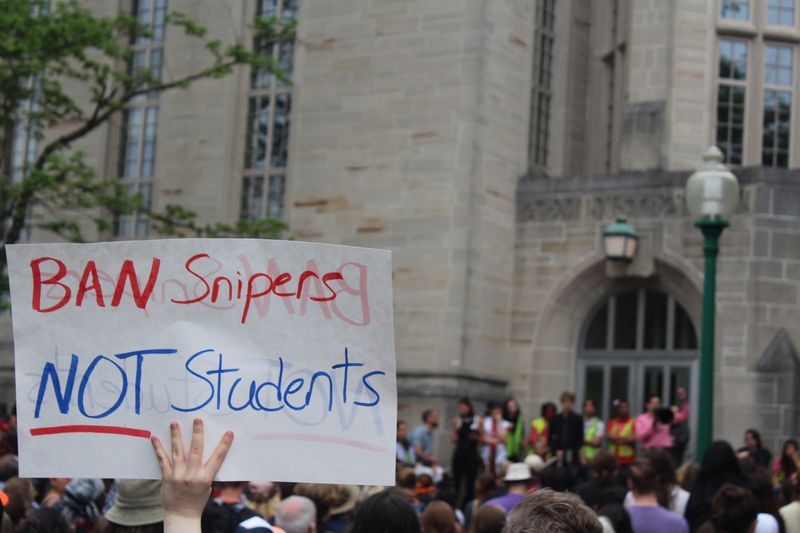
In Tuesday’s rankings, the Foundation for Individual Rights and Expression tanked IU’s score largely because leadership cancelled a speaker in response to the anti-DEI movement and placed a sniper atop the student union during 2024’s pro-Palestine encampment.

FIRE, a nonpartisan organization that defends First Amendment rights across the political spectrum, and survey company College Pulse rank the campus speech environment of 257 public and private universities each year. It uses student surveys, policy wording and university decisions to calculate each college’s score.
Many IU students in survey responses scorned the university’s free-speech environment.
“Our administration at Indiana University has publicly and repeatedly silenced students that speak out on controversial topics,” one student wrote in FIRE’s survey. “I am afraid that I would get retaliation from the administration in terms of a lawsuit, a ban from campus, and expulsion from the university.”
Purdue sits on the opposite end of FIRE’s free speech rankings as the country’s top public university for its First Amendment environment — though the group notes that could change next year.
“Indiana is home to some of the nation’s strongest and weakest campus speech environments,” FIRE said in its state review. “Raising the floor through policy reform and broader commitment to expressive rights would help close the state’s gap.”
About half of respondents for each Indiana university said they self-censored on campus at least once or twice a month. Many also noted they felt uncomfortable expressing political views in class.
Two private Hoosier colleges, the University of Notre Dame and DePauw University, also received rankings.
Indiana University
IU was ranked 255 out of 257 schools, only scoring better than New York’s Columbia University and Barnard College — both private colleges. The campus dropped 12 spots from last year.
For years, FIRE has criticized the university for actions it says violate the First Amendment and damage the free-speech climate. Like last year, FIRE highlighted IU in its report, pointing to the school’s response to pro-Palestine advocacy and the cancellation of multiple speaking events and an art exhibit, among other examples.
“These actions at IU reflect a broader national trend: When university administrations respond to speech and protest with sudden rule changes, opaque enforcement, or punitive discipline, they undermine student trust and contribute to a climate of self-censorship,” the report reads.
In June, a district court judge ruled IU likely violated the campus community’s First Amendment rights when it made an abrupt change to its “expressive activities” policy in reaction to the encampment. The university later revised its policy.
The pro-Palestinian solidarity encampment stood on campus for months during the spring 2024 semester, drawing national attention, resulting in over 50 arrests and requiring “extensive repairs” of the area.
In survey responses from 325 students, some said they felt the university was trying to prevent students from speaking out on the Israel-Gaza war and other controversial topics. Many said they feared punishment for attending protests or posting on social media.
“During the peak of protests on IU’s campus last year, I attended a few protests and speeches,” the report quoted one student as saying. “Out of fear for my safety and ability to continue attending IU, I stopped going to the protests. I couldn’t risk losing my financial aid or being arrested.”
FIRE’s Sean Stevens said the usage of snipers at the Dunn Meadow encampment, specifically, impacted many students’ responses to the survey.
“Students definitely noticed that,” Stevens said. “A number of them commented on that incident from Indiana. Students are very unhappy with the administration and what they perceive as a kind of heavy-handed punishment of expression.”
Purdue University
Purdue’s No. 2 ranking was the best ranking out of any public university. Only California’s private Claremont McKenna College scored better. Still, FIRE gave Purdue a C grade.
Also, FIRE said Purdue’s top score may drop next year after it used its institutional neutrality commitment to distance itself from the student newspaper ahead of this school year. The decision took place after FIRE’s data collection period for this year.
In June, Purdue leadership told the Exponent it should omit “Purdue” from its masthead, wouldn’t support on-campus paper distribution and pulled Exponent staff’s ability to purchase parking passes.
“Purdue’s actions reflect a betrayal of the press freedom our Constitution requires it to uphold,” Dominic Coletti, a program officer on FIRE’s campus advocacy team, told IndyStar at the time.
FIRE positively graded Purdue in a separate report specifically devoted to free-speech policies that was released in early August. It also applauded the school’s adoption of “the Chicago statement” — language that universities have widely adopted to symbolize their commitment to free expression.
“It is a helpful reminder that even schools with strong overall records on free expression can, and do, make decisions that run counter to the very principles we commend them for holding,” FIRE’s report said regarding Purdue.
The University of Notre Dame
The prestigious Catholic university dropped 71 spots from last year, falling to 238 out of 257. The sudden decline is tied to the cancellation of a speech on Palestine, student survey results and poor policy wording.
The Observer, Notre Dame’s student newspaper, reported that an invitation to Eman Abdelhadi, a University of Chicago professor and grassroots organizer, to speak about pro-Palestine organizing was rescinded, citing the event’s inability to adhere to the university safety policy. Abdelhadi claimed it was censorship.
The 311 Notre Dame students surveyed reflected a noticeable drop in political tolerance and an increase in self-censorship, FIRE said.
Notre Dame received a red-light warning for its policies after FIRE found its data and information technologies policy, which polices how students behave on the university’s online network, can substantially infringe on students’ rights.
DePauw University
Like Purdue, DePauw received a top score, landing at No. 18 out of 257 and an overall grade of a C-.
Of the 162 students surveyed, FIRE reported students’ comfort in expressing ideas had one of the largest year-over-year swings ever, jumping from the bottom 25 to the top 25.
FIRE favorably graded the language of each of the university’s expressive-activity policies and noted its adoption of the Chicago statement. It does mention their score could improve by adopting an official commitment to institutional neutrality.
The Tennessean’s Angele Latham contributed to this report.
The USA TODAY Network – Indiana’s coverage of First Amendment issues is funded through a collaboration between the Freedom Forum and Journalism Funding Partners.
Have a story to tell? Reach Cate Charron by email at ccharron@indystar.com, on X at @CateCharron or Signal at @cate.charron.28.
This article originally appeared on Indianapolis Star: Indiana University ranked as U.S.’s worst public college for free speech
Reporting by Cate Charron, Indianapolis Star / Indianapolis Star
USA TODAY Network via Reuters Connect