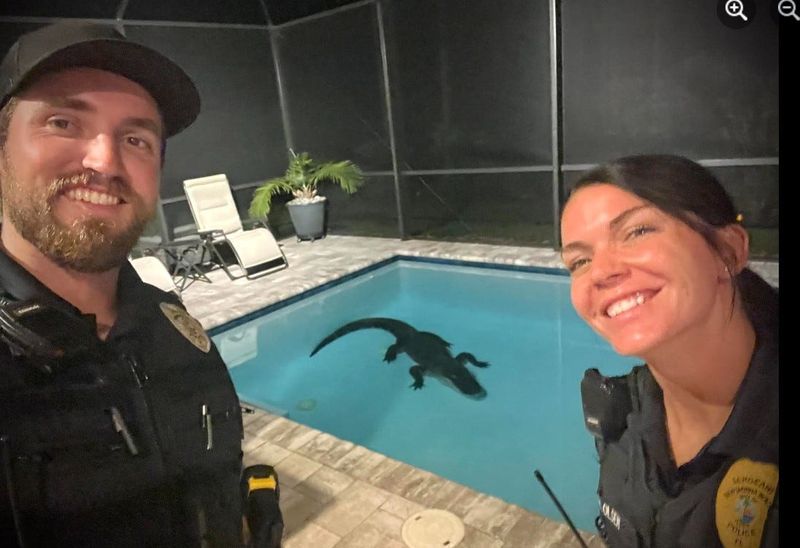
If you’ve lived in Florida for long enough, you likely know that coexisting with alligators is a part of life in the Sunshine State. As long as you keep your distance and never feed one if it crosses your path, you should be fine.
But there are some risks to be aware of, especially if you’re planning on swimming in a lake or your home is near a body of water (even if the closest one is a retention pond).

During the summer, there’s a higher likelihood that our reptilian neighbors turn up in unwanted places, like yards, pools and golf courses. This is due to alligator mating season, which ended in June.
However, just because summer is ending and the mating season is over for gators, it doesn’t mean they stop roaming altogether. While mating season ends in June, female gators typically nest and lay their eggs in June and July, and September is hatchling season, according to the FWC.
Here’s what you should do if there’s a gator in your yard or pool, what to know about mating and hatchling season, how to identify an alligator nest and what to do if you have to run or swim away from a gator.
What months are alligators most active in Florida?
Alligators are most active between the months of April and September, from when their mating season begins, through hatchling season.
Alligator mating season in Florida lasts from April through June. To be exact, April is alligator “courtship” season and May is when most Alligators start mating, according to the FWC.
“Courtship begins in early April, and mating occurs in May or June. Females build a mound nest of soil, vegetation, or debris and deposit an average of 32 to 46 eggs in late June or early July,” The Florida Fish and Wildlife Conservation Commission’s (FWC) website says.
“Incubation requires approximately 63-68 days, and hatching occurs from mid-August through early September.”
During mating season, male gators become more combative and have a much wider range of travel than is typical throughout the rest of the year. During these months, they can roam over 1,000 acres of land and tend to become more aggressive.
Dominant males typically kick out the weaker male gators during mating season, which is one of the reasons Floridians see more gators in their yards, retention ponds and pools during the summer months.
Although mating season for Florida’s gators has ended as of Sept. 2, it doesn’t mean they’ll stop popping up in unwanted places, like your pool or porch. September is peak hatchling season, when eggs laid over the summer begin to crack open and baby alligators emerge.
Mating season are when male alligators become more mobile and aggressive, but during hatchling season, female alligators become more assertive and protective of their nests.
If you have a gator in your yard or pool, don’t freak out. These dinosaurs can be found in every Florida county and you can usually call FWC to remove them.
What does a gator nest look like? What to know about alligator nesting in Florida
If you want to avoid encountering a mama gator, look for large mounds of natural debris and vegetation near water sources. Alligator nests are typically a mound, constructed from vegetation, brush, debris and mud. The nests themselves are made on land, but usually near a swampy area or a body of water.
These mound nests usually measure around 2 to 3 feet high and around 7 to 10 feet in diameter, according to The Smithsonian’s National Zoo and Conservation Biology Institute.
“After mating has taken place, the female builds a nest of vegetation… around late June and early July, the female lays 35 to 50 eggs. Some females can lay up to 90 eggs. The eggs are then covered with vegetation and hatch after a 65-day incubation period…” The Smithsonian says. “Alligator nests are sometimes used by other reptiles for their own egg deposition and incubation.”
Staying away from alligator nests isn’t just for your benefit; it’s also for the benefit of the gator population. While these huge reptiles do present some danger to humans, they are a crucial part of Florida’s ecosystem, and many hatchlings are already at a disadvantage, with a third of gator nests being destroyed by predators or flooding, according to the FWC.
“About 1/3 of alligator nests are destroyed by predators (mainly raccoons) or flooding. The average clutch size of an alligator nest is 38. For nests that survive predators and flooding, an estimated 24 live hatchlings will emerge,” the FWC says.
“Only 10 alligator hatchlings will live to one year. Of these yearlings, eight will become subadults (reach four feet in length). The number of subadults that reach maturity (six feet in length) is approximately five… Alligator eggs are susceptible to drowning, being crushed by the female, predation, and other less common calamities. Raccoons are the primary predator, although hogs, otters and bears have been reported to depredate nests.”
Gator removal in Florida: What to do if you see an alligator in your backyard
Removing a gator from your yard isn’t the same as calling a private critter control service or your community’s animal control. You have to call the state’s fish and wildlife conservation commission.
The FWC has a Statewide Nuisance Alligator Program with a gator hotline. If there is a gator in your yard or pool, call the free Nuisance Alligator Hotline at 866-FWC-GATOR (866-392-4286).
The Statewide Nuisance Alligator Program (SNAP) will issue a permit to one of its contracted nuisance alligator trappers, authorizing the removal of the gator.
The state pays its contracted nuisance alligator trappers for each job they are called out to. Calling SNAP’s toll-free number and having a trapper come to your home won’t cost you anything.
What makes alligators a nuisance in Florida?
An alligator is deemed a nuisance if it:
“You should never handle an alligator, even a small one, because alligator bites can result in serious infection and it’s illegal. If there’s an alligator under four feet in your swimming pool, on your porch or in a similar situation, call the Nuisance Alligator Hotline,” the FWC’s website says.
How to keep alligators out of your pool
The best way to keep roaming alligators from cooling off in your pool during the summer is to get an enclosure for the area around your pool. If you think a chain link fence around your backyard is good enough, think again. Alligators can climb fences.
If you already have a screened-in pool deck, check for any holes or weak points that might need to be repaired. Making sure you properly maintain your pool enclosure can also help keep snakes, iguana and bugs away from your pool deck.
What is the best defense against an alligator?
Though Florida residents have learned to coexist with alligators, the potential for conflict always exists, according to the Florida Fish and Wildlife Conservation Commission.
The wildlife commission recommends people avoid feeding alligators and to keep your distance if you see one. “Swim only in designated swimming areas during daylight hours. And keep pets on a leash and away from the water,” FWC’s site states.
If you’re already swimming and see an alligator while you’re in the water, calmly swim in the other direction and get out of the water. Don’t splash around, this will attract the alligator.
According to the FWC, “If an alligator bites you, the best thing to do is fight back, providing as much noise and resistance as possible. Hitting or kicking the alligator or poking it in its eyes may cause it to release its grip. When alligators seize prey they cannot easily overpower, they will often let go and retreat.”
You can also trigger a gator’s gag reflex by shoving objects into the back of its mouth, if you have to. If it gags and tries to reposition its grip on you, that’s your window to escape.
Serious injuries caused by alligators are rare here, but if you are concerned about a gator, call the nuisance alligator hot line at 866-392-4286 or visit myfwc.com.
Running away from an alligator: Should you run in a zig-zag?
Most native Floridians learn as early as preschool to run away in a zig-zag line if a gator crosses their path, but this has been debunked.
Gators can run fast on land, but only for short distances before they get tired. Simply run away in a straight line.
If you find yourself tempted to take a night swim in a lake, river, pond or any natural body of freshwater, the possibility of running into an alligator is rarely zero. If the sun is down, the gators are out.
Are alligators protected under Florida law? Can I shoot a gator in my yard?
Don’t try to “take care” of any gators yourself. If you don’t have a permit to hunt gators, you can’t shoot one.
Under Florida law, it’s a third-degree felony to “intentionally kill, injure, possess or capture, or attempt to kill, injure, possess or capture an alligator or other crocodilian, or the eggs of an alligator or other crocodilian, unless authorized by rules of the commission.”
What does FWC do with nuisance alligators?
The Statewide Nuisance Alligator Program trappers relocate gators under 4 feet long and kill nuisance gators that are longer than 4 feet.
“Relocated alligators often try to return to their capture site,” according to the SNAP website.
“They can create problems for people or other alligators along the way. If an alligator successfully returns, capturing it again would be necessary and likely more difficult the second time.”
This article originally appeared on Florida Today: Hatchling season: What to do if an alligator is in your pool, Florida wildlife laws to know
Reporting by Lianna Norman and Jennifer Sangalang, USA TODAY NETWORK – Florida / Florida Today
USA TODAY Network via Reuters Connect