Marco Islanders won’t see increased electric bills as their city council voted against adding a franchise fee to help pay for capital improvements and make up for the loss of a 1-cent sales tax imposed by Collier County that ended Dec. 31, 2024.
Marco Island considered collecting a franchise fee of 3% from LCEC, which would have increased residents’ monthly electric bills by that amount. Councilors voted 4-3 Monday, Aug 18, against imposing the fee. If council members decide later the city needs the money, they can vote to impose it at any time, not just during budget discussions for fiscal year 2026.

After eight years of property tax rollbacks, Marco Island is looking to cover increased staffing costs and dig out of the hole that staff and council say has been created and left city assets in disrepair. With increasing property values, mostly from new construction, over the past decade, Marco Island’s city councils focused on lowering property tax rates for most property owners, while maintaining the same revenue for the city – that is rollback.
Council members are in budget discussions now for fiscal year 2026, which begins Oct. 1. An increase in the property tax, or millage rate, is on the table, but how much of an increase and what to prioritize in the budget are major questions for the council.
A fee to replace revenue from sunsetted 1 cent tax
The LCEC franchise fee would have generated $1.5 million, said Assistant City Manager Casey Luciu. Staff recommended putting the money into the city’s capital improvement plans to make up for the loss of the 1 cent tax for capital projects that Collier County chose not to ask voters to continue, she said. The tax had been in place since November 2018.
Florida governments have the authority to impose a franchise fee to collect additional operational funds. Neighboring Everglades City, Cape Coral, Sanibel and Lee County governments all collect franchise fees from LCEC. Marco Island approved a franchise agreement in 2004, and in 2009, the city council voted to eliminate the fee.
Aug. 18 was the second reading of the proposed fee. Council members approved the idea at the first reading Aug. 4 so they could gather more information. Councilors Stephen Gray, Tamara Goehler, Darrin Palumbo and Chairman Erik Brechnitz voted against the fee. Councilors Rene Champagne, Deb Henry and Bonita Schwan voted in favor.
Goehler and Palumbo said they were opposed to the fee and any tax rate increase after a mistake in the budgeting process was discovered.
Staff members found that the formula and factors being used to calculate allowed spending by Marco Island as laid out in the city charter contained an error. That forced cuts in the proposed budget and tax rate. The information had been used during budget planning workshops since April while then finance director Guillermo “Gil” Polanco was in charge. Polanco resigned a day after disagreeing with Brechnitz about results of the annual financial audit.
Based on the information under the incorrect formula and direction for councilors, city staff proposed a $36.5 million FY26 general fund, which is an increase of $9 million over FY25. To cover that budget, city council was considering imposing a 34% property tax, or millage, rate increase.
The discovery of the mistake about two weeks ago, according to City Manager Mike McNees, changed everything.
“We started working on how to get the budget in under the spending cap” as soon as the error was found, McNees said in a telephone interview Aug. 19.
“We are here fixing this debacle and doing everything in public,” Palumbo said. “I’m not voting to raise taxes one penny, not one LCEC fee until we prove to the public that we know what we’re doing.”
Though Goehler campaigned in 2024 with a promise not to raise taxes, she changed her mind after hearing during budget workshops about all the capital needs on Marco Island, including the need to fix roads, bridges and water quality. Now, she said, she won’t consider a tax increase.
Now what?
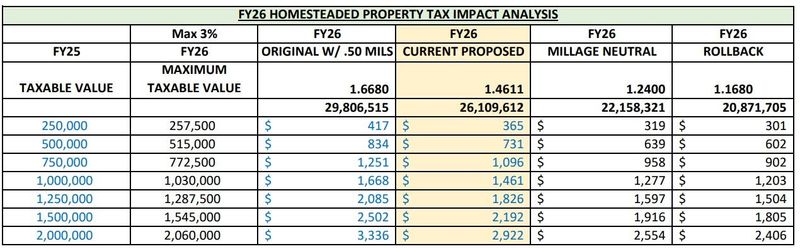
The new proposed general fund budget is a 4% increase to $33.03 million instead of the previously proposed $36.5 million. The proposed tax rate increase, or millage, also is lower at 1.4611 mills instead of the previous proposed max of 1.6680. Another option is keeping the rate the same as in FY25, at 1.2400. Council members also could choose to approve a rollback rate of 1.1680.
One mill equates to $1 for every $1,000 worth of a property’s assessed, or taxable, value (after adjustments, such as the homestead exemption for primary residents). According to Zillow, the average home price on Marco Island is $861,713, down 6.4% from this time last year. The city’s total taxable value of real and personal property is $18.5 billion, up from this year’s $17.1 billion.
Under the new proposed property tax rate, a homeowner with a $1 million home would pay $1,461 in 2026.
“I will not spport any tax raise as of right now,” Goehler said. “I will only support 1.24 and even that makes me sick to my stomach.”
But Goehler said she is not in support of rollback.
“Rollbacks hurt us,” she said. “I will not propose rollbacks ever again. I think it’s ridiculous.”
The city council will hold a special meeting Monday, Aug. 25 at 2 p.m. to continue the tax rate and budget discussion. A first reading of the budget and property tax rate will be held Sept. 2 with second and final approval set for Sept. 15.
Meeetings are held in the Dr. Fay and Bedford Biles Community Room, 51 Bald Eagle Drive, Marco Island.
This article originally appeared on Naples Daily News: City Council rejects proposed LCEC fee, talks Marco FY26 budget after accounting error
Reporting by J. Kyle Foster, Naples Daily News / Naples Daily News
USA TODAY Network via Reuters Connect