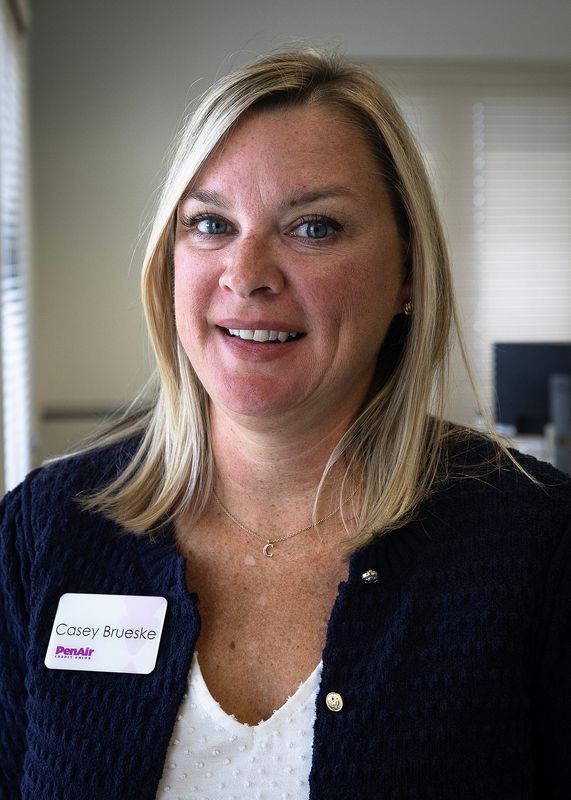
Casey Brueske is on a mission. And, no, it’s not to watch Bernie Brewer slide down the twisty slide after a Milwaukee home run.

And although that would be fun, the PenAir Credit Union community education development specialist instead travels throughout the Panhandle teaching high school and college students how to save money to build strong financial habits for life.
Banking 101: Money in and money out.
“You need a plan to save and a plan to spend,” Brueske said, referring to both high school and college students. “So, I always suggest that by college age they have opened (checking and saving) accounts. Maybe some of them have already had jobs. But paying yourself first is one thing that we tell everyone.”
“Paying yourself first” is code for learning how to save, not spend, money. Brueske said saving 5% of every paycheck is a good start for learning how to build a rainy day fund.
Doing the math, that would be $5 saved for every $100 earned. Doesn’t seem like a lot, but over time, healthy financial habits add up.
“And then if students automate (the 5% savings) they’re not paying attention to it and don’t see that money (moving from their checking account to their savings account),” Brueske said referring to direct deposits from employers.
Brueske added that certificates and high-yield checking accounts are other options for saving money, but require more financial discipline.
So, what is a rainy day fund?
A rainy day fund is money set aside for an emergency: unemployment; medical emergency; car repair; hurricane damage. Brueske suggests setting aside the equivalent of 3-6 months of income for a rainy day fund.
Math class.
Let’s say Jen Romano’s take-home pay is $4,000 per month, and she saves 5% of it each month. How long would it take Romano to save for a three-month emergency fund?
($4,000 per month)(3 months) = $12,000 emergency fund needed.($4,000 per month)(.05% savings) = $200 per month.$12,000/$200 = 60 months, or 5 years.
Healthy habits don’t happen overnight. Saving money takes time.
“Your financial journey is like your health journey,” Brueske said soberly. “I’m not going to lose 10 pounds tonight just because I didn’t eat today. You’re also not going to have three months of emergency funds saved tomorrow just because you drank coffee at home and didn’t go to Starbucks, you know what I mean? (Financial stability) doesn’t happen overnight. It takes discipline. It takes that routine.”
For more information about how to use a credit card responsibly, contact one of PenAir’s financial counselors at penair.org. For classroom facilitation opportunities or requests, Brueske can be contacted at (850) 505-3200, extension 8472 or 7770. Her email is casey.brueske@penair.org
This article originally appeared on The News Herald: High school, college students learn banking basics from PenAir education specialist
Reporting by Tyler Orsburn, Panama City News Herald / The News Herald
USA TODAY Network via Reuters Connect