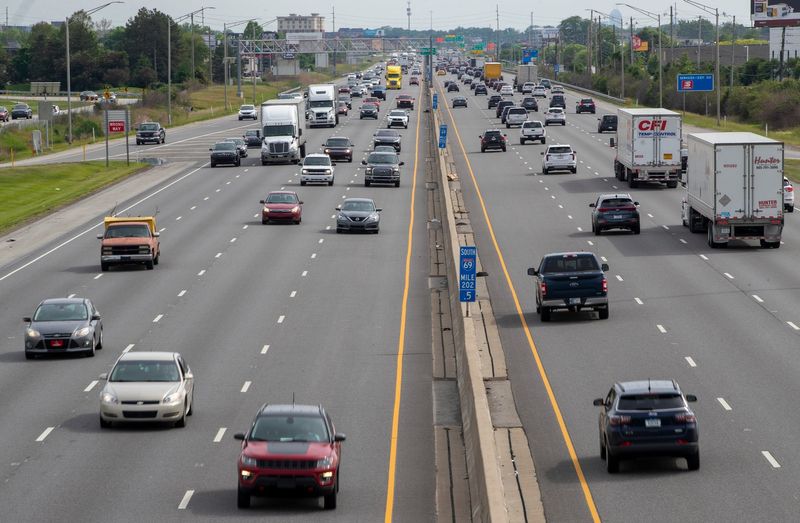
Indiana highways and roadways stretch across miles of mostly flat land, with over 240 state roads and 13 interstate highways. Not all of these roadways are navigated under the same traffic laws.
Generally speaking, Indiana Code applies statewide, but different cities have their own codes on the books. In South Bend, you’re not allowed to put your head through the sunroof of a car while a vehicle is being driven.

In Indianapolis, horses are considered vehicles on the road and are limited to a speed of 10 mph.
Indiana has more than 97,000 miles of roadways, according to the Indiana Department of Transportation.
Whether you are a native Hoosier or just traveling through the crossroads of America, here’s a look at some of the state’s traffic laws if you want to avoid a ticket.
Indianapolis horses must follow driving rules
In Indianapolis, horses are considered vehicles and are subject to speed limits and the requirement of warning flags on public roads. The code states that no horse shall be driven or ridden on any street in the city at a speed more than 10 MPH, and every horse shall be kept under control at all times by the person in charge of it.
Horse riders must follow all the same traffic laws that apply to regular motor vehicles.
‘Move over!’ When other vehicles are on the side of a road
If you approach a disabled vehicle on the side of a road or highway with its flashers on, you must move over to another lane.
This applies to drivers on all Indiana roads, including two-lane roads where there might not be room to move over. If that’s the case, or if you can’t safely switch lanes on a four-lane road, the law says you need to slow down by 10 mph below the speed limit to stay in compliance.
The “Move Over” law was originally put in place to protect emergency vehicles that had pulled over on the side of the road. Drivers aren’t allowed to stop, stand, or park on the shoulder of an interstate, unless it’s an actual emergency.
Drivers who fail to switch lanes when approaching a disabled vehicle on the side of the road that has its flashers on could receive a class B infraction.
You have to provide police with identifying information
Drivers must provide identifying information like name, address, and date of birth, or their ID to law enforcement during a traffic stop if there is a valid reason for the stop by an officer.
Refusing to provide your identity during a lawful stop can lead to a Class C misdemeanor, which carries up to 60 days in jail and a $500 fine.
You can’t drive with your phone in your hand
Indiana’s hands-free law prohibits drivers from using any electronic device like a cellphone in their hands while operating a vehicle unless they’re using it with a hands-free or voice-activated feature.
Serious traffic crashes and deaths have risen sharply across the U.S., largely due to distracted driving. In 15 states with hands-free laws, traffic deaths dropped by an average of 16%, according to federal data.
You can face a fine of up to $500, plus points on your driving record, if you’re caught breaking this law. Indiana uses a point system for traffic violations, and accumulating 20 points within two years can lead to license suspension.
Is it illegal to cut through a parking lot in Indiana?
Technically, there isn’t a statewide law that specifically outlaws cutting through parking lots, but you could still run into trouble in a few ways.
1. Local OrdinancesMany towns or cities in Indiana include local traffic rules that apply to parking lots.
In Greenville, Indiana, it is illegal to drive across parking lots, sidewalks, or curbs to bypass traffic backups at road intersections within the town limits unless you’re driving a lawn tractor or being directed by police during emergencies. Violators can be fined $50 by the Greenville Marshal Department.
2. Trespassing or Private Property RulesParking lots are usually private property, so cutting through them, especially just to skip a red light or traffic, can get you in trouble. If the property owner decides to enforce their rules, you could end up facing trespassing charges or even a civil lawsuit.
3. Moving Violation / Reckless DrivingIf taking a shortcut puts other drivers or pedestrians in danger, you could be hit with a “reckless driving” ticket or another moving violation.
4. Enforceable on Private PropertySome traffic laws, like DUI, reckless driving, or ignoring signs, can be enforced on private property if the lot is open to the public and properly signed per municipal agreement.
Liability insurance is required under state law
Indiana law requires all drivers to carry liability insurance. The state mandates minimum liability coverage of $25,000 for bodily injury or death of one person, $50,000 for bodily injury or death of two or more people, and $25,000 for property damage in a single accident.
In 2021, legislation revised insurance laws that removed a first-time 90-day license suspension if you’re caught without insurance. Now, a violation could result in an indefinite suspension of driving privileges, according to Indiana code.
Motorcyclists don’t have to wear a helmet
Anybody under the age of 18 is required to wear a helmet and eye protection, but the state doesn’t have any law that requires the life-saving accessories for adults.
DUI laws: Harsh penalties for driving under the influence
Operating While Intoxicated (OWI), also known as a DUI, is a serious offense defined by the state’s legal limits for blood alcohol concentration (BAC). A BAC of 0.08% or higher for drivers 21 and over, 0.02% for those under 21, and 0.04% for commercial drivers can lead to an OWI charge.
Penalties include fines, jail time, license suspension, and mandatory substance abuse programs.
Slow drivers must stay out of left lanes
Drivers are required to stay out of the left lane except when passing or preparing to turn.
Indiana Code states that drivers should move to the right lane when another vehicle is overtaking them from behind.
Passing on the right
You can pass another vehicle on the right, but only in certain situations:
But there’s an important catch: Even if those conditions are met, you can only pass on the right if it’s safe. And you’re not allowed to drive off the main part of the road, like onto the shoulder or grass, to make the pass.
Jade Jackson is a Public Safety Reporter for the Indianapolis Star. You can email her at Jade.Jackson@IndyStar.com and follow her on X, formerly Twitter @IAMJADEJACKSON.
This article originally appeared on Indianapolis Star: It’s illegal to stick your head out of a sunroof. Here are 10 traffic laws for Indiana
Reporting by Jade Jackson, Indianapolis Star / Indianapolis Star
USA TODAY Network via Reuters Connect