“Wet.”
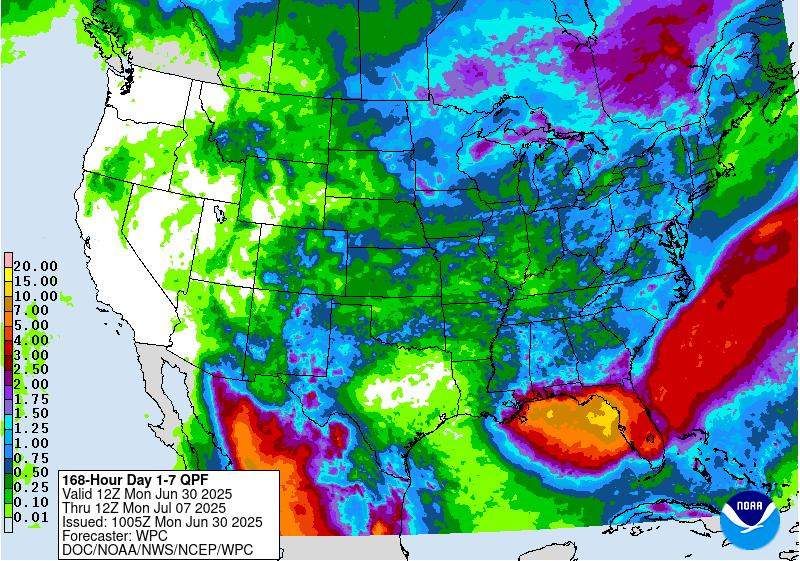
That’s the one-word description the National Weather Service Melbourne used to describe what east-central Florida can expect through the Fourth of July.

And that’s even if a system dropping into the southeastern United States and Florida doesn’t spin into a tropical depression or tropical storm, which as of July 1, it currently has a low chance — 30% — of doing.
➤ Track all active storms
➤ Weather alerts via text: Sign up to get updates about current storms and weather events by location
“Some gradual tropical or subtropical development could occur thereafter as the low drifts and moves little,” the National Hurricane Center said at 2 p.m. July 1.
“Regardless of development, heavy rainfall is possible across portions of the southeast U.S., particularly across the west-central Florida coast.”
What happens over the holiday weekend all depends on where, how or if that system develops, although there is “pretty good agreement for the unsettled pattern and flooding potential to continue through the weekend.”
If the right conditions are there, they could “potentially ignite tropical development,” said Alex DaSilva, AccuWeather lead hurricane expert in an email Monday, June 30.
“This is fairly common this time of the year, June and July, that you get old frontal boundaries kind of coming off the southeast coast and into the Gulf and stalling. And then you get a little area of spin to develop along that decaying cold front, and then that’s how you get these usually fairly short-lived tropical systems early in the season.
“They tend to be a little on the weaker side, but they can bring a lot of rain, especially if they do develop. I think that’s what we might end up seeing here.”
National Hurricane Center tracking area of disturbance
“A frontal boundary is expected to stall and weaken off the southeast U.S. coast late this week. An area of low pressure could develop from the weakening front by the weekend over the Atlantic waters off the southeast U.S., over Florida, or over the eastern Gulf,” the National Hurricane Center said.
“Some gradual tropical or subtropical development could occur thereafter as the low drifts and moves little.”
➤ National Hurricane Center tracking system that could stall over Florida
“A cold front will dive off the coast late this week, and it may act as a catalyst for development either in the eastern Gulf or off the Southeast coast,” DaSilva said.
Will tropical storm impact Florida over Fourth of July weekend? Here’s what could happen
“The Fourth of July looks pretty wet overall for the state of Florida, especially the peninsula,” DaSilva said.
“This system poses no direct threat to Florida over the next five to seven days,” the Florida Department of Emergency Management said.
“However, this system could bring increased shower and thunderstorm activity and an increased rip current risk along the Gulf or Atlantic Coast later this week and will continue to be monitored closely.
“Regardless of tropical development, local flooding rain risk remains into the weekend. Daily afternoon and evening thunderstorms are expected. … with a potential for flash flooding, the National Weather Service Jacksonville posted on X.
“Models disagree on this exact point about where tropical development could occur,” according to the Florida Public Radio Emergency Network.
“These two models represent two very different scenarios; they could produce opposite results regarding the weather for the holiday weekend in Florida,” Florida Public Radio Emergency Network said.
“If the American model verifies and a storm develops over the Gulf, there could be increased rainfall activity for the Florida peninsula during the holiday weekend. If the European model is confirmed, conditions are likely to remain drier than normal for the July 4th weekend.”
“If tropical system does eventually develop east of Florida or south of the Carolinas, steering currents are light, so it could well linger near the Gulf Stream into next week,” said Dr. Ryan Truchelut, chief meteorologist with WeatherTiger. “Dry air and some northerly wind shear would most likely keep anything that develops weak.”
Truchelut is a Florida meteorologist who works with the USA TODAY Network.
“For Florida’s sake, it would be better for it to happen east of Florida because then it would likely just get pushed out to sea.
“If it happens in the Gulf, it’s likely to be pushed eastward into Florida, although there are some indications that, depending on the strength of the Bermuda High, it could actually push the storm a little farther west, maybe towards Louisiana. I think that’s a fairly low chance right now,” DaSilva said.
“I think the most likely would it be just pushed east into Florida. But that’s something that we would have to watch for as well.”
Will it rain in Florida over Fourth of July holiday weekend?
The system moving east over the U.S. could “ignite” a tropical system, the Florida Public Radio Emergency Network said.
Even if there is no tropical development, expect plenty of rain this week and into the holiday weekend across Florida, DaSilva said.
“We must continue to monitor the progress of the frontal system, which will inject and deliver sufficient energy near Florida. At this point, it is impossible to know precisely where, and if, a storm could form,” Florida Public Radio Emergency Network said.
“Expected rainfall totals over the five days across most of Florida and the eastern Gulf Coast are in the 2-4” range, with locally higher accumulations and slight chances of localized flash flooding. North Florida rain chances will decline in a few days, but the Florida peninsula will see elevated rain coverage through the weekend,” Truchelut said.
Here’s the forecast around Florida for the holiday weekend:
Heading to one of the central Florida theme parks? Here’s your forecast for Orlando:
Will Tropical Storm Chantal form ahead of historical average?
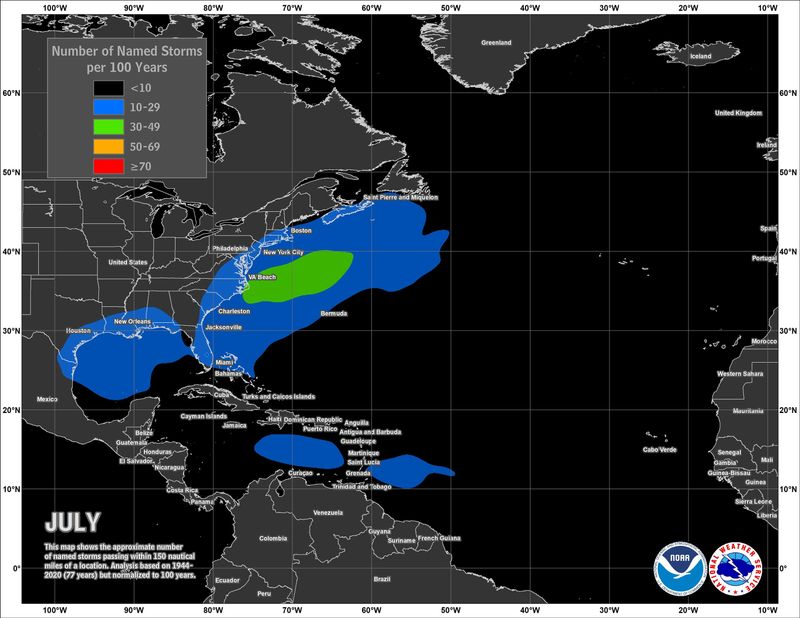
The average date for the third named storm in the Atlantic basin is Aug. 3, DaSilva said.
Andrea, the first named storm of the season formed a little later than average, on June 24, four days past the average date of June 20 for the first named storm of the season.
Barry formed June 29, well ahead of the historical average of July 17.
Water temperatures in the Gulf would support tropical development, but wind shear and some dry air from Saharan dust would work against tropical development, DaSilva said.
“We don’t anticipate this blowing up into a hurricane. If it develops, it’s likely to be a tropical depression or a tropical storm, which could enhance the rainfall across Florida.”
Storms developing close to US tend to be rainmakers with little time to react
“Most of the time, ‘homegrown’ storms tend to be on the weaker side in terms of wind speed, but a lot of times they tend to be big rainmakers,” DaSilva said.
“They also give people less time to react because they form closer to the coast. You don’t have the luxury of watching it come across the entirety of the Atlantic. We’re urging people to follow the forecast updates closely over the next couple of days.
“It’s possible that nothing develops at all and it just happens to be a wetter weekend. But there is also the possibility that we might end up with a tropical depression or a tropical storm, and it can really enhance the rainfall, and we could have some flooding issues.
“There isn’t enough time. If anything develops, it would only be over the water for a day or two before pushing inland if it develops in the eastern Gulf.”
Weather alerts issued in Florida
NWS radar: Track storms moving across Florida
See latest around Florida: Follow National Weather Service offices on X
Stay informed. Get weather alerts via text
What’s next?
We will continue to update our weather coverage as conditions warrant. Download your local site’s app to ensure you’re always connected to the news. And look for our special subscription offers here.
This story was updated to add new information.
This article originally appeared on Naples Daily News: In a word, wet. What’s ahead for much of Florida through Fourth of July holiday
Reporting by Cheryl McCloud, USA TODAY NETWORK – Florida / Naples Daily News
USA TODAY Network via Reuters Connect