

By Jim Bloch

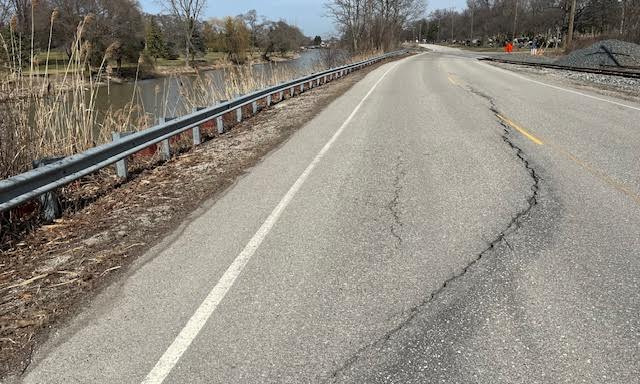
Six months ago, a section of St. Clair Highway began to collapse immediately southwest of Hillside Cemetery along the Pine River in the city of St. Clair. The guardrail has sunk as well. The city installed signs warning motorists of uneven pavement and asked AEW, Inc., which consults on city road projects, to investigate the problem.
According to Ryan Kern, a project manager with AEW, a fix is likely to cost upwards of a half-million dollars.

Kern, who addressed the St. Clair City Council at its regular meeting June 16, searched for past engineering studies of the highway. The history of the sinking section of road is filled with expense and failure.
St. Clair Highway was rebuilt in 2010. By 2011, a portion of road near the cemetery had dropped about 30 inches and the city spent about $260,000 to build a new retaining wall near the river to hold up the roadway. The new seawall was 35 feet in length and was driven 15 feet into the earth. But the wall did not stop the movement of the bank or the road above it.
Early in November of that year, the city of St. Clair spent $5,455 to mill the asphalt on the 200-foot sunken section and replaced it with crushed limestone. The city kept the highway open for winter and monitored it. It kept sinking and the seawall kept moving. The city closed the road completely in the spring of 2013 and it remained closed for six years. It reopened in July 2018 with the sinking section graveled, which later was repaved.
McDowell & Associates in 2011 had done some geotechnical reporting before the seawall was installed and made recommendations to stabilize the slope.
The issue, Kern said, is that the weight and downward pressure of the soil is causing the seawall to move outward, destabilizing the bank and threatening the highway.
In 2016, AEW conducted its own geotechnical reporting and assessed four alternatives to halt the sinking road.
The first was to reroute St. Clair Highway away from the seawall to the far side of the railroad tracks. AEW said that alternative to be somewhat sketchy because it would involve seeking permits from the railroad, a notoriously difficult entity with which to negotiate.
Second, some kind of fill could be placed on the frontside of the seawall. But that would involve filling a portion of the Pine River and would likely mean a lengthy permitting process involving the Michigan Department of Environment, Great Lakes and Energy and possibly the US Army Corps of Engineers, without a guaranteed outcome.
Third, roadway could be lowered three feet, “which would be basically impossible because of the railroad crossing,” Kern said, as heard on the CTV-Channel 6 recording of the meeting posted on YouTube.
Another way to alleviate the problem would be to remove the soils below the road down to the water table – six to seven feet down – and replace it with a light-weight fill – an industrial Styrofoam-like material.
“That was our recommended option back in 2016,” Kern said.
AEW estimated the cost of the project at $500,000, which would likely be dramatically more expensive now.
“That seemed to be the most cost effective (approach) then and we still think that would be the most cost-effective way to correct the issue that’s going on,” Kern said.
Kern said he would update the cost estimates.
“That’s where we are right now with the seawall,” Kern said.
Jim Bloch is a freelance writer based in St. Clair, Michigan. Contact him at bloch.jim@gmail.com.
