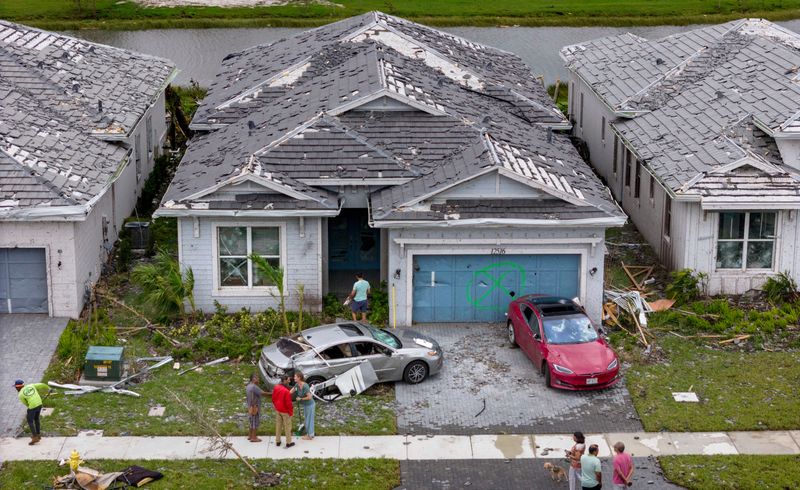
“With FEMA gutted, and NOAA gutted, the insurance industry in Florida in shambles, and the fact that most of the roofing and construction companies (used to) mostly employ immigrants, just what exactly are we supposed to do?”
Politics and insurance were at the top of the list of what you wanted to know about the upcoming hurricane season during a June 12 “Ask Me Anything.”

Reporter Anne Geggis and editor Antonio Fins from the Palm Beach Post joined meteorologist Ryan Truchelut (aka WeatherTiger) to answer some of your questions about 2025 hurricane season in Florida.
Here are highlights from the discussion:
Home insurance policies, hidden ‘gotchas’
Q: What hidden ‘gotchas’ do you suggest people review their insurance policies for?
Geggis: When it comes to fixing disaster damage, the number one thing I’d say is check and see whether you can hire your own contractor to fix damage, or if you’ve got to use the insurance company’s dedicated one.
The other biggie is water damage. Of course, most HO policies don’t cover flooding that occurs during a hurricane … only if the water comes in through a breach (like a tree falling and causing a hole in the roof) is water damage in a storm covered. Also, some policies limit the payout for water damage to $10K … which usually doesn’t cover a lot of the damage that water can cause to a house.
Also, you can be faced with a big hole in your budget if you insure for “actual value” and not “replacement value.” If you need a new roof after damage, for example, “actual value’ means a payment that would not pay for a whole new roof. What the insurer would pay would be lowered by how old your existing roof was.
Q: Why is insurance mandatory? If I want to buy a house in Fort Myers, it should be my option of having or not insurance. If I need a mortgage, why isn’t the bank issuing the mortgage to be the one responsible to get insurance?
Geggis: Insurance is not mandatory if you own your home outright. We’ve written about people who are, arguably, taking extravagant risks. As far as I know, for example, some of the mansions on the most exclusive islands literally can’t get it … Citizens Property Insurance Corp., for instance, is the only insurer in the riskiest places (the Keys, town of Palm Beach) and they will only insure up to $700,000 of value, $1 million in Monroe and Miami-Dade counties… Requiring banks to insure their lending is an interesting idea I hadn’t thought of … Pretty sure lawmakers would have to get involved!
The politics of hurricanes, NOAA/National Weather Service cuts
Q: How much impact will the cuts made to any weather monitoring programs have on the ability for forecasters to do their jobs?
Truchelut: I fielded a similar question down thread, but this is where I am right now: As a meteorologist, the tools I use to predict storms and warn folks to protect life and property are either degraded (somewhat) or threatened, but still functional.
We’ve lost some key observations out of our upper-air weather balloon sounding network and ocean observations, and losing those could well diminish forecast model skill for hurricane threats later in the year. We don’t really know until the system is tested. The NWS frontline meteorologists are badly overstretched and their offices are understaffed, which is going to hamper local efforts to communicate and manage storm risk.
But overall, right now, stuff like radar, satellites, models, and NWS offices are still working. I am concerned that a crisis will break something, as maintenance and support staffing for these complex systems has been cut. Additionally, it’s totally unpredictable as to what the next slash to the system might be, and there have been many, many cuts to research and future programs, which will manifest as forecasts not improving in the future, at least at the rate they could have.
Q: Considering the gutting of funds from our gov’t as of late, will that deter your ability to inform Floridians (and of course the folks in our neighboring states) on the trajectory of potentially dangerous hurricanes?
Fins: Thanks for the question. Obviously we rely on the quality of the information we get from the different meteorological experts and agencies. But from everything we have heard, we should be able to adequately inform people of dangers. With what precision remains to be seen. At the end of the day, we all need to be prepared and have a plan regardless. But I think our team is confident that we will be able to alert to danger.
Truchelut: I’ll chime in on this one too. Right now, as a meteorologist, I’m at a place where I can say that the tools I use to predict storms and warn folks to protect life and property are either degraded (somewhat) or threatened, but still functional. We’ve lost some key observations out of our upper-air weather balloon sounding network that could well diminish forecast model skill for hurricane threats later in the year, and the NWS frontline meteorologists at the local offices that are where the rubber hits the road are badly overstretched and understaffed. But right now, stuff like radar, satellites, models, and NWS offices are still working. I am very concerned that a crisis will break something, given that needed staffing for maintenance and support of these complex systems has been cut, however.
Q: With FEMA gutted, and NOAA gutted, the insurance industry in Florida in shambles, and the fact that most of the roofing and construction companies (used to) mostly employ immigrants, just what exactly are we supposed to do? … Can we trust the NWS? What about the NHC? Can they afford to send in hurricane hunter planes?
Truchelut: You can absolutely still trust the NHC and the NWS. There are a few open positions at the NHC, but not more than normal (for now). I fully expect NHC forecasts to continue to be up to their high standards of excellence, which broke records for lowest average forecast error in the 2024 season:
The NWS? Well, the individuals in the system are going to continue to do their very, very best. But many local offices are short-staffed by 40% or more, and we’re asking good people to do too much. Again, I do worry about mistakes or critical weather information infrastructure breaking under stress this year, simply because we’re not properly maintaining these complex but necessary and valuable systems. I know it is cliche, but I do strongly advocate contacting your elected reps and telling them to fully fund and staff the NWS and NOAA– we’re slowly clawing back some staff losses due to public support and pressure. (I.E., rehiring some of the fired Hurricane Hunters.) And we need to keep up the pressure to stop further losses, as the political attacks on our public safety utilities like the NWS and FEMA continue.
Hurricane trends: Are storms getting stronger? What about tornadoes?
Q: Have you noticed any trends on where hurricanes tend to strike the state and their relative strengths? Is it mostly just random chance?
Fins: The warm waters off the Gulf Coast have definitely made the hurricanes hitting the west side of the state more frequent and notable. Southeast Florida has not had a direct strike since Hurricane Andrew came ashore 31 years ago. The other interesting weather trend numerous people have commented on is that, more and more, these hurricanes are becoming flooding events … particularly for the interior of the state. so i would recommend flood insurance even before buying a power generator. I heard permanent, built-in ones are nice … and avoid that carbon monoxide poisoning problem that we see a lot with the kind that move around.
Truchelut: Good question. In general, we don’t have quite enough data to really answer this question in a satisfying way, as a relatively complete record of Florida landfalls only goes back to 1900 or so. (We have data for 1851-1900, but might have missed some storms due to few people living in South Florida.)
Overall, Florida has gone through some incredibly rough periods for hurricane landfalls, like the mid/late 40s, late 50s/early 60s, mid 2000s, and late 2010s/early 2020s, but mixed in with much quieter timeframes as well, like the 1910s, 1980s, and 2006-2015. In the long-term, there’s not really a trend in the overall number of Florida hurricane landfalls, though Gulf Coast landfalls seem to be rising in frequency in the last 30 years as East Coast landfalls have been scarcer.
One thing that is a real change is an increased proportion of hurricanes intensifying into landfall. Think Charley, Michael, Ian, etc. That is very likely due to unnaturally warm waters in the Gulf caused by climate change, with may be adding a category or two to the landfall intensity of those hurricanes.
Q: Will we or will we not know if there is a tornado coming? How much time would we have to prepare if there were one? Would our phones alert us? Is there an app we can download? … I’m not really scared of hurricanes, but I am terrified of tornadoes & it has me on edge the entire season. I never know when to be serious during a storm or hurricane & when to relax so I just panic through all of them. Please help.
Truchelut: Tornado Warnings are issued by the network of 122 local Weather Forecast Offices of the National Weather Service. You can find your local office here: https://www.weather.gov/srh/nwsoffices.
NWS Tornado Warnings are immediately disseminated on issuance to the media, emergency management and law enforcement, and directly to the general public. You can configure your phone to give you a geographically specific alert if you are in a Tornado Warning region.
Typically, NWS Tornado Warnings give you 15-30 minutes of lead time between the alert and the potential arrival of a tornado, which gives you plenty of time to get to an interior room or safe space. Florida’s tornadoes tend to be weaker and shorter-lived than classic Plains tornadoes, and hurricanes often produce tornadoes in bands north or east of the center (as in Milton).
I wrote more about the link between tornadoes and hurricanes last year: https://weathertiger.substack.com/p/got-cows-hurricane-watch-weekly-column.
Preparing for hurricane season: Do I need shutters?
Q: Do hurricane windows in condos protect completely? I am me here. Never experienced a hurricane. Do I need shutters too? On top third floor of condo in Melbourne.
Fins: If you have what is “impact resistant windows” you shouldn’t need hurricane shutters in addition. They have been tested and are less likely to shatter. I hate to scare you, but third floors are more vulnerable to hurricane impact than ground floors, if you are asking. And, if you live on a barrier island, you may face a mandatory evacuation order. As detailed here … hurricanes can obliterate some of the most well-built structures if it’s hitting with the full fury: https://www.nhc.noaa.gov/aboutsshws.php.
See a gator? Here’s what to do
Q: Weird question here … but after Milton came over our house in mainland Brevard, we had localized flooding in the neighborhood and an alligator came into our drainage ditch (no sewer or storm drain) and under our driveway culvert. Is there a number to call to help deal with that? Luckily it was a baby gator but I’m wondering if there’s an animal control number?
Fins: If the gator is under 4 feet long, no need to worry … not dangerous to people or pets! That’s according to the FWC. Only if these smaller gators are in your swimming pool or on your porch will someone respond. In that case, or for bigger gators in close proximity, you can call Nuisance Alligator Hotline at 866-FWC-GATOR (866-392-4286) … Not sure how responsive FWC would be in a state of emergency, though…
This article originally appeared on Palm Beach Post: 9 questions about Florida hurricane season, from preparation to politics, answered by our experts
Reporting by Randi Atwood, Palm Beach Post / Palm Beach Post
USA TODAY Network via Reuters Connect